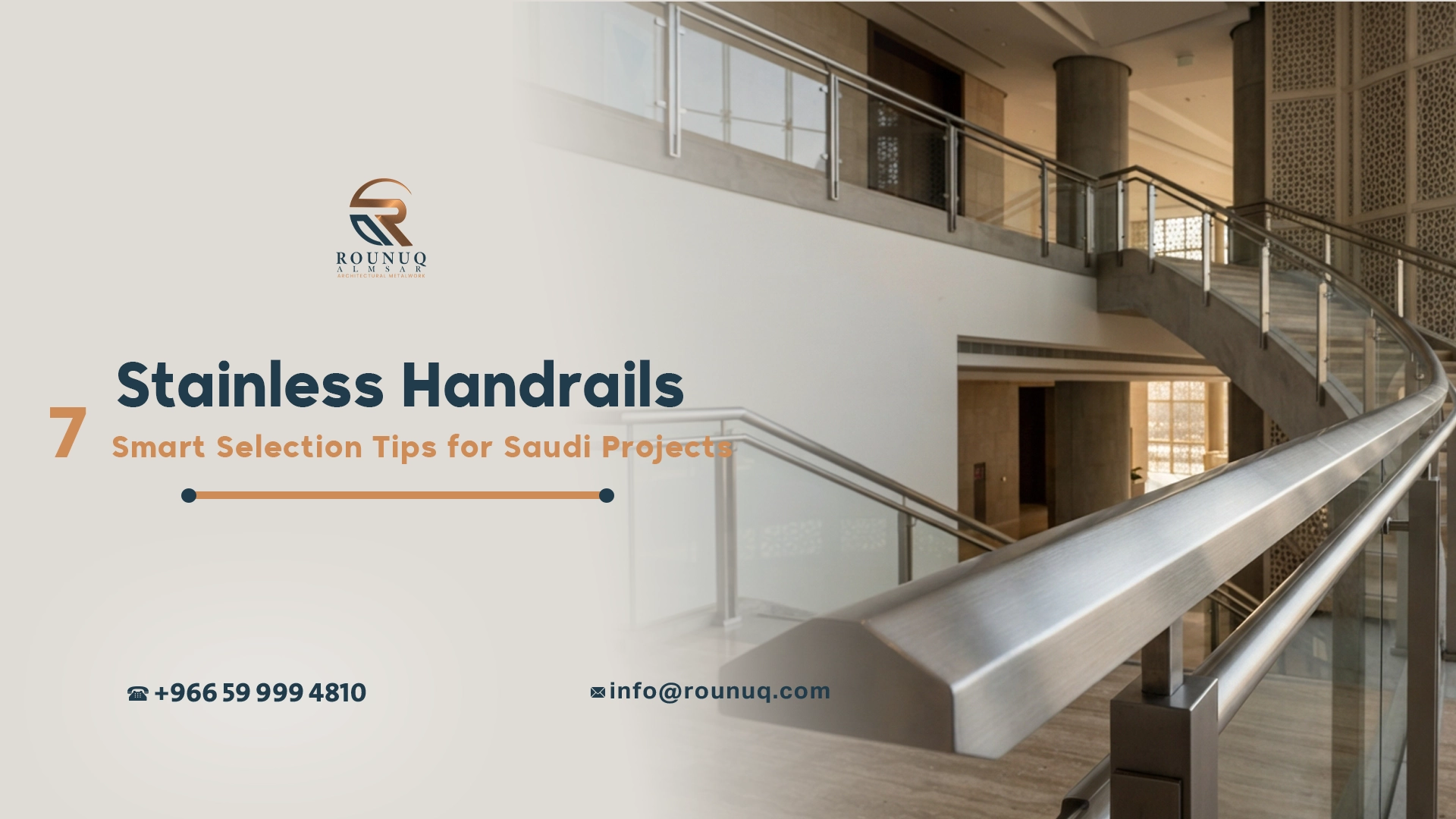
Stainless Handrails in Saudi Arabia: 9 Smart Tips for Choosing the Right System
Stainless handrails are widely used in modern buildings because they combine practical support with a clean architectural appearance. They can be found on staircases, ramps, balconies, walkways, entrances, and other circulation areas where people need a secure surface to hold.
However, choosing a stainless handrail is not simply a matter of selecting a tube and a finish.
The material grade, environmental exposure, profile, surface finish, fixing method, dimensions, fittings, substrate, and applicable building requirements can all affect the performance and appearance of the finished installation.
For projects in Saudi Arabia, these decisions become particularly important because an internal staircase in an air-conditioned building does not experience the same conditions as an exterior staircase, coastal development, swimming-pool area, or rooftop installation.
This guide explains the most important factors to consider before specifying or fabricating stainless handrails.
What Are Stainless Handrails?
Stainless handrails are hand-support systems manufactured from stainless steel and installed along stairs, ramps, walkways, balconies, platforms, and other areas where users require physical guidance or support.
They are different from a guard or balustrade, although the two systems can be designed together.
A handrail is primarily intended to be grasped by the user. A balustrade or guardrail generally provides edge protection and may include posts, glass panels, balusters, or other infill elements.
A stainless handrail may therefore be:
- Wall-mounted
- Supported by vertical posts
- Integrated with a glass balustrade
- Fixed to a staircase
- Installed along a ramp
- Combined with decorative metalwork
- Used as part of an exterior railing system
The most suitable configuration depends on the building layout, intended use, structural requirements, applicable regulations, and architectural design.
For example, a simple wall-mounted handrail in an office corridor has very different design requirements from a stainless steel and glass system running beside a large commercial staircase.
Why Are Stainless Handrails Used in Architectural Applications?
Stainless handrails are widely used in architectural applications because they combine corrosion resistance, durability, fabrication flexibility, and a clean, modern appearance.
Their corrosion resistance comes from the chromium-containing passive layer that forms naturally on the steel surface. However, stainless steel is not completely immune to corrosion.
Chlorides, contaminants, moisture, poor detailing, unsuitable grades, surface damage, and inappropriate maintenance can all affect the performance and appearance of stainless handrails.
This is why specifying a stainless handrail involves more than simply choosing “stainless steel” as the material.
The environment matters.
A useful way to think about the selection process is:
Environment → Grade → Profile → Finish → Fixing → Maintenance
Each decision should support the next one.
304 vs 316 Stainless Handrails: Which Is Better?
For architectural stainless handrails, 304 and 316 are two of the most commonly considered austenitic stainless steel grades.
Neither should automatically be described as the “best” grade for every project.
The appropriate choice depends primarily on the exposure conditions.
According to World Stainless guidance on stainless steel grades and corrosion resistance, grade 316 provides improved resistance to pitting and crevice corrosion compared with 304, particularly in chloride-containing environments.
| Factor | 304 Stainless Steel | 316 Stainless Steel |
|---|---|---|
| General interior applications | Excellent choice | Usually more than necessary |
| Typical architectural use | Very common | Very common in demanding environments |
| Chloride exposure | More limited | Better suited |
| Coastal environments | Requires careful assessment | Often preferred |
| Swimming-pool environments | Application dependent | Often preferred |
| Cost | Generally lower | Generally higher |
| Best selection method | Evaluate exposure | Evaluate exposure |
When Does 304 Make Sense?
304 stainless steel can be a practical option for many interior architectural applications where exposure to aggressive chemicals and chlorides is limited.
Examples include:
- Interior staircases
- Office buildings
- Residential interiors
- Retail spaces
- General commercial areas
- Indoor hospitality environments
However, “interior” does not automatically mean 304 is always appropriate. Cleaning chemicals, humidity, nearby pools, industrial contaminants, and other conditions can change the exposure profile.
When Should 316 Be Considered?
316 contains molybdenum, which improves its resistance to localized corrosion, particularly in chloride-containing environments.
It may therefore be considered for applications such as:
- Coastal buildings
- External architectural handrails
- Swimming-pool environments
- Areas exposed to salt
- Certain industrial environments
- Projects where chloride exposure is a significant concern
Importantly, 316 is not “corrosion-proof.” Even 316 can suffer surface staining or localized corrosion in aggressive environments, especially where deposits, crevices, poor detailing, or unsuitable surface finishes are present.
The correct approach is therefore to specify the grade based on the actual environment rather than choosing a grade solely because it is more expensive.
Stainless Handrail Profiles: Round, Square, or Custom?
The profile of stainless handrails affects both usability and architectural appearance. The right shape should provide a comfortable gripping surface while also fitting the visual language and technical requirements of the project.
Round Profiles
Round handrails are widely used because they provide a familiar and comfortable gripping surface. They can work particularly well with:
- Glass railing systems
- Stainless steel posts
- Wall-mounted brackets
- Staircases
- Minimalist interiors
- Contemporary commercial buildings
A smooth, properly finished round profile is particularly suitable for areas where the handrail will be frequently touched.
Square and Rectangular Profiles
Square and rectangular profiles can create a more geometric architectural appearance.
They may suit:
- Contemporary interiors
- Commercial fit-outs
- Modern staircases
- Minimalist architectural concepts
However, visual appearance should not override grip comfort, edge treatment, or applicable accessibility requirements.
Custom Profiles
Custom fabrication can be useful when stainless handrails need to follow unusual geometry, curved stairs, special transitions, or bespoke architectural detailing.
Before fabrication, the selected profile should be reviewed together with the supporting brackets, connections, wall clearances, substrate, and surrounding finishes.
Stainless Steel Handrail Finishes: Brushed, Hairline, Mirror, or PVD?
The finish is one of the most visible decisions when specifying stainless steel handrails because the surface is often positioned at eye level and is frequently touched.
The finish affects more than appearance. It can also influence how visible fingerprints, scratches, surface marks, and other contaminants are over time.
Brushed Stainless Steel
A brushed finish creates directional surface lines and a softer reflection than a highly polished surface.
It can be a practical choice for modern commercial and residential interiors because minor marks and fingerprints may be less visually prominent than on highly reflective surfaces.
Hairline Stainless Steel
Hairline finishes provide a finer and more controlled linear appearance.
They can work particularly well when the handrail needs to coordinate visually with other architectural stainless steel elements, such as cladding, trims, columns, or decorative metalwork.
Mirror Finish
Mirror-polished stainless steel produces a highly reflective appearance.
It can create a more luxurious architectural effect, but the reflective surface can also make fingerprints, marks, and surface imperfections more noticeable.
For frequently touched stainless handrails, maintenance expectations should therefore be considered before selecting a highly reflective finish.
PVD Stainless Steel
PVD, or Physical Vapor Deposition, can provide decorative architectural colors and effects that are different from conventional stainless steel finishes.
Depending on the specified system, architectural PVD stainless steel may be available in tones such as:
- Gold
- Bronze
- Black
- Rose gold
- Other decorative tones
Rounuq Al Msar’s published architectural cladding information identifies PVD-coated stainless steel as an option for architectural finishes and bespoke fit-out applications.
The finish should be selected together with the surrounding architectural palette rather than treated as an isolated color choice.
For example, a bronze-toned handrail may complement warm stone and timber, while brushed stainless steel may be better suited to a minimalist commercial interior.
Handrails vs Balustrades: What Is the Difference?
The terms are often used interchangeably in everyday conversation, but handrails and balustrades serve different functions.
A handrail is primarily designed to provide a gripping surface for support and guidance.
A balustrade or guardrail is generally intended to provide protection against falling from an elevated edge.
A staircase may therefore contain both:
- A guard or balustrade that protects the open edge
- A handrail that users can grasp
The two elements can be manufactured from the same material and designed as a visually integrated system, but their functional requirements are not identical.
This distinction becomes especially important when specifying stainless steel and glass systems.
For example, a glass balustrade may provide edge protection while a stainless steel handrail runs along its upper edge.
Understanding this distinction helps architects, contractors, and property owners specify the correct system rather than treating every stainless steel railing component as a handrail.
What Safety Factors Should Be Considered for Stainless Handrails?
Stainless handrails should be treated as functional building elements, not merely decorative metal tubes.
Key considerations include:
- Handrail height
- Grip profile
- Continuity
- Clearance from adjacent surfaces
- Smoothness
- Edge treatment
- Support spacing
- Connection design
- End conditions
- Relationship to stairs and ramps
- Applicable accessibility requirements
- Applicable structural requirements
For Saudi projects, the starting point should be the applicable Saudi Building Code, project specifications, and approved architectural and engineering drawings.
The official Saudi Building Code provides requirements relevant to building safety and accessibility, while applicable provisions address elements such as stairways, ramps, handrails, and guards.
International standards should not automatically be substituted for the requirements governing a Saudi project.
For comparison, the U.S. Department of Justice’s 2010 ADA Standards specify handrail gripping-surface heights of 34–38 inches (865–965 mm) for the applications covered by that standard, along with requirements concerning continuity, clearance, gripping surfaces, and cross-sections.
These figures demonstrate how specific handrail requirements can be, but they should not be presented as Saudi Building Code requirements.
The applicable Saudi code, authority requirements, project specifications, and approved drawings should control the final design.
How Should Stainless Handrail Installation Be Planned?
Many problems with stainless handrails originate before the fabrication stage.
A handrail can be manufactured accurately and still fail to fit correctly on site if surrounding architectural elements were not properly coordinated.
Before production, review:
- Finished floor levels
- Stair dimensions
- Wall thickness
- Stone or tile thickness
- Structural substrate
- Glass thickness where applicable
- Bracket locations
- Fixing points
- Expansion joints
- Adjacent finishes
- Lighting
- Installation access
- Final handrail height
- Approved shop drawings
For example, a wall-mounted stainless steel handrail installed before stone cladding is completed may end up with incorrect wall clearance if the final thickness of the cladding was not included in the coordination drawings.
This is why handrail installation should be considered part of the architectural coordination process rather than an isolated final-stage activity.
For complex projects, coordination between the architect, contractor, metal fabricator, glass contractor, and installation team can help identify conflicts before fabrication begins.
What Are Handrail Fittings and Why Do They Matter?
Handrail fittings are the components that connect the visible rail to the building or to other parts of the railing system.
Depending on the design, they may include:
- Wall brackets
- Elbows
- Connectors
- End caps
- Flanges
- Posts
- Base plates
- Glass clamps
- Mechanical anchors
- Fasteners
These components affect both appearance and performance.
A premium stainless steel tube combined with poorly selected brackets can still produce a weak, poorly aligned, or visually inconsistent installation.
The fittings should therefore be specified as part of the complete handrail system rather than treated as secondary accessories.
The substrate also matters. A bracket fixed into a suitable structural element is not equivalent to a bracket fixed only into a weak or unsuitable finishing layer.
For this reason, fixing details should be reviewed during the design and shop-drawing stage, particularly when the handrail is being installed over stone, tile, gypsum board, cladding, glass, or other architectural finishes.
Where Are Stainless Handrails Commonly Used?
Stainless steel handrails can be used across many architectural environments.
Residential Projects
They are common in villas, apartment buildings, private residences, and premium interiors.
The design can be coordinated with:
- Marble stairs
- Timber
- Glass
- Decorative wall finishes
- Lighting
- Stainless steel cladding
Commercial Buildings
Offices, retail developments, and commercial buildings often require handrails that can tolerate frequent use while maintaining a consistent appearance.
A brushed finish may be appropriate where practical maintenance is important.
Hospitality
Hotels, restaurants, and hospitality environments often place greater emphasis on finish quality and architectural coordination.
Here, stainless steel can be combined with glass, stone, wood, lighting, and decorative metalwork.
Exterior Areas
External staircases, ramps, terraces, entrances, and balconies require more careful consideration of environmental exposure.
The material grade, drainage, surface finish, detailing, cleaning, and exposure to chlorides should all be reviewed.
Staircases and Architectural Features
When a staircase is a major design feature, the handrail should be designed as part of the overall composition.
Rounuq’s current portfolio includes custom spiral staircase solutions using materials such as stainless steel, mild steel, and glass.
This type of coordination is especially useful when the staircase, balustrade, handrail, and surrounding metalwork need to look like one integrated architectural system.
Stainless Handrails vs Other Handrail Materials
Stainless steel is not automatically the best material for every project.
The correct choice depends on the project’s environment, design language, maintenance requirements, and budget.
| Material | Main Advantages | Potential Limitations | Suitable Applications |
|---|---|---|---|
| Stainless steel | Corrosion resistance, durability, modern appearance | Higher cost than basic steel | Interior and exterior architectural projects |
| Mild steel | Strong, versatile, economical | Requires protective finishing against corrosion | Industrial and architectural applications |
| Aluminum | Lightweight and corrosion resistant | Lower stiffness than steel | Lightweight architectural systems |
| Timber | Warm natural appearance | Requires more care and is sensitive to environment | Residential and hospitality interiors |
| Glass + stainless steel | Transparency and contemporary appearance | More complex coordination | Balconies, stairs, premium interiors |
The comparison shows why material selection should begin with the project requirements rather than the material name alone.
What Maintenance Do Stainless Handrails Need?
Stainless steel is relatively easy to maintain, but “low maintenance” does not mean “no maintenance.”
Regular cleaning helps remove:
- Dust
- Fingerprints
- Salt deposits
- Construction residue
- Pollutants
- Other contaminants
Exterior handrails may require more frequent cleaning than protected interior installations, particularly in areas exposed to airborne salts or other contaminants.
Cleaning methods should also be compatible with the specified stainless steel grade and finish.
Avoid treating every stainless finish as if it were identical. A mirror finish, brushed surface, and decorative PVD finish can have different appearance and maintenance considerations.
Good detailing also matters.
Water and contaminants should not be allowed to accumulate unnecessarily around joints, crevices, brackets, or other difficult-to-clean areas.
What Affects the Cost of Stainless Handrails?
There is no meaningful single price for stainless handrails without knowing the project specification.
The final cost can be influenced by:
- Stainless steel grade
- Tube or profile dimensions
- Total linear length
- Number of posts
- Bracket type
- Glass integration
- Curved geometry
- Custom fabrication
- Surface finish
- PVD treatment
- Site conditions
- Fixing method
- Installation complexity
- Shop drawings and coordination
- Access requirements
For example, a straight wall-mounted 304 stainless steel handrail with a standard finish is a very different fabrication requirement from a curved 316 system with custom fittings, glass interfaces, and a decorative PVD finish.
The most useful way to compare quotations is therefore to compare the same technical specification, not simply the total price.
9 Things to Check Before Ordering Stainless Handrails
Before approving fabrication, use this checklist:
1. Confirm the stainless steel grade
Make sure the specified grade is suitable for the environment.
2. Confirm the profile
Review the diameter or cross-section and make sure it suits both the architectural design and intended grip.
3. Approve the finish
Do not rely only on a digital color representation. Where appearance is important, review a physical sample.
4. Check dimensions
Confirm heights, offsets, clearances, transitions, and overall lengths.
5. Review fittings
Make sure brackets, connectors, end caps, posts, and anchors are included in the specification.
6. Coordinate with the substrate
Confirm exactly where the handrail will be fixed and whether the substrate can accommodate the connection.
7. Coordinate with adjacent finishes
Stone, tile, glass, wood, cladding, and lighting can all affect the final position.
8. Review the applicable code
The design team should verify the relevant Saudi Building Code provisions and project-specific requirements before fabrication.
9. Approve shop drawings before production
Fabrication should follow approved dimensions and details rather than assumptions made from architectural intent alone.
When Should You Consider Custom Stainless Handrails?
Custom fabrication becomes particularly useful when the project includes non-standard geometry or requires the handrail to coordinate with other architectural elements.
Examples include:
- Curved staircases
- Spiral staircases
- Complex transitions
- Custom wall conditions
- Glass interfaces
- Bespoke brackets
- Decorative finishes
- PVD colors
- Integrated architectural metalwork
Rounuq Al Msar’s published company information describes a workflow covering design coordination, fabrication, finishing, and installation, while its service portfolio includes handrails and other architectural metalwork.
For a project that requires a fabricated rather than off-the-shelf solution, discussing the technical requirements early can help resolve dimensional and coordination issues before production.
Frequently Asked Questions About Stainless Handrails
Are stainless handrails suitable for outdoor use?
Yes, stainless steel can be used outdoors, but the correct grade and detailing depend on the environmental exposure. Coastal, humid, poolside, and chloride-rich environments require more careful material selection than protected interior applications.
Is 304 or 316 better for stainless steel handrails?
Neither grade is universally better. 304 is widely suitable for many general architectural applications, while 316 offers improved resistance to localized corrosion in chloride-containing environments.
Are stainless steel handrails different from balustrades?
Yes. A handrail is primarily intended to provide a gripping surface for support, while a balustrade or guard generally provides protection at an elevated edge. They can be integrated into one architectural system.
What is the best finish for a stainless steel handrail?
There is no universal best finish. Brushed and hairline finishes are often suitable for contemporary architectural applications, while mirror and PVD finishes can provide more decorative effects. The choice should consider appearance, touching frequency, surrounding finishes, and maintenance.
Can stainless handrails be combined with glass?
Yes. Stainless steel and glass are frequently combined in architectural railing systems. The glass, clamps, handrail, structural supports, and applicable safety requirements should be coordinated as one system.
How high should a handrail be?
The required height depends on the applicable building code, accessibility requirements, occupancy, and project specification. Do not use an international dimension as a substitute for the requirements governing a Saudi project.
Do stainless handrails require maintenance?
Yes. Stainless steel generally requires relatively simple maintenance, but regular cleaning is important, especially in exterior or contaminated environments. Salt deposits and other contaminants should not be allowed to accumulate.
Can stainless handrails be made in custom shapes?
Yes. Custom fabrication can accommodate curved staircases, unusual transitions, bespoke brackets, different profiles, and architectural coordination requirements.
Are PVD stainless steel handrails suitable for luxury interiors?
PVD can provide decorative architectural colors and finishes and can be considered where the handrail forms part of a premium interior design. The exact finish should be specified and approved before production.
What should be included in a stainless handrail quotation?
A useful quotation should clearly identify the stainless steel grade, profile, finish, dimensions, fittings, fixing method, fabrication scope, installation scope, and any glass or architectural coordination requirements.
Final Conclusion
Choosing stainless handrails is ultimately a technical and architectural decision, not simply a material-selection exercise.
The most important factors are the environment, stainless steel grade, profile, finish, fittings, fixing method, applicable building requirements, fabrication quality, and installation coordination.
For many interior applications, 304 can provide a practical balance of corrosion resistance and cost. For environments with significant chloride exposure, 316 may offer an advantage because of its improved resistance to localized corrosion. The correct choice should always be based on the actual project conditions.
For Saudi projects, the applicable Saudi Building Code and approved project specifications should guide safety, accessibility, stair, ramp, handrail, and guard requirements.
If your project requires a custom architectural handrail, the next step is not simply to select a finish. The better approach is to define the application, environment, grade, profile, fixing details, finish, and surrounding architectural elements together.
For projects that require fabricated architectural handrails, you can review Rounuq Al Msar’s handrail solutions and, when the project is ready for technical discussion, use the company’s contact page to share the relevant drawings, dimensions, material requirements, and finish preferences.