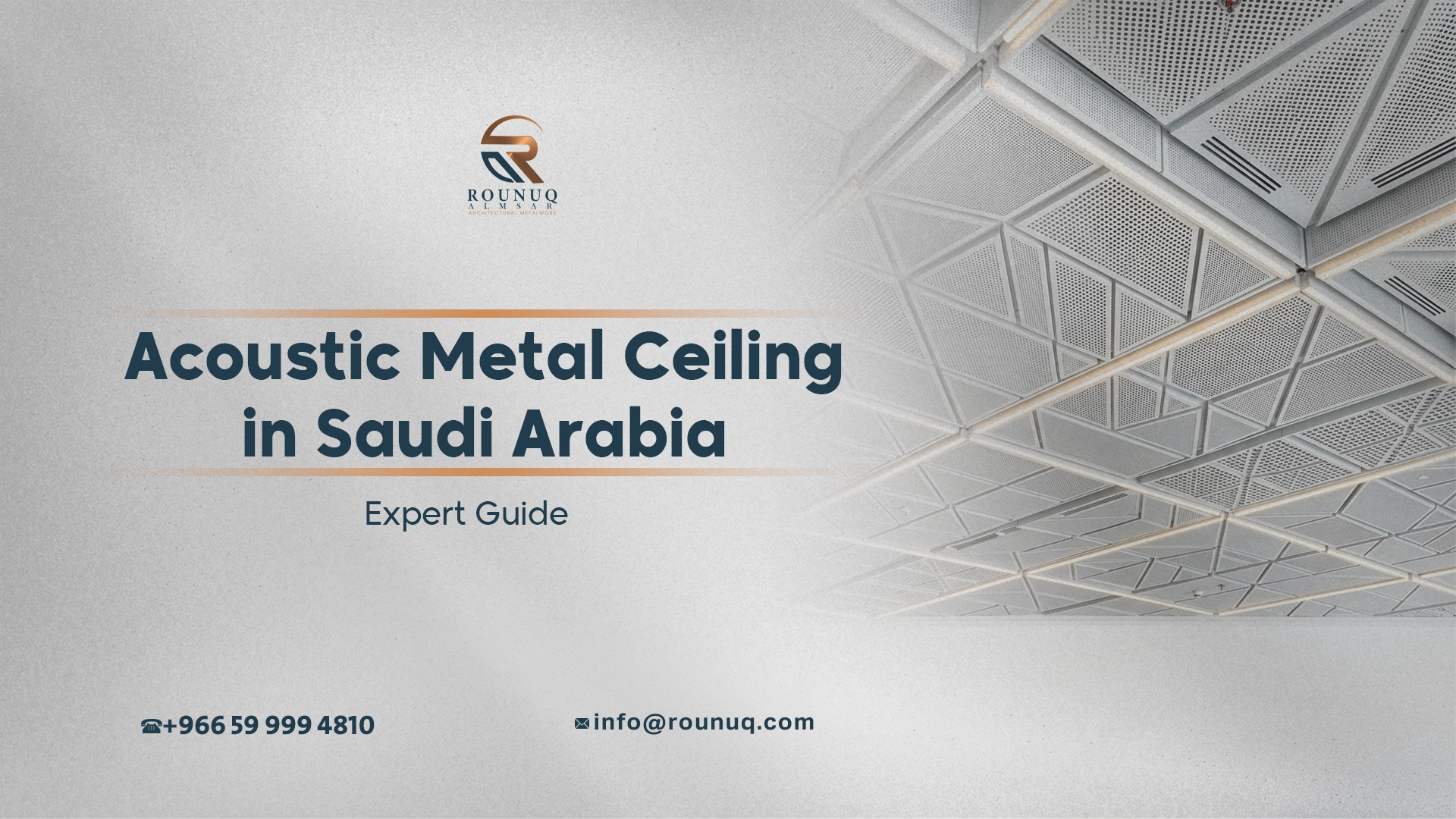
Acoustic Metal Ceiling in Saudi Arabia: Expert Guide
In a modern commercial interior, a ceiling has to do more than hide services above the occupied space. It can influence how a room sounds, how easily building services are accessed, and how the architectural design is perceived.
An acoustic metal ceiling is particularly useful when a project needs the durability and visual flexibility of metal while also requiring better control of reflected sound. The acoustic result, however, does not come from the metal sheet alone. Perforation, the material behind the panel, ceiling configuration, room geometry and installation details all contribute to the final result.
This matters in Saudi projects where offices, hotels, retail environments, educational facilities, healthcare spaces and other high-use interiors often need to balance architectural appearance with acoustic comfort.
ROUNUQ already provides architectural metal ceiling systems using aluminum, stainless steel and steel, including acoustical systems, perforated panels and acoustic infill options.
This guide explains how the system works, what to specify, and which questions should be answered before fabrication.
What Is an Acoustic Metal Ceiling?
An acoustic metal ceiling is a suspended or fixed architectural ceiling system that uses metal panels or elements designed to help control sound within a room.
The visible metal component may be a perforated panel, tile, linear element, baffle, raft or another architectural configuration. Behind or around the metal, an absorptive layer can be used to reduce reflected sound.
The important distinction is that the metal surface and the acoustic treatment work together.
A typical system may contain:
- A metal panel or ceiling element.
- Perforations or another acoustic opening pattern.
- An acoustic backing or infill.
- A suspension or fixing system.
- A concealed ceiling void containing services.
- Lighting, HVAC, sprinkler and other coordinated components.
This construction gives designers considerable freedom because the visible surface can remain metallic while the acoustic treatment performs a separate functional role.
How Does an Acoustic Metal Ceiling Work?
The basic principle is sound absorption.
When sound reaches a hard, uninterrupted metal surface, much of the acoustic energy can be reflected back into the room. A properly designed perforated system allows some sound energy to pass through the openings toward an absorptive material behind the panel.
The absorber then dissipates part of that acoustic energy rather than allowing it to continue reflecting around the room.
This is why an acoustic metal ceiling should not be judged simply by looking at the thickness or appearance of the metal sheet.
The acoustic build-up is more important.
The role of perforation
Perforation creates openings through which sound can interact with the absorptive layer behind the metal.
The result depends on the complete system, including:
- Open area
- Hole diameter
- Pattern
- Panel geometry
- Backing material
- Air space
- Installation configuration
Changing the perforation pattern can therefore affect both the appearance and acoustic behavior of the ceiling.
The role of acoustic infill
An absorber behind the metal panel can substantially change the behavior of a perforated ceiling.
Common solutions may include mineral-based absorptive materials or other tested acoustic products. The exact material should be selected according to the required performance, fire requirements, environmental conditions and manufacturer’s tested configuration.
ROUNUQ’s existing metal ceiling specification identifies acoustic infill panels and mineral fiber inserts among its material options.
Why the air space matters
The cavity between the visible panel and the absorber is also relevant.
An acoustic designer should therefore consider the complete ceiling assembly rather than specifying a metal finish separately from its backing and suspension arrangement.
The same visible metal finish can produce different acoustic outcomes when the backing material, perforation or cavity changes.
Sound Absorption vs Sound Insulation: What Is the Difference?
This is one of the most important distinctions when specifying an acoustic metal ceiling.
Sound absorption reduces reflections within a room. It can help make speech easier to understand and reduce the sense of excessive reverberation.
For building acoustic applications, ISO 11654 provides a framework for rating sound absorption.
Sound insulation is concerned with limiting sound transmission from one space to another.
A ceiling designed to improve absorption inside a conference room is not automatically a solution for preventing noise from an adjacent room from passing through the building.
For example, an office may need:
- Absorption to control conversations and reverberation inside the workspace.
- Insulation to limit sound transmission between meeting rooms.
- Mechanical isolation to reduce vibration from equipment.
These are related acoustic problems, but they require different strategies.
Saudi technical guidance also distinguishes laboratory sound-insulation testing from actual field performance. SASO’s publication on ISO 10140-2 explains that laboratory measurements can be used to assess building elements, including suspended ceilings, while field performance can be affected by factors such as flanking transmission and boundary conditions.
Which Acoustic Metal Ceiling Formats Are Available?
There is no single ceiling configuration that suits every project.
The appropriate format depends on the room, visual concept, acoustic requirement, access requirements and coordination with building services.
| Ceiling format | Typical architectural character | Acoustic potential | Useful when |
|---|---|---|---|
| Perforated panels | Clean and continuous | High when paired with suitable absorption | Offices, education, hospitality |
| Linear ceiling | Directional and contemporary | Depends on backing and spacing | Corridors, retail, commercial interiors |
| Baffles | Open and visually expressive | Strong when properly spaced and absorptive | Large open rooms and offices |
| Acoustic rafts | Floating visual elements | Useful for targeted absorption | Open-plan interiors and meeting areas |
| Metal tiles | Modular appearance | Depends on perforation and backing | Accessible suspended ceiling layouts |
| Custom geometric panels | Bespoke architectural appearance | Can incorporate acoustic treatment | Feature interiors and premium projects |
The performance should always be checked against the actual specified system rather than inferred from its category.
What Is the Best Material for an Acoustic Metal Ceiling?
Material selection should begin with the project’s functional requirements rather than appearance alone.
Aluminum
Aluminum is useful where low weight, corrosion resistance and architectural flexibility are important.
ROUNUQ’s current ceiling service includes customized aluminum ceiling systems and finishes.
For large suspended areas, weight can also influence handling, suspension design and installation logistics.
Stainless steel
Stainless steel can be appropriate where a premium metallic appearance is part of the design.
It can be supplied in finishes such as brushed, mirror and PVD-treated surfaces depending on the project specification. ROUNUQ lists stainless steel among its ceiling materials and PVD finishes among its broader architectural metal capabilities.
However, stainless steel should not be selected simply because it looks premium. The designer should consider whether its weight, finish, cost and fabrication requirements are justified for the particular ceiling.
Steel
Steel can be useful where the design requires a robust architectural system or particular structural characteristics.
The required coating and protection should be considered according to the environment and project specification.
Where Are Acoustic Metal Ceilings Used?
An acoustic metal ceiling can be appropriate in spaces where reflected sound needs to be controlled without giving up a durable architectural ceiling surface.
Typical applications include:
Offices and meeting rooms
Open-plan offices can contain many simultaneous conversations, telephone calls and equipment sounds.
The objective is not necessarily to make the room silent. Instead, the ceiling can form part of a broader acoustic strategy designed to improve comfort and speech intelligibility.
Hotels and hospitality
Hotel lobbies, restaurants, reception areas and other hospitality spaces often need a balance between visual identity and acoustic comfort.
Metal allows the ceiling to become part of the architectural language while acoustic treatment works behind the visible finish.
Educational facilities
Classrooms and teaching spaces can benefit from controlled reverberation because excessive reflected sound can interfere with speech communication.
The ceiling should be considered alongside wall treatments, room geometry and other acoustic elements.
Healthcare environments
Healthcare spaces have additional functional requirements, including hygiene, maintenance and service access.
The selected ceiling system should therefore be evaluated as a complete specification rather than only for acoustic performance.
Retail and public spaces
Retail environments, showrooms and public interiors may use baffles, linear systems, perforated panels or custom configurations to create visual interest while addressing acoustic requirements.
How Should an Acoustic Metal Ceiling Be Specified?
A common mistake is to specify only:
“Perforated metal ceiling with acoustic backing.”
That description is usually insufficient for a detailed project specification.
A more useful specification should define the complete system.
Consider documenting:
- Base metal — aluminum, stainless steel or steel.
- Material grade — where applicable.
- Panel thickness.
- Panel dimensions and module.
- Perforation pattern and open area.
- Acoustic backing material.
- Cavity or air-space arrangement.
- Suspension system.
- Finish and color.
- Access requirements.
- Fire-performance requirements.
- Acoustic test data.
- Integration requirements for MEP services.
- Cleaning and maintenance requirements.
For an acoustic metal ceiling, tested performance should be tied to the actual assembly being proposed.
Do not assume that two systems with the same metal, perforation and visible appearance will automatically have identical acoustic results.
What Does NRC Mean?
NRC, or Noise Reduction Coefficient, is commonly used to describe sound absorption performance.
It is useful when comparing absorptive products, but it should not be treated as a complete description of a building’s acoustic performance.
The ASTM C423 standard is commonly referenced when measuring sound absorption using the reverberation room method.
The final acoustic environment depends on:
- Room dimensions
- Surface finishes
- Occupancy
- Furniture
- Ceiling coverage
- Wall absorption
- Floor finishes
- Background noise
- Sound transmission paths
- Mechanical systems
For that reason, an acoustic metal ceiling with a strong laboratory absorption result may still be insufficient if the room has highly reflective walls, floors and furniture.
Where a project has demanding acoustic requirements, the specification should rely on appropriate test documentation and acoustic design rather than a single marketing number.
How Does an Acoustic Metal Ceiling Affect Speech Intelligibility?
Speech intelligibility is particularly important in spaces such as classrooms, meeting rooms, conference facilities and training rooms.
Excessive reverberation can make words overlap acoustically, making conversations more difficult to follow.
A properly designed ceiling can reduce some of those reflections.
However, the ceiling is only one part of the solution.
The room should also be evaluated for:
- Wall reflection
- Floor finish
- Furniture
- Room volume
- Background mechanical noise
- Occupancy
- Speaker/listener position
- Room geometry
This is why acoustic design should begin with the room’s function rather than with the appearance of the ceiling.
Acoustic Metal Ceiling vs Conventional Hard Metal Ceiling
A conventional hard metal ceiling and an acoustic metal ceiling may look similar from below while behaving differently acoustically.
| Consideration | Conventional hard metal ceiling | Acoustic metal ceiling |
|---|---|---|
| Primary purpose | Architectural finish | Architectural finish + sound absorption |
| Surface | Usually solid | Often perforated or acoustically configured |
| Absorptive backing | Not necessarily included | Usually part of the acoustic assembly |
| Reverberation control | Limited by itself | Designed to contribute to absorption |
| Design flexibility | High | High |
| MEP coordination | Required | Required |
| Acoustic testing | May not be central | Important for performance claims |
| Best use | Spaces where acoustic control is secondary | Spaces where acoustic comfort is a design requirement |
The key difference is not simply whether the ceiling is made from metal. It is whether the complete system has been designed and tested to provide the required acoustic function.
What Should Saudi Projects Consider?
An acoustic metal ceiling for a Saudi project should be evaluated against the project’s actual building requirements, environmental conditions and specification documents.
The Saudi Building Code provides mandatory requirements and references covering areas such as architectural, structural, mechanical, electrical, energy and fire-safety requirements.
The Saudi Building Code platform states that the 2024 edition has been applied to all types of building occupancies since June 30, 2025.
That does not mean every acoustic ceiling has one universal specification.
The applicable requirements depend on the building, occupancy, system and project documentation.
Climate and environment
Material and finish selection should reflect the actual environment.
For interiors, the designer should consider:
- Air-conditioning conditions
- Humidity exposure
- Cleaning requirements
- Traffic and impact
- Surface finish durability
For projects in demanding environments, the material, coating and maintenance specification should be reviewed together.
Project coordination
Large Saudi commercial and hospitality projects frequently involve multiple trades working within the same ceiling zone.
The ceiling therefore needs to be coordinated with:
- HVAC diffusers
- Lighting
- Sprinklers
- Smoke detectors
- Speakers
- Access panels
- Electrical services
- Inspection requirements
ROUNUQ describes its ceiling workflow as integrating architectural requirements with lighting, HVAC and other building elements.
How Should the Ceiling Be Coordinated With MEP Services?
Ceiling coordination should happen before fabrication.
A frequent project problem occurs when a beautifully designed ceiling panel is manufactured before the final positions of diffusers, lights, sprinklers or access panels are confirmed.
That can create:
- Unnecessary panel cutting
- Visual inconsistencies
- Relocated fixtures
- Difficult maintenance access
- Additional fabrication
- Installation delays
For custom systems, the fabrication drawings should therefore reflect the latest coordinated architectural and MEP information.
This is especially important when perforation patterns are visually directional or when panel joints need to align across a large ceiling.
Maintenance and Access Considerations
Acoustic performance is only one part of long-term ceiling performance.
Before approving an acoustic metal ceiling, ask how the ceiling will be accessed after installation.
Important questions include:
- Can individual panels be removed?
- Where are inspection points located?
- Can MEP equipment be serviced without damaging adjacent panels?
- Can damaged panels be replaced individually?
- How will the finish be cleaned?
- Will the acoustic backing remain protected during maintenance?
Suspended metal ceiling manufacturers commonly provide different access mechanisms, including removable or hinged configurations, specifically because access to the ceiling void is a practical requirement.
A visually impressive ceiling that makes routine maintenance unnecessarily difficult can create problems long after handover.
Common Mistakes When Choosing an Acoustic Metal Ceiling
1. Selecting the metal before defining the acoustic objective
The first question should be what the room needs acoustically.
2. Looking only at the visible panel
The acoustic backing, cavity and perforation form part of the system.
3. Confusing absorption with sound isolation
A ceiling can reduce reflected sound without preventing noise from passing between rooms.
4. Using a generic acoustic rating
Performance data should correspond to the actual ceiling assembly.
5. Ignoring MEP coordination
Late changes can affect panel layout, appearance and fabrication.
6. Forgetting access
Lighting and HVAC equipment eventually require inspection and maintenance.
7. Treating appearance as the only selection criterion
Material, finish, fire requirements, maintenance and acoustic performance should be evaluated together.
A Practical Selection Checklist
Before approving an acoustic metal ceiling, the project team should be able to answer these questions:
- What acoustic problem are we trying to solve?
- Is the objective absorption, isolation or both?
- What metal and finish are required?
- Is perforation required?
- What acoustic backing is being used?
- Is the complete system tested?
- What performance data is available?
- How much ceiling area will be acoustically active?
- How will lighting and HVAC integrate with the panels?
- Where are access panels required?
- What maintenance method will be used?
- What fire and safety requirements apply?
- Does the proposed assembly satisfy the project’s specification?
- Has the final coordinated drawing been approved before fabrication?
If several of these questions have no clear answer, the ceiling specification is probably not ready for fabrication.
When Should You Choose an Acoustic Metal Ceiling?
An acoustic metal ceiling makes particular sense when a project needs three things at the same time:
- A durable architectural metal surface.
- Controlled sound reflection.
- A ceiling design that can integrate building services and architectural details.
It can be especially useful in offices, hospitality interiors, education, conference facilities, retail environments and other spaces where appearance and acoustic comfort need to work together.
For projects that need custom aluminum, stainless steel or steel ceiling systems, ROUNUQ’s dedicated Metal Ceiling Systems service covers architectural ceiling design, fabrication and installation, including acoustical systems and custom configurations.
How ROUNUQ Approaches Architectural Metal Ceiling Projects
ROUNUQ’s published metal ceiling capabilities include aluminum, stainless steel and steel systems, along with CNC tube processing, fiber laser cutting, CNC bending, V-grooving, welding, assembly, finishing and acoustic panel integration.
The company also identifies ceiling baffles, acoustical systems, perforated panels and bespoke ceiling designs within its current offering.
For a project that requires custom architectural metalwork beyond the ceiling itself, ROUNUQ also works across related architectural applications including decorative cladding and other fabricated metal elements. Its published workflow follows design, fabrication, finishing and installation.
The practical next step is to provide the project drawings, ceiling area, room use, preferred material/finish and acoustic requirements so the appropriate system can be evaluated against the actual application.
Frequently Asked Questions
Is an acoustic metal ceiling actually effective for sound absorption?
Yes, when it is designed as a complete acoustic assembly. Perforated metal can work with absorptive material behind the panel to reduce reflected sound. Performance depends on the complete system rather than the metal surface alone.
Does a perforated metal ceiling automatically provide good acoustics?
No. Perforation by itself does not guarantee a particular acoustic result. The perforation pattern, backing material, cavity, ceiling coverage and tested assembly all matter.
What is the difference between an acoustic metal ceiling and an acoustic tile ceiling?
Both can provide sound absorption, but they use different visible and structural systems. Metal offers architectural durability and design flexibility, while acoustic tiles use a different material construction. The appropriate option depends on the project’s appearance, access, performance and maintenance requirements.
Can acoustic metal ceilings be customized?
Yes. Depending on the system, customization can include panel dimensions, perforation patterns, forms, finishes, layouts and integration with lighting or other architectural elements. ROUNUQ specifically lists bespoke metal ceiling designs and acoustic panel integration among its capabilities.
Are metal ceilings suitable for offices?
They can be. Offices often need control of reflected sound, speech comfort and access to services. A properly designed ceiling can contribute to the overall acoustic strategy, particularly when combined with appropriate wall, floor and furniture treatments.
Is NRC enough to select an acoustic ceiling?
No. NRC can be useful for comparing absorption characteristics, but it does not describe every aspect of room acoustics or sound transmission between spaces. The complete room and ceiling assembly should be considered.
Can acoustic metal ceilings be used in hotels and hospitality projects?
Yes. Hospitality spaces can benefit from the combination of architectural metal finishes and acoustic treatment. The final system should be selected according to the room function, appearance, maintenance requirements and acoustic objectives.
What should I provide to a ceiling fabricator?
Useful information includes architectural drawings, reflected ceiling plans, ceiling dimensions, material and finish preferences, MEP coordination drawings, access requirements and any project-specific acoustic or fire-performance requirements.
Does Saudi Building Code compliance mean every acoustic ceiling is automatically approved?
No. Applicable requirements depend on the building and project circumstances. The Saudi Building Code establishes requirements for applicable construction work, but the proposed ceiling assembly still needs to be evaluated against the relevant project specifications and applicable requirements.
Conclusion
An acoustic metal ceiling is not simply a perforated sheet suspended below a slab. It is a coordinated architectural system in which the metal surface, perforation, acoustic backing, cavity, suspension method and surrounding room all contribute to the final result.
For Saudi projects, the most reliable approach is to define the acoustic objective first, select the material and ceiling format second, and then coordinate the complete assembly with architectural, MEP, fire and maintenance requirements.
The result should be judged by more than appearance. A successful ceiling should provide the required acoustic function while remaining practical to fabricate, install, access and maintain.
For projects requiring a custom architectural ceiling system in aluminum, stainless steel or steel, you can review ROUNUQ’s Metal Ceiling Systems service or discuss the project directly through ROUNUQ’s contact page. ROUNUQ’s published capabilities include custom acoustic configurations, perforated panels and acoustic integration for architectural projects in Saudi Arabia.
2 Comments
Ceiling Baffle Systems in Saudi Arabia: A Complete Guide
September 21, 2026
[…] architectural metal approach. For the acoustic-metal side of the decision, Rounuq also publishes an acoustic metal ceiling guide for Saudi projects covering perforation, backing, cavity, and specification […]
Metal Feature Walls in Saudi Arabia: Design & Project Guide
October 13, 2026
[…] acoustic performance, the whole assembly has to be designed for it, with backing and absorber. Acoustic metal systems are engineered differently from decorative […]