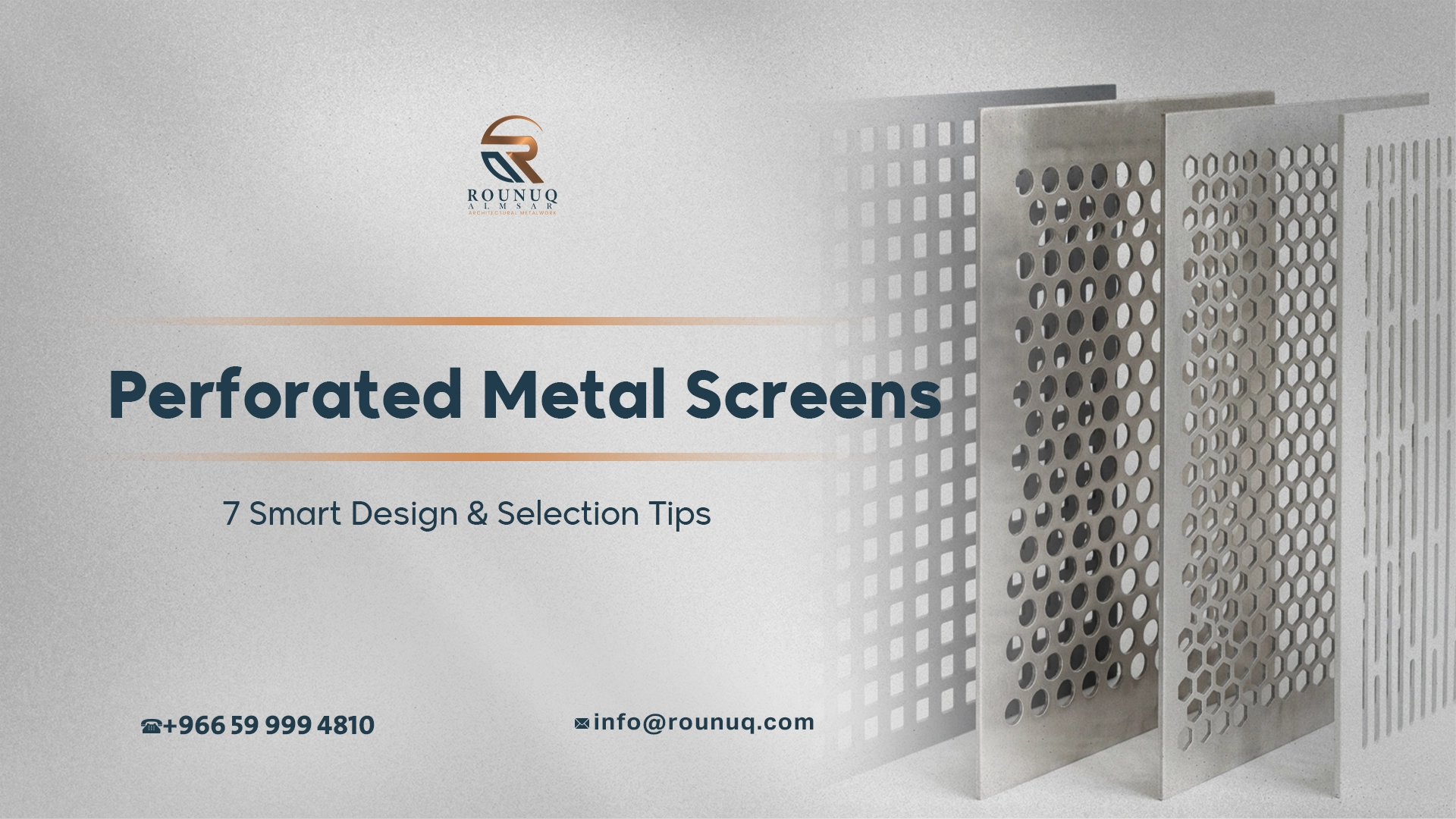
Perforated Metal Screens: 7 Smart Design & Selection Tips
Perforated Metal Screens are architectural elements made from metal sheets with controlled openings that allow designers to manage visibility, sunlight, airflow and visual separation without creating a completely solid barrier.
For commercial and residential projects, Perforated Metal Screens can combine architectural expression with practical control over light, views and airflow.
Their value is not simply decorative. The size and arrangement of the openings can change how much light passes through, how transparent the screen feels, how much privacy it provides and how the building looks from different viewing distances.
For architects, contractors and property developers in Saudi Arabia, choosing the right screen requires more than selecting an attractive pattern. The material, thickness, open area, orientation, fixing system, finish and environmental exposure all influence the final result.
This guide explains how to approach that decision, including material comparisons, privacy and shading considerations, common applications, installation requirements and practical questions to answer before fabrication.
What Are Perforated Metal Screens?
A perforated metal screen is a sheet-metal architectural screen manufactured with a planned arrangement of openings. The openings may be round, square, rectangular, slotted or custom-designed, depending on the required appearance and performance.
Unlike a solid metal panel, the screen allows controlled amounts of light and air to pass through. Unlike a fully open mesh, it can provide a more deliberate visual pattern and a stronger architectural surface.
The most important specification is not simply the hole shape. Designers should consider the relationship between:
- Hole size
- Hole spacing
- Pattern direction
- Open area percentage
- Sheet thickness
- Panel dimensions
- Viewing distance
- Lighting conditions
- Screen orientation
A screen with a relatively high open area can feel light and visually transparent, while a denser pattern can create stronger privacy and a more substantial visual layer.
The same principle applies to exterior screens. A perforated facade layer can filter sunlight and views while remaining visually lighter than a solid wall. Rounuq’s existing facade guidance similarly describes perforated panels as a way to balance ventilation, daylight penetration and architectural appearance.
For this reason, Perforated Metal Screens should be specified according to both their visual appearance and the performance expected from the finished installation.
How Do Perforated Metal Screens Work?
The screen works by controlling what passes through the metal surface.
Three functions are particularly important:
1. Light Control
The openings allow daylight through instead of completely blocking it. The resulting light pattern changes according to the hole geometry, density, orientation and position of the screen relative to glazing.
This can be useful around windows, entrances, courtyards and semi-exterior spaces.
Building-envelope design should consider shading together with orientation, glazing and daylight requirements rather than treating a screen as an isolated decorative component. The U.S. Department of Energy identifies shading, glazing and building orientation as interconnected considerations in daylighting and solar-heat-gain strategies.
2. Visual Control
The screen can reduce direct views into a space without making it completely enclosed.
However, privacy is not determined by the perforation pattern alone. Viewing angle, distance, lighting conditions and the position of people on either side all matter.
A screen that provides strong privacy during the day may appear substantially more transparent at night if the interior is brightly illuminated.
3. Air Movement
Because the surface contains openings, air can pass through the screen. This can be valuable for certain external architectural applications where a solid barrier would create a more enclosed condition.
The required open area should still be determined according to the project’s actual performance requirements rather than assuming that more openings are always better.
When properly designed, Perforated Metal Screens can create a controlled transition between an open exterior environment and a more protected interior space.
7 Factors to Consider Before Choosing a Screen
The best screen is the one that satisfies the project’s functional requirements while fitting the architectural concept.
Before selecting Perforated Metal Screens, the design team should establish the project’s functional requirements, environmental conditions and architectural objectives.
1. Define the Main Purpose
Start with the reason the screen is being specified.
Is the priority:
- Privacy?
- Solar control?
- Decorative appearance?
- Ventilation?
- Visual separation?
- Screening equipment?
- Creating a secondary facade layer?
- Creating a feature wall?
- Controlling views from balconies or courtyards?
A screen designed primarily for privacy may require a different opening density from one intended mainly as a decorative facade element.
These requirements determine whether Perforated Metal Screens should prioritize privacy, solar screening, ventilation, decoration or a combination of functions.
This first decision prevents the common mistake of choosing a pattern visually and trying to make it perform a function afterward.
2. Choose the Right Open Area
Open area describes the proportion of the sheet occupied by openings.
It affects the visual density of the screen, daylight transmission, airflow and perceived privacy.
A simple way to think about it is:
| Requirement | Typical design direction |
|---|---|
| Strong visual separation | Lower open area |
| Balanced privacy and daylight | Medium open area |
| Maximum visual permeability | Higher open area |
| Strong decorative emphasis | Depends on pattern and viewing distance |
| Solar screening | Depends on orientation, sun position and opening geometry |
| Ventilation screening | Requires adequate open area and system-specific assessment |
These are design directions, not universal performance values. The final specification should consider the building orientation, screen location and intended use.
For Perforated Metal Screens, open area should therefore be evaluated together with viewing distance, lighting and the intended relationship between the screen and the space behind it.
3. Select the Perforation Pattern
Pattern affects more than appearance.
Round openings can produce a regular, understated appearance. Square or rectangular openings can create a more geometric architectural language, while custom patterns can become a stronger visual feature.
Pattern selection should consider:
- Building style
- Panel size
- Viewing distance
- Required privacy
- Desired light transmission
- Repetition across elevations
- Relationship with glazing and other materials
A pattern that looks attractive in a small sample may appear very different when repeated across a large facade.
In large architectural installations, Perforated Metal Screens also need consistent pattern alignment so that individual panels read as one coordinated design.
4. Select the Metal
Material selection can significantly affect the appearance, weight and long-term performance of Perforated Metal Screens.
The most common architectural choices include aluminum and stainless steel, while copper and coated steel can also be considered depending on the project.
Aluminum
Aluminum is attractive where low weight, corrosion resistance and finish flexibility are important.
It can work particularly well for:
- External architectural screens
- Solar-control elements
- Lightweight facade features
- Canopies
- Decorative partitions
Rounuq already lists aluminum among the materials used for its custom decorative screens and facade solutions.
Stainless Steel
Stainless steel is often selected where a more substantial premium appearance, durability and decorative finish are required.
It can be particularly suitable for:
- Feature screens
- High-end interiors
- Entrance elements
- Premium facade details
- Decorative partitions
- Hospitality projects
The appropriate stainless-steel grade depends on the environment. In aggressive coastal conditions, grade selection becomes especially important. ASSDA notes that stainless grades have different resistance to chloride exposure and recommends appropriate corrosion-resistant grades for coastal environments.
Rounuq’s stainless-steel offering includes decorative finishes such as PVD, mirror and brushed finishes, subject to the project’s requirements.
5. Consider the Screen’s Location
Interior and exterior screens should not automatically receive the same specification.
For interior applications, the main concerns may be:
- Appearance
- Cleaning
- Impact resistance
- Integration with partitions and lighting
- Finish consistency
For exterior applications, the specification should additionally consider:
- Sun exposure
- Dust
- Rainwater
- Wind
- Corrosion
- Drainage
- Access for cleaning
- Fixing details
- Thermal movement
These conditions should be reviewed before the fabrication drawings for Perforated Metal Screens are finalized.
This distinction is especially relevant in Saudi projects, where exterior architectural elements can experience strong solar exposure and dusty conditions.
6. Coordinate the Support System
The visible perforated surface is only one part of the installation.
A complete screen assembly may require:
- Structural or secondary support
- Frames or perimeter members
- Brackets
- Mechanical fixings
- Panel joints
- Movement allowances
- Access for maintenance
- Drainage where required
The support system should be coordinated with the building structure and adjacent facade or glazing system before fabrication.
Rounuq’s published fabrication capabilities include laser cutting, CNC bending, V-grooving, welding, assembly and surface finishing, which are relevant when a screen requires more than simple flat-panel production.
7. Specify the Finish for the Environment
The finish should be selected together with the base metal and location.
Potential directions include:
- Brushed stainless steel
- Mirror stainless steel
- PVD finishes
- Powder-coated aluminum
- Anodized aluminum
- Painted steel
A finish should not be selected only from a color chart. Outdoor exposure, cleaning requirements, surrounding materials and the required appearance over time should be considered.
Where Are Perforated Metal Screens Used?
Perforated Metal Screens can serve many architectural roles, but each application has a different design priority.
The versatility of Perforated Metal Screens allows them to be adapted to both exterior building envelopes and interior architectural environments.
Facade Screens
Facade screens can act as a secondary architectural layer in front of glazing or opaque surfaces.
They may help:
- Filter daylight
- Reduce direct views
- Create visual depth
- Add pattern to a building elevation
- Create a distinctive architectural identity
Rounuq’s facade and glazing solutions service covers facade systems and custom perforated metal panels.
For readers specifically researching facade panels rather than screens, Rounuq’s existing Perforated Metal Facade Panels guide covers that more specific topic.
Privacy Screens
Privacy screens are useful where a project needs separation without creating a completely opaque wall.
Typical locations include:
- Balconies
- Courtyards
- Villa entrances
- Outdoor seating
- Hospitality spaces
- Rooftops
- Service areas
In these applications, Perforated Metal Screens can provide separation while preserving a degree of visual openness.
The important point is to design privacy around the actual viewing direction. A dense screen may provide excellent frontal privacy but still leave angled views open.
Solar-Shading Screens
External screens can form part of a wider solar-control strategy.
The appropriate design depends on:
- Facade orientation
- Window location
- Sun angle
- Opening geometry
- Screen distance from glazing
- Desired daylight level
When positioned correctly, Perforated Metal Screens can become part of a coordinated shading strategy rather than functioning only as a decorative layer.
A perforated screen should therefore be treated as one component of the facade’s environmental strategy rather than automatically described as an energy-saving solution.
Interior Screens and Partitions
Inside a building, screens can divide spaces while maintaining visual connection.
They are suitable for:
- Hotel lobbies
- Restaurants
- Reception areas
- Offices
- Retail environments
- Feature walls
- Circulation spaces
Rounuq’s published decorative-screen capabilities include feature walls, partitions, ceiling elements and facade accents using stainless steel, aluminum and copper.
Perforated Metal Screens vs Laser-Cut Screens
These systems can look similar, but they are not identical.
| Feature | Perforated Screen | Laser-Cut Screen |
|---|---|---|
| Opening pattern | Usually repeated | Can be highly customized |
| Hole geometry | Standard or controlled patterns | Almost unlimited 2D geometry |
| Decorative graphics | More limited | Excellent for complex motifs |
| Repetition | Efficient for repeated patterns | Suitable for bespoke designs |
| Privacy control | Controlled through density | Controlled through custom geometry |
| Branding/pattern artwork | Possible but more constrained | Particularly suitable |
| Best suited to | Repeated architectural screening | Bespoke decorative architecture |
The right choice depends on the geometry and performance requirements rather than assuming that one manufacturing method is universally better.
Rounuq’s laser-cutting capabilities include decorative screens, feature panels, partitions, cladding components and architectural shapes.
Perforated Screens vs Metal Mesh
Metal mesh is another option when the project needs a visually lighter and more transparent layer.
Perforated sheet is generally preferable when the design calls for a controlled hole pattern and a more defined panel surface.
Mesh can be more appropriate when:
- Transparency is a priority
- A lightweight visual layer is desired
- The design benefits from a woven appearance
- The application calls for flexible or semi-transparent screening
The decision should therefore be based on the desired architectural effect and performance rather than simply comparing materials by appearance.
What Works Best for Saudi Architectural Projects?
There is no single screen specification that fits every Saudi project.
For an exterior installation, the design team should review:
- Solar orientation
- Dust accumulation
- Cleaning access
- Wind exposure
- Corrosion environment
- Fixing and support
- Drainage
- Finish durability
- Relationship with glazing
- Required privacy level
For Saudi developments, Perforated Metal Screens should be evaluated according to the actual location, facade orientation and expected maintenance conditions.
For coastal locations, stainless-steel selection deserves additional attention because chloride exposure can increase corrosion risk. ASSDA’s technical guidance explains that grade selection, surface condition, drainage and maintenance all influence stainless-steel performance in coastal environments.
For interior luxury fit-outs, the emphasis may shift toward:
- Finish quality
- Pattern precision
- Lighting interaction
- Joint alignment
- PVD or decorative finish
- Integration with ceilings and walls
The correct specification is therefore project-specific.
Common Design Mistakes to Avoid
Choosing the Pattern Before Defining the Function
A beautiful pattern is not automatically a good privacy or shading solution.
Ignoring Nighttime Visibility
A screen can appear private during daylight but become more transparent when the space behind it is brightly illuminated.
Treating Open Area as the Only Performance Variable
Open area matters, but pattern geometry, orientation, location and viewing angle matter too.
Designing the Screen Without Its Support System
Large panels require coordinated fixing and support. The visible panel should not be treated as a standalone object.
Selecting the Finish Without Considering Exposure
Interior and exterior conditions can be very different. Coastal exposure, cleaning and pollution should be considered before finalizing the finish.
Leaving Maintenance Access Until the End
A screen that is difficult to clean can become a maintenance problem even when the original design looks excellent.
A Practical Selection Checklist
Before approving a screen design, confirm:
- What is the primary function?
- How much privacy is required?
- How much daylight should pass through?
- Is airflow important?
- What is the required open area?
- Which metal is appropriate for the environment?
- What perforation pattern fits the architecture?
- Is the installation interior or exterior?
- How will the panels be supported?
- How will the finished screen be cleaned and maintained?
If these questions are answered before fabrication, the design team has a much better basis for selecting the panel geometry, material and finish.
Frequently Asked Questions About Perforated Metal Screens
What are perforated metal screens used for?
They are used for privacy, solar screening, visual separation, ventilation, facade design, equipment screening, decorative partitions and other architectural applications where a solid barrier is not desirable.
Are perforated metal screens suitable for exterior use?
Yes, they can be used outdoors when the material, finish, fixing system and environmental exposure are properly specified. Exterior applications require more attention to corrosion, wind, drainage, cleaning and long-term finish performance.
Which is better for screens: aluminum or stainless steel?
Neither is universally better. Aluminum is attractive where low weight and corrosion resistance are important, while stainless steel can be preferable when a premium metallic appearance, durability and decorative finishing are priorities.
Do perforated screens provide privacy?
They can, but privacy depends on hole size, open area, viewing angle, screen position, lighting and the distance between the viewer and the screened space. A sample should be reviewed from realistic viewing positions before final approval.
Can the perforation pattern be customized?
Yes. Standard repeated patterns and custom architectural patterns can be produced depending on the selected manufacturing method, material, thickness and required geometry.
Are perforated screens suitable for Saudi weather?
They can be suitable for Saudi exterior applications when the design accounts for solar exposure, dust, cleaning, wind, corrosion environment, drainage and finish selection.
Can perforated screens be used with stainless steel PVD finishes?
They can be considered for decorative applications where the selected stainless substrate, finish and exposure are appropriate. Rounuq’s published decorative-screen and PVD information identifies stainless-steel screens and PVD finishes among its architectural capabilities.
What should be specified before fabrication?
At minimum, the project team should define the material, thickness, perforation geometry, open area, panel dimensions, finish, support system, fixing method, location and required performance.
Conclusion: Choosing the Right Screen for the Project
Perforated Metal Screens are most effective when their appearance and function are designed together.
The right solution depends on what the screen needs to accomplish: privacy, solar control, airflow, visual separation, architectural expression or a combination of these requirements.
Material selection is equally important. Aluminum can be attractive for lightweight architectural applications, while stainless steel can provide a premium finish and strong durability when properly specified. Pattern density, open area, viewing angle, support, finish and maintenance should all be considered before fabrication.
For Saudi projects, exterior exposure deserves particular attention. A screen that looks excellent in a sample room still needs to work with the actual facade, sun exposure, dust, cleaning strategy and environmental conditions of the project.
Ultimately, successful Perforated Metal Screens depend on coordination between architecture, material selection, fabrication and installation rather than pattern selection alone.
Rounuq’s published capabilities include custom decorative screens in stainless steel, aluminum and copper, together with laser cutting, CNC fabrication and architectural cladding solutions.
If you are developing a screen for a facade, entrance, balcony, partition or other architectural application, the next step is to define the required privacy, open area, material, pattern and installation conditions before fabrication. Rounuq can then be considered alongside the project’s architectural and fabrication requirements through its decorative cladding and metal-screen solutions.
2 Comments
Solar Shading Systems in Saudi Arabia: Practical Guide
September 29, 2026
[…] or bending, large unsupported panels flex in wind, and deep recesses trap dust. Rounuq’s guide to perforated metal screens covers pattern and material selection in detail, and its façade and glazing solutions show how […]
Stainless Steel Handrails in Saudi Arabia: Design & Guide
September 29, 2026
[…] Decorative metal screens […]