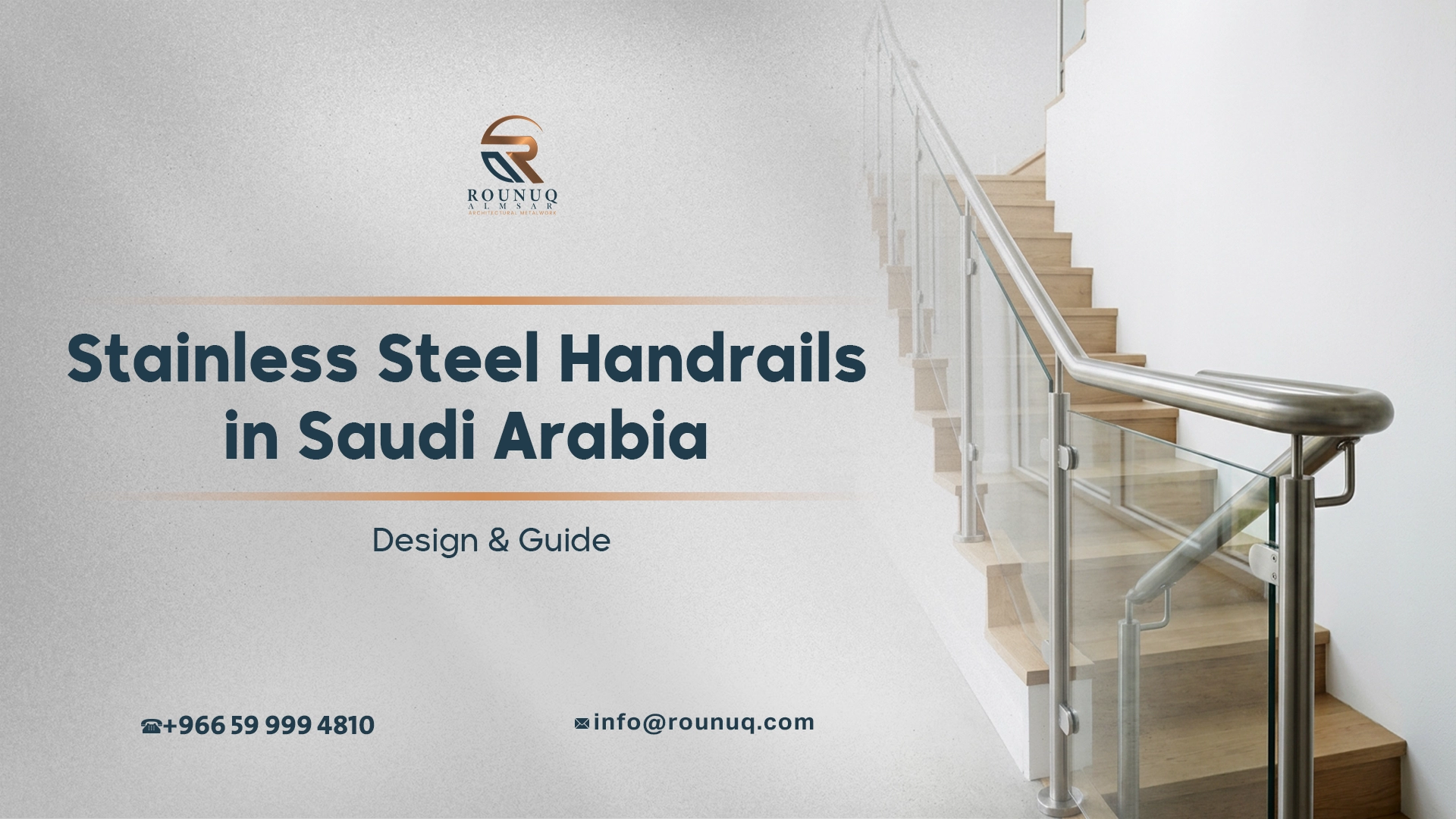
Stainless Steel Handrails in Saudi Arabia: Design & Guide
For major commercial, hospitality, residential, healthcare, institutional, and mixed-use developments, stainless steel handrails in Saudi Arabia are not simply a finishing element. They are part of the project’s safety, accessibility, architectural appearance, coordination, and long-term maintenance requirements.
For developers, architects, consultants, contractors, and procurement teams, selecting a handrail supplier therefore involves more than comparing stainless steel prices. The project team needs to consider material grade, profile, finish, fixing method, substrate conditions, fabrication quality, shop drawings, installation tolerances, accessibility requirements, and the consistency of the finished system across the project.
This guide explains the main considerations for specifying and procuring stainless steel handrails in Saudi Arabia, with a focus on large-scale projects where design coordination and execution quality matter as much as the material itself.
What Are Stainless Steel Handrails?
A stainless steel handrail is a metal rail designed to provide continuous support along stairs, ramps, walkways, platforms, and other circulation areas.
It can be fabricated as a standalone wall-mounted rail, a component of a balustrade or guardrail system, or an architectural element integrated with glass, steel, or other materials.
For major projects, the handrail should be treated as a coordinated architectural and functional system rather than an isolated metal tube.
The final specification normally covers:
- Stainless steel grade
- Tube or profile dimensions
- Surface finish
- Brackets and supports
- Posts or structural connections where required
- Fixings and anchors
- Welding and joint treatment
- End conditions
- Transitions and returns
- Installation tolerances
- Accessibility requirements
- Cleaning and maintenance requirements
ASTM E985-24, the standard specification for permanent metal railing systems and rails for buildings, covers hand, wall, grab, and transfer rails. It also addresses basic requirements related to loads and deflection, while making clear that project-specific field conditions remain the responsibility of the designer, specification writer, and applicable code authorities. The project team should therefore use the applicable project code and engineering requirements rather than treating one standard as a complete substitute for local regulations.
Why Stainless Steel Is Used in Major Saudi Projects
Stainless steel is widely used in architectural applications because corrosion resistance is an important consideration in material selection.
The British Stainless Steel Association identifies corrosion resistance as a primary consideration for architectural stainless steel, and its architecture, building and construction resource specifically discusses stainless steel handrails and balustrades as building applications.
For stainless steel handrails in Saudi Arabia, the material can be particularly useful when the project requires a combination of durability, architectural appearance, and relatively low routine maintenance.
Typical applications include:
- Luxury hotels and resorts
- Corporate headquarters
- Commercial developments
- Shopping malls
- Hospitals and healthcare facilities
- Educational buildings
- Residential towers
- High-end villas
- Airports and transportation facilities
- Government and institutional buildings
- Mixed-use developments
- Large hospitality fit-outs
The material is also suitable for projects where the handrail needs to visually coordinate with other stainless steel architectural elements.
For example, a developer may use the same material language across staircases, balustrades, entrance elements, decorative metalwork, wall details, and feature areas.
Stainless Steel Handrails: 304 vs 316
One of the first technical decisions is choosing an appropriate stainless steel grade.
Grade selection should be based on the actual service environment rather than simply choosing the most expensive option.
| Consideration | 304 Stainless Steel | 316 Stainless Steel |
|---|---|---|
| General architectural use | Common | Common |
| Corrosion resistance | Good | Higher in many aggressive environments |
| Typical interior applications | Suitable for many projects | Can also be used |
| More demanding environments | Requires project-specific assessment | Often considered where additional resistance is required |
| Cost | Generally lower | Generally higher |
| Selection approach | Based on environment and specification | Based on environment and specification |
The correct grade depends on factors such as exposure, atmospheric conditions, cleaning regime, proximity to aggressive environments, and the project specification. For interior work, the BSSA’s note on selecting stainless steels for internal building applications is a useful starting point.
For external stainless steel handrails in Saudi Arabia, material selection should be coordinated with the consultant and project requirements rather than being decided only by price.
The BSSA’s guidance on selecting stainless steels for external building applications also recommends considering the service environment, surface finish, drainage, and fabrication quality when stainless steel is used externally.
Surface Finishes for Stainless Steel Handrails
The finish affects both the appearance and the practical performance of the handrail. The BSSA maintains a set of surface finish and corrosion resistance articles aimed at architects and specifiers.
Common architectural finishes include:
Brushed Finish
A brushed finish provides a directional satin appearance and is widely used in contemporary architectural applications.
It is particularly suitable when the design requires a refined appearance without the reflectivity of a mirror finish.
Hairline Finish
Hairline finishing creates a finer directional appearance and can be selected when the architectural concept requires a more controlled visual texture.
Mirror Finish
Mirror-polished stainless steel provides a highly reflective appearance and can be appropriate for selected luxury interiors.
However, the design team should consider the visibility of fingerprints, scratches, cleaning requirements, and lighting reflections before specifying it across a high-traffic environment.
PVD-Colored Stainless Steel
For luxury architectural projects, PVD finishes can introduce colors such as gold, bronze, black, or rose gold.
The finish should be selected as part of the overall material palette rather than as an isolated decorative decision.
Rounuq also works with PVD-coated architectural metals and decorative finishes, as explained in its guide to stainless steel cladding in Saudi Arabia.
Stainless Steel Handrails With Glass
Combining stainless steel with glass can create a visually open railing system while maintaining a strong architectural presence.
This approach is common in:
- Hotel staircases
- Corporate interiors
- Commercial atriums
- Residential developments
- Retail environments
- Hospitality projects
- Luxury villas
The coordination becomes more important when glass, stainless steel, structural supports, and architectural finishes meet at the same interface. Where a glass balustrade runs next to a curtain wall or structural glazing, the handrail details should be resolved together with the facade and glazing package rather than separately.
A project specification should therefore clarify:
- Glass type and thickness
- Edge treatment
- Handrail profile
- Support configuration
- Connection details
- Tolerances
- Joint treatment
- Interface with flooring and walls
ASTM maintains separate standards covering glazing in railings, including ASTM E2358-24 for the performance of glazing in permanent railing systems, guards, and balustrades, so the applicable requirements should be reviewed according to the project’s system and jurisdiction.
Saudi Accessibility and Handrail Requirements
Handrails should not be specified purely from an aesthetic perspective.
Accessibility and building-code requirements can influence the position, continuity, dimensions, extensions, and configuration of handrails.
The Saudi General Building Code (SBC 201) includes dedicated sections for stairways (Section 1011), ramps (Section 1012), handrails (Section 1014), and guards (Section 1015), plus a separate section on glass in handrails and guards (Section 2407). The current code should be checked for the specific occupancy and project conditions.
For Riyadh projects, the Universal Accessibility Code launched by the Royal Commission for Riyadh City provides additional accessibility guidance. Its handrail guidance includes requirements relating to dual-height handrails, handrail extensions, stairs, landing areas, and intermediate handrails on wide stairs.
This is particularly relevant to large developments where accessibility coordination must be considered from the design stage rather than corrected during installation.
Project teams should therefore coordinate handrail design with:
- Architectural drawings
- Accessibility requirements
- Stair geometry
- Ramps
- Landing areas
- Structural drawings
- Interior design
- MEP coordination
- Fire and life-safety requirements
- Final finishes
The applicable authority requirements should always take precedence over a generic online specification.
What Should Be Included in a Handrail Specification?
For major Saudi projects, a professional specification should provide enough information for the consultant, contractor, procurement team, and fabricator to understand exactly what is required.
A useful specification can include:
| Item | Specification Consideration |
|---|---|
| Material | Stainless steel grade |
| Profile | Round, square, rectangular, or custom |
| Diameter / dimensions | As required by design and code |
| Finish | Brushed, satin, mirror, PVD, etc. |
| Supports | Brackets, posts, or concealed supports |
| Fixings | Anchors and connection method |
| Joints | Welded, mechanical, or concealed |
| Ends | Returns, caps, wall termination, transitions |
| Substrate | Concrete, steel, masonry, or other |
| Coordination | Architectural and structural interfaces |
| Installation | Alignment and tolerance requirements |
| Quality | Finish consistency and fabrication standards |
| Documentation | Shop drawings, samples, approvals |
This level of detail reduces ambiguity when multiple suppliers submit quotations.
Shop Drawings Matter on Large Projects
For a small installation, a basic measurement may appear sufficient.
For a major Saudi development, it is usually not.
A professional handrail package should be coordinated through shop drawings before fabrication.
The drawings may show:
- Plans
- Elevations
- Sections
- Handrail profiles
- Bracket locations
- Post spacing
- Stair transitions
- Wall connections
- Floor connections
- Expansion or movement interfaces
- Material and finish callouts
- Dimensions
- Connection details
This is particularly important when handrails are repeated across multiple floors or buildings.
A small coordination error repeated hundreds of times can become a significant project issue.
Fixings and Substrate Coordination
The handrail itself may be fabricated correctly while the installation fails because the fixing strategy was not properly coordinated.
Before fabrication, the supplier should understand whether the handrail will be fixed to:
- Reinforced concrete
- Structural steel
- Masonry
- Finished walls
- Stone
- Tile
- Raised floors
- Other architectural substrates
The fixing method should be compatible with the substrate and the expected loads.
For projects requiring engineering verification, the connection should be reviewed by the responsible project engineer.
ASTM also maintains E894-23, the test method for anchorage of permanent metal railing systems and rails for buildings, which can be relevant when evaluating anchorage performance requirements.
How Major Companies Should Compare Handrail Suppliers
Price is only one part of a procurement comparison.
A lower initial quotation can become expensive if it creates problems with fabrication, finish consistency, dimensions, installation, or project coordination.
For large projects, procurement teams can compare suppliers using criteria such as:
| Evaluation Area | Questions to Ask |
|---|---|
| Material | Is the specified stainless grade clearly identified? |
| Fabrication | Can the supplier produce the required profiles and details? |
| Finish | Can the supplier maintain consistent finishing across batches? |
| Drawings | Are shop drawings and technical details provided? |
| Coordination | Can the supplier coordinate with consultant and contractor drawings? |
| Installation | Is installation included and properly coordinated? |
| Quality Control | Are fabrication and finishing inspected before delivery? |
| Capacity | Can the supplier handle the project’s quantity and schedule? |
| Customization | Can unusual dimensions and architectural details be fabricated? |
| Documentation | Are samples, drawings, and technical information available? |
| Support | Is technical communication available throughout the project? |
For a major development, supplier capability should be evaluated against the actual project scope rather than based only on catalogue products.
Custom Stainless Steel Handrails for Complex Projects
Not every architectural project can use a standard handrail profile.
Large projects may require:
- Custom bends
- Curved sections
- Continuous runs
- Special wall returns
- Concealed brackets
- Custom transitions
- Integrated lighting
- Glass interfaces
- Decorative PVD finishes
- Bespoke support details
- Coordination with custom staircases
This is where a fabrication-focused supplier can provide greater value than a supplier that only distributes standard components. Where the sheet-metal cladding around stair edges or wall returns needs sharp, tight folds, processes such as V grooving before bending can help keep those edges crisp next to the handrail.
Rounuq provides architectural handrail solutions with stainless steel, glass, and steel options and customizes handrails according to project dimensions, architectural requirements, and functional needs.
For projects involving a staircase package, the handrail should also be coordinated with the complete stair design. Rounuq’s guide to luxury spiral staircases explains how railing choices fit into a bespoke staircase and coordinated metalwork package.
Stainless Steel Handrails and Architectural Metalwork Coordination
Handrails rarely exist independently in a luxury development.
The same project may include:
- Stainless steel cladding
- Decorative metal screens
- Feature walls
- Staircases
- Balustrades
- Canopies
- Metal ceilings
- Gates
- Architectural structures
When the same supplier can coordinate several metalwork packages, the project team can potentially reduce inconsistencies between finishes, fabrication details, and site interfaces. The same logic applies inside lift cars, where joint lines in elevator cladding should line up with handrails, doors, and control panels.
For example, stainless steel handrails can be visually coordinated with the stainless steel and decorative cladding used on feature walls, columns, entrances, or other architectural elements.
This becomes especially valuable in hospitality, commercial, and high-end residential projects where material consistency contributes directly to the overall architectural appearance.
Quality Control Before Installation
Before installation, project teams should inspect the fabricated handrails for:
- Correct material and dimensions
- Surface finish
- Weld quality
- Visible joints
- Scratches and dents
- Uneven polishing
- Discoloration
- Bracket alignment
- Component completeness
- Finish consistency
For large projects, sample approval is particularly useful.
A representative mock-up can establish the accepted:
- Profile
- Finish
- Weld appearance
- Joint treatment
- Bracket detail
- Color
- Surface quality
Once approved, the sample becomes a practical visual benchmark for subsequent production.
Common Mistakes in Stainless Steel Handrail Projects
Choosing the Material Before Understanding the Environment
A stainless grade should be selected based on the service environment and project requirements.
Treating the Handrail as a Generic Product
Architectural projects often require custom dimensions, connections, finishes, and transitions.
Ignoring the Substrate
A beautiful handrail cannot compensate for an unsuitable or poorly coordinated fixing strategy.
Waiting Until Site Installation to Resolve Details
Shop drawings and interface coordination should happen before fabrication whenever possible.
Mixing Finishes Across Suppliers
Small differences in polishing, brushing, or PVD appearance can become obvious when components are installed next to each other.
Focusing Only on Unit Price
For major projects, fabrication capacity, documentation, installation, QA/QC, and schedule reliability can be just as important as the initial quotation.
Using Generic Code Information Without Project Verification
Saudi projects can involve different occupancies, authorities, locations, and approval requirements. Code information should always be checked against the current project documentation and responsible consultant.
Where Stainless Steel Handrails Are Commonly Used
The flexibility of stainless steel makes it suitable for many project types.
Hotels and Hospitality
Hotels often require handrails that combine durability with a premium architectural appearance.
Stainless steel can be paired with glass or coordinated with other decorative metal elements throughout public areas.
Commercial Buildings
Corporate offices, retail developments, and mixed-use buildings may require consistent handrail systems across stairs, ramps, terraces, and circulation areas.
Healthcare Projects
Hospitals and healthcare facilities require careful coordination of safety, accessibility, hygiene, durability, and maintenance.
Residential Developments
High-end villas and residential towers can use stainless steel handrails for balconies, stairs, terraces, and interior circulation spaces.
Industrial and Institutional Buildings
Industrial and institutional projects may prioritize durability, practical maintenance, and performance over purely decorative considerations.
Project Checklist for Stainless Steel Handrails in Saudi Arabia
Before approving a handrail package, the project team should confirm:
- Stainless steel grade approved
- Service environment evaluated
- Profile and dimensions approved
- Finish approved
- Handrail height coordinated with applicable requirements
- Accessibility requirements reviewed
- Stair and ramp geometry coordinated
- Fixing substrate confirmed
- Anchoring strategy reviewed
- Shop drawings approved
- Material samples approved
- Mock-up approved where required
- Weld and finishing requirements defined
- Installation tolerances defined
- QA/QC inspection process established
- Delivery sequence coordinated with the construction program
- Final inspection criteria agreed
Why Supplier Capability Matters for Large Saudi Projects
For a major Saudi development, the ideal supplier is not simply the company that can manufacture a handrail.
The supplier should be able to participate in the project workflow.
That can include:
- Reviewing project requirements
- Coordinating with architectural drawings
- Preparing shop drawings
- Producing samples
- Fabricating approved details
- Controlling finishing quality
- Coordinating delivery
- Installing the system
- Resolving site interfaces
- Supporting final inspection
This approach is particularly important when the project contains hundreds of meters of handrails or multiple buildings requiring consistent fabrication.
Choosing a Stainless Steel Handrail Partner in Saudi Arabia
When selecting a supplier, major companies should look beyond the product photograph.
Ask for evidence of:
- Relevant project experience
- Fabrication capability
- Technical coordination
- Custom manufacturing
- Finishing capability
- Installation resources
- Quality-control procedures
- Project documentation
- Ability to meet project schedules
- Capacity for large quantities
- Experience working with consultants and contractors
For large commercial, hospitality, residential, and institutional developments, these capabilities can make the difference between a straightforward installation and repeated site coordination problems.
Project references are the easiest way to test these claims. On the Nawafez Trading Offices project in Riyadh, for example, Rounuq’s scope covered handrails and glass handrails alongside staircases, curtain wall, structural glazing, and aluminum cladding, which is the kind of multi-package coordination described above.
Rounuq Almsar provides custom handrails for residential and commercial environments, including stainless steel, glass, and galvanized steel options. The company also provides architectural metalwork and custom fabrication for larger fit-out and construction requirements.
Frequently Asked Questions
What are stainless steel handrails used for?
Stainless steel handrails provide support along stairs, ramps, walkways, platforms, and other circulation areas. They can also form part of larger balustrade and architectural metalwork systems.
Which stainless steel grade should be used for handrails?
The appropriate grade depends on the service environment, exposure conditions, project specification, and applicable engineering requirements. Grade selection should be confirmed by the project consultant rather than based solely on price.
Are stainless steel handrails suitable for outdoor projects in Saudi Arabia?
They can be suitable for outdoor applications when the stainless grade, surface finish, fabrication quality, drainage, fixing system, and environmental exposure are appropriately considered.
Can stainless steel handrails be combined with glass?
Yes. Stainless steel and glass can be combined in architectural railing and balustrade systems, particularly in hospitality, commercial, and high-end residential projects. The complete system should be coordinated according to the applicable project requirements.
Can handrails be custom fabricated?
Yes. Custom fabrication can accommodate different profiles, dimensions, curves, transitions, brackets, finishes, and connection details.
Do stainless steel handrails require much maintenance?
Stainless steel can offer relatively low maintenance when the appropriate grade and finish are selected and the fabrication and installation are carried out correctly. Cleaning requirements still depend on the environment and finish.
What should be included in a handrail quotation?
A project quotation should clearly identify material grade, profile, dimensions, finish, supports, fixing method, fabrication, delivery, installation, shop drawings, samples, testing or documentation where applicable, and exclusions.
Should handrails be approved through shop drawings?
For major construction projects, shop drawings are an important part of coordination because they allow the design team to review dimensions, connections, transitions, fixing details, and interfaces before fabrication.
How do I choose a handrail supplier for a large Saudi project?
Evaluate the supplier based on technical capability, fabrication capacity, quality control, finishing, shop drawings, installation capability, project experience, documentation, and ability to coordinate with consultants and contractors—not only the quoted unit price.
Final Takeaway
Stainless steel handrails in Saudi Arabia should be specified as part of the overall project design and construction strategy.
For major developments, successful handrail packages depend on more than stainless steel itself. Material selection, architectural finish, accessibility, fixing details, shop drawings, fabrication quality, installation, and project coordination all influence the final result.
For developers, consultants, contractors, and procurement teams, the most useful approach is to define the technical requirements early, approve representative samples, coordinate interfaces before fabrication, and select a supplier capable of delivering consistent quality at project scale.
If your project requires custom stainless steel handrails in Saudi Arabia, architectural metalwork, or coordinated fabrication for a large commercial, hospitality, residential, or institutional development, Rounuq can review the project requirements and discuss the appropriate fabrication and installation approach through its project consultation and contact team.