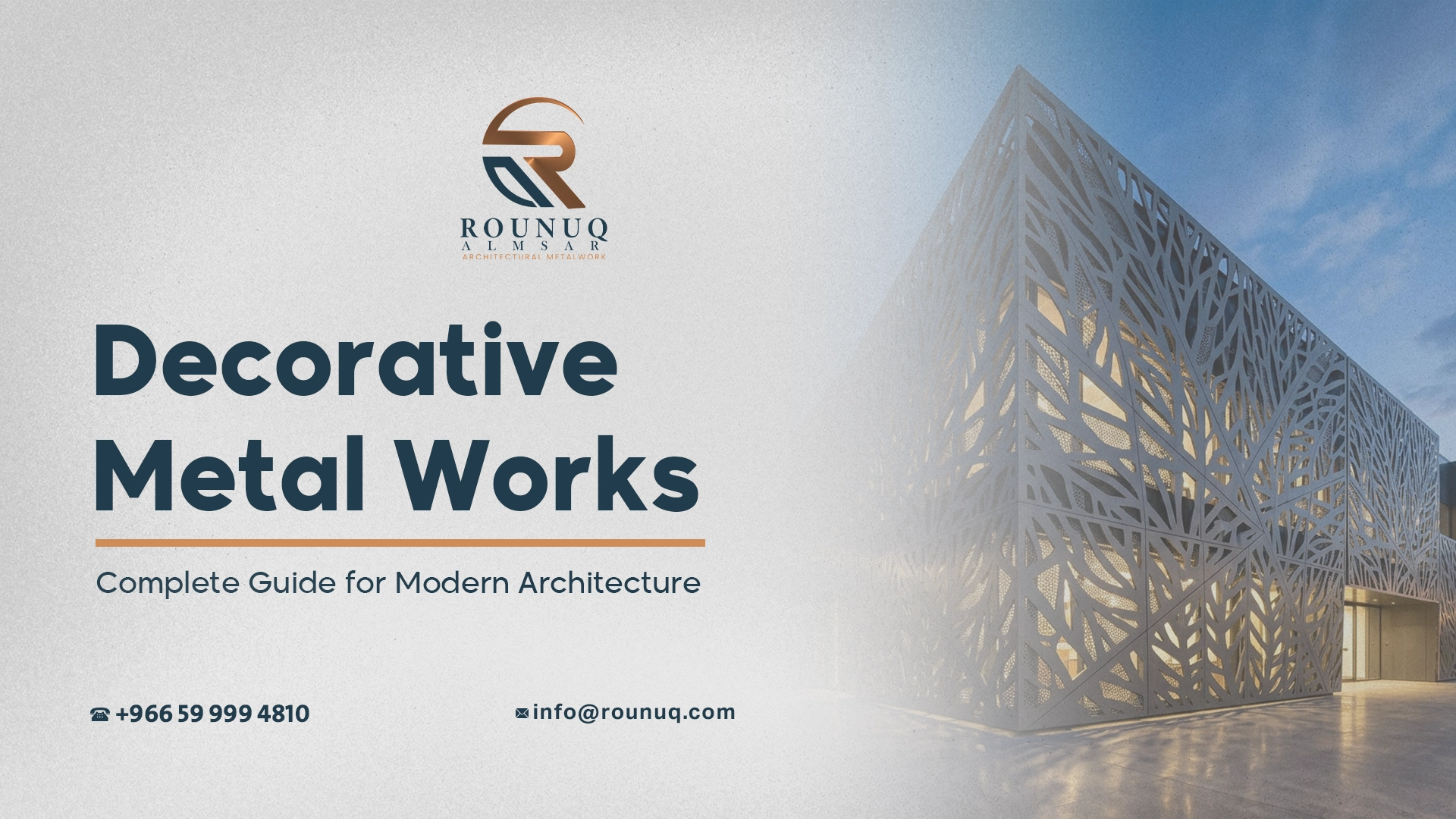
Decorative Metal Works: Complete Guide for Modern Architecture
Decorative Metal Works have become an important part of contemporary architecture, particularly in projects where appearance, durability, customization, and precise detailing need to work together.
Well-designed Decorative Metal Works can also help define the architectural identity of a project, particularly when material, finish, pattern, and detailing are developed as one coordinated system.
From luxury hotel lobbies and retail interiors to façades, feature walls, ceilings, columns, screens, entrances, and outdoor structures, metal can transform an ordinary architectural element into a distinctive design feature.
However, successful metalwork is not simply about choosing an attractive metallic color. The material, thickness, surface finish, fabrication method, fixing system, environmental exposure, maintenance requirements, and installation details all influence the final result.
For projects in Saudi Arabia, these considerations become particularly important because architectural metal elements may be exposed to heat, dust, humidity, intensive use, or coastal conditions depending on their location.
This guide explains how decorative metal works are used, which materials and finishes are available, how fabrication works, and what architects, interior designers, contractors, and project owners should consider before approving a specification.
What Are Decorative Metal Works?
Decorative metal works are architectural metal elements designed to enhance the appearance, functionality, or identity of an interior or exterior space.
They can be manufactured from stainless steel, aluminum, mild steel, copper, brass, and other suitable metals. The appropriate material depends on the application, environment, design intent, fabrication requirements, and expected maintenance.
In modern commercial and hospitality projects, Decorative Metal Works can range from relatively simple metal trims to highly customized architectural installations.
Common examples include:
- Decorative metal panels
- Stainless steel wall cladding
- Feature walls
- Decorative metal screens
- Laser-cut partitions
- Perforated panels
- Metal ceilings
- Column cladding
- Elevator cladding
- Decorative trims and skirting
- Architectural gates
- Staircases
- Handrails and balustrades
- Canopies and pergolas
- Bespoke architectural elements
- Outdoor metal features
The important distinction is that decorative metalwork is not purely about appearance. A properly designed system must also consider fabrication tolerances, substrate conditions, fixing methods, movement, corrosion exposure, cleaning, access, and installation sequence.
For architectural projects in Saudi Arabia, Rounuq Almsar provides architectural metal solutions involving materials such as stainless steel, aluminum, copper, and steel for architectural and fit-out applications.
Why Are Decorative Metal Works Important in Architecture?
Decorative Metal Works are important in contemporary architecture because they allow designers to combine visual character with practical architectural requirements.
This allows decorative metal works to serve both aesthetic and practical purposes.
1. They Create a Strong Visual Identity
A carefully selected metal finish can influence the character of an entire space.
For example:
- Mirror stainless steel creates a highly reflective appearance.
- Brushed stainless steel provides a directional architectural texture.
- PVD finishes can create gold, bronze, black, rose-gold, and other metallic appearances.
- Powder-coated aluminum allows controlled color selection.
- Laser-cut panels can incorporate patterns designed specifically for a project.
The finish should therefore be considered as part of the architectural concept rather than selected as an afterthought.
2. They Can Combine Aesthetics With Function
A decorative screen, for example, can act as a visual divider while also providing privacy.
Perforated panels and metal mesh can be used where ventilation, daylight, visual screening, or shading are required.
For projects requiring these applications, Rounuq’s facade and glazing solutions include perforated metal panels and decorative metal mesh systems.
3. They Support Bespoke Design
One of the major advantages of custom metal fabrication is the ability to coordinate dimensions, patterns, profiles, joints, and finishes with the architectural concept.
This can be especially valuable for:
- Luxury hospitality
- Retail environments
- Commercial interiors
- High-end residential projects
- Corporate spaces
- Showrooms
- Branded environments
- Feature entrances
Instead of adapting the architecture to a standard product, bespoke fabrication allows the metal element to be developed around the design.
The value of Decorative Metal Works therefore comes from the way the metal element is designed, fabricated, finished, and integrated into the surrounding architecture.
Main Materials Used in Decorative Metal Works
Choosing the right material is one of the most important decisions when developing Decorative Metal Works, because the material affects appearance, fabrication, durability, weight, maintenance, and cost.
There is no single best material for every architectural application.
The correct selection depends on the environment, appearance, weight, strength, fabrication process, corrosion exposure, budget, and maintenance requirements.
Stainless Steel
Stainless steel is one of the most widely considered materials for premium Decorative Metal Works.
It is particularly suitable when a project requires:
- Corrosion resistance
- A clean architectural appearance
- Premium surface finishes
- Durable high-contact surfaces
- Wall cladding
- Feature columns
- Ceilings
- Decorative panels
- Handrails
- Bespoke architectural details
Stainless steel’s corrosion resistance is associated with the formation of a chromium-rich passive surface film. World Stainless — corrosion properties
However, stainless steel is not completely immune to corrosion or staining. Material grade, environmental exposure, fabrication, surface finish, contaminants, and maintenance all influence performance.
For many architectural applications, grades such as 304 and 316 are considered, with the final selection depending on the environment.
Rounuq also provides guidance on stainless steel grades 304 and 316, including considerations for more demanding environments.
Aluminum
Aluminum is another practical option for Decorative Metal Works, particularly when designers want lightweight components that can be formed into different architectural profiles.
It can be considered for:
- Decorative façades
- Canopies
- Pergolas
- Ceiling systems
- Decorative screens
- Architectural panels
- Doors and windows
- Lightweight features
Rounuq’s metal ceiling systems include aluminum options as well as stainless steel and steel systems.
Aluminum also requires proper detailing. Contact with incompatible materials, construction chemicals, and unsuitable environmental conditions can affect its performance and appearance.
Mild Steel
Mild steel can be appropriate when a project requires heavier fabricated elements or structural capacity.
Typical applications include:
- Structural frames
- Gates
- Staircases
- Heavy-duty architectural elements
- Canopies
- Large fabricated structures
Because carbon steel requires appropriate corrosion protection, the coating system and environmental exposure should be considered as part of the design.
For steel structures requiring protective coating systems, ISO 12944 provides an internationally recognized framework for corrosion protection of steel structures.
Copper and Brass
Copper and brass are often selected for their distinctive appearance and ability to introduce warmer metallic tones into an architectural interior.
These materials can give Decorative Metal Works a warmer visual character than conventional stainless steel or aluminum.
They can be used for:
- Feature walls
- Decorative panels
- Luxury interiors
- Feature counters
- Bespoke details
- Decorative screens
- Architectural accents
The appearance of these materials can change over time depending on the alloy, finish, environment, and maintenance regime.
Therefore, the expected appearance at handover should be distinguished from the appearance after years of exposure.
Decorative Metal Finishes: More Than Just Color
The surface finish is one of the most important decisions when specifying decorative metal works.
Two panels manufactured from the same stainless steel grade can look completely different because of their surface treatment.
Common architectural stainless steel finishes include brushed, satin, polished, mirror, patterned, and colored finishes.
World Stainless — surface treatment and finishes provides technical information about stainless steel surface treatments and finish designations.
Mirror Finish
Mirror stainless steel has a highly reflective surface and can create a dramatic appearance.
It is often considered for:
- Luxury interiors
- Columns
- Feature walls
- Elevator interiors
- Decorative ceilings
- Retail environments
Its reflective nature can make imperfections, fingerprints, scratches, and distortion more visible.
Brushed or Hairline Finish
A brushed finish creates a directional texture across the surface.
It is often selected when the design requires a refined metal appearance without the strong reflection of mirror stainless steel.
Grain direction should be coordinated across adjacent panels. A mismatch can become particularly noticeable across large feature walls.
Satin Finish
Satin finishes provide lower reflectivity while maintaining a refined metallic appearance.
They can be useful when designers want the character of stainless steel without a highly reflective surface.
PVD Finish
Physical Vapor Deposition (PVD) is a specialized coating process used to create decorative colored finishes on suitable substrates.
Architectural PVD stainless steel can produce appearances such as:
- Gold
- Bronze
- Black
- Rose Gold
- Antique tones
Rounuq’s stainless steel and decorative cladding service includes PVD stainless steel solutions for feature walls, columns, ceilings, and other architectural applications.
PVD should not simply be treated as another type of paint. The substrate preparation, base finish, coating process, handling, fabrication, and final installation can all influence the finished appearance.
For high-visibility projects, physical samples should be approved before production.
Rounuq also provides a technical comparison of PVD and electroplated coatings, including differences in coating processes and performance considerations.
Decorative Metal Works vs. Architectural Metal Cladding
These terms overlap, but they are not always interchangeable.
Decorative metal works is a broad category that can include screens, panels, ceilings, trims, staircases, gates, handrails, ornamental components, and bespoke architectural features.
Architectural metal cladding generally refers to metal panels or sheets used to cover walls, columns, façades, ceilings, or other surfaces.
| Application | Typical Material | Common Finish | Main Purpose |
|---|---|---|---|
| Feature wall | Stainless steel / aluminum | PVD / brushed / mirror | Visual impact |
| Column cladding | Stainless steel / aluminum | PVD / hairline | Architectural enhancement |
| Decorative screen | Stainless steel / aluminum | Powder coat / PVD | Privacy and visual separation |
| Exterior façade panel | Aluminum / stainless steel | Powder coat / suitable exterior coating | Appearance and protection |
| Metal ceiling | Aluminum / stainless steel / steel | Powder coat / PVD / brushed | Architectural ceiling design |
| Handrail | Stainless steel / steel | Brushed / polished / coated | Safety and appearance |
| Pergola | Aluminum / steel | Powder coat | Shade and architectural character |
| Decorative gate | Steel / aluminum | Powder coat | Security and entrance design |
| Elevator cladding | Stainless steel | Mirror / brushed / PVD | Premium interior finish |
| Metal trim | Stainless steel / aluminum | Brushed / mirror / PVD | Detail and edge protection |
Where Are Decorative Metal Works Used?
The flexibility of custom fabrication makes these solutions suitable for many architectural environments.
Feature Walls
Metal feature walls can become focal points in:
- Hotel lobbies
- Restaurants
- Retail stores
- Corporate reception areas
- Luxury villas
- Showrooms
The design can range from simple brushed panels to patterned, perforated, laser-cut, or PVD-coated compositions.
Columns
Column cladding can turn structural elements into intentional parts of the interior design.
Stainless steel, aluminum, copper, and PVD finishes can be selected according to the project’s appearance and technical requirements.
Ceilings
Metal ceilings can introduce rhythm, texture, depth, and integrated lighting opportunities.
Rounuq’s architectural metal ceiling systems include linear aluminum tubes, steel tube ceilings, stainless steel ceilings, water-ripple stainless steel ceilings, baffle systems, acoustic systems, and bespoke designs.
Ceiling coordination should include:
- Lighting
- HVAC
- Fire protection
- Access panels
- Acoustic requirements
- Structural supports
- MEP services
- Maintenance access
Decorative Screens and Partitions
Laser-cut and perforated metal screens can divide spaces without completely closing them.
Depending on the pattern and opening ratio, they can contribute to:
- Privacy
- Air movement
- Daylight penetration
- Visual separation
- Shading
- Branding
Façades
Metal can be incorporated into façades as:
- Feature panels
- Perforated screens
- Decorative mesh
- Accent panels
- Sun-shading elements
- Architectural fins
- Canopies
For exterior applications, the environmental exposure should be considered before selecting the material grade and surface treatment.
This is especially important in coastal or chloride-rich locations. The British Stainless Steel Association’s guidance on external applications discusses the importance of selecting stainless steel grades and finishes according to environmental exposure.
Staircases and Handrails
Metal staircases can function as both circulation elements and architectural focal points.
Rounuq’s architectural metal portfolio includes luxury spiral staircase solutions, while its broader architectural services include handrails and balustrades.
Canopies and Pergolas
Aluminum and steel are commonly considered for outdoor architectural structures such as:
- Entrance canopies
- Pergolas
- Outdoor seating structures
- Walkways
- Landscape features
Exterior structures require consideration of structural design, drainage, connections, wind loads, coating performance, and maintenance in addition to appearance.
How Are Decorative Metal Works Manufactured?
A high-quality architectural metal element starts long before the material reaches the installation site.
1. Design Coordination
Early coordination is particularly important for complex Decorative Metal Works, where panel dimensions, joints, lighting, MEP services, and fixing systems must work together.
The fabricator should understand:
- Architectural drawings
- Dimensions
- Material specification
- Finish
- Joint locations
- Substrate
- Fixing method
- Lighting integration
- Site conditions
- Access requirements
For complex projects, CAD or BIM coordination can help identify clashes before production.
2. Material Selection
The material should be selected according to the intended environment and application.
An interior feature wall does not necessarily require the same specification as an exposed façade.
3. Cutting
Modern metal fabrication may involve:
- Fiber laser cutting
- CNC cutting
- Shearing
- Waterjet cutting where appropriate
Laser cutting is particularly useful for detailed decorative patterns and repeatable designs.
4. Bending and Forming
Panels and components can require CNC bending, rolling, tube processing, or other forming methods.
Bend radius and material behavior should be considered before production.
5. Welding and Assembly
Welding quality is especially important where the final surface is visible.
Poor fabrication can result in:
- Distortion
- Uneven joints
- Heat discoloration
- Visible grinding marks
- Misalignment
6. Surface Finishing
For visible Decorative Metal Works, surface consistency should be treated as a quality-control requirement rather than simply a cosmetic preference.
The component may then undergo:
- Brushing
- Polishing
- Grinding
- PVD coating
- Powder coating
- Other specified treatments
The production sequence matters. A finish that appears acceptable on a small sample may reveal inconsistencies when applied across a large installation.
7. Quality Control
Before installation, quality checks can include:
- Dimensions
- Panel alignment
- Finish consistency
- Color consistency
- Joint spacing
- Edge quality
- Weld quality
- Surface defects
- Fixing locations
8. Installation
Installation should follow approved drawings and the agreed sequence.
For large decorative metal works, site tolerances can directly affect the final visual result. Site measurements and substrate coordination should therefore be completed before final fabrication whenever practical.
7 Key Considerations Before Choosing Decorative Metal Works
1. Where Will the Metal Be Installed?
Start with the environment.
Ask whether the element is:
- Interior
- Exterior
- Coastal
- High humidity
- High traffic
- Frequently touched
- Exposed to cleaning chemicals
- Exposed to direct sunlight
The location can change the appropriate material and finish.
2. What Appearance Do You Want?
Define the visual target before choosing the finish.
Is the desired character:
- Luxury?
- Minimalist?
- Industrial?
- Traditional?
- Contemporary?
- Highly reflective?
- Subtle and matte?
- Warm and metallic?
A physical sample is often more useful than a digital rendering when approving a critical finish.
3. What Substrate Will Receive the Metal?
Cladding should not be specified independently of the surface behind it.
The team should consider whether the substrate is:
- Concrete
- Gypsum board
- Steel framing
- Aluminum framing
- Existing masonry
- Another architectural system
4. How Will It Be Fixed?
Possible fixing systems include:
- Mechanical fasteners
- Concealed clips
- Frames
- Brackets
- Adhesive systems where appropriate
- Welded assemblies
The fixing system affects appearance, access, maintenance, and installation.
5. How Will Adjacent Panels Meet?
Panel joints should be designed intentionally.
Important questions include:
- Where should joints appear?
- Should joints align with architectural grids?
- What joint width is required?
- Will grain direction continue across panels?
- How will corners be formed?
- How will movement be accommodated?
6. How Will the Surface Be Maintained?
A premium finish needs an appropriate maintenance approach.
Stainless steel, for example, still benefits from suitable cleaning and maintenance despite its inherent corrosion resistance. World Stainless — architecture and maintenance information
7. Has the Final Finish Been Approved?
Do not rely solely on a rendering.
For high-end decorative metal works, approval should ideally consider:
- Actual material
- Actual finish
- Actual thickness
- Lighting conditions
- Grain direction
- Edge details
- Joint details
Common Mistakes in Decorative Metal Projects
Many problems with Decorative Metal Works do not originate from the metal itself; they result from incomplete specifications, poor coordination, unsuitable finishes, or installation decisions made too late.
Choosing the Material Based Only on Price
A lower initial price does not necessarily mean a lower total project cost.
The comparison should consider material suitability, fabrication requirements, installation, maintenance, and expected service conditions.
Selecting the Finish From a Screen
Digital colors are not reliable substitutes for physical metal samples.
This is especially important with PVD, brushed stainless steel, polished surfaces, and metallic colors.
Ignoring Grain Direction
Brushed stainless steel can look inconsistent when adjacent panels have different grain directions.
Treating Every Stainless Steel Application the Same
Grade, finish, fabrication, environment, and cleaning all matter.
World Stainless notes that inappropriate grade selection, poor fabrication or jointing, unsuitable surface finish, and insufficient cleaning can contribute to staining.
Leaving Coordination Until Installation
If the metalwork is designed after ceilings, lighting, MEP, doors, and structural elements have already been finalized, clashes become more likely.
Designing a Decorative Screen Without Considering Function
A screen may need to provide more than decoration.
If it is intended for privacy, ventilation, daylight control, or shading, the opening pattern and panel arrangement should reflect those requirements.
How to Choose the Right Decorative Metal Works for a Saudi Project
Selecting Decorative Metal Works for a Saudi project requires consideration of both the architectural design and the conditions in which the finished installation will operate.
Saudi projects range from fully conditioned interiors to exposed outdoor architecture, so the specification should begin with the actual environment.
For a luxury interior, stainless steel with a brushed, mirror, satin, or PVD finish may be appropriate depending on the design.
For an exterior feature, the project team should consider:
- UV exposure
- Dust
- Humidity
- Temperature
- Coastal conditions where applicable
- Cleaning frequency
- Corrosion exposure
- Fixing materials
- Coating system
For Saudi projects, the specification of Decorative Metal Works should account for the actual installation environment rather than relying on a generic material specification.
For steel elements requiring protective paint systems, environmental exposure and expected durability should be considered as part of the corrosion-protection specification.
ISO 12944 corrosion protection framework provides an established framework for corrosion protection of steel structures.
For stainless steel, grade and surface finish should be considered together rather than independently.
Decorative Metal Works and Design Coordination
One of the strongest advantages of working with an experienced architectural metal fabricator is early coordination.
A typical process can be simplified into:
Design → Fabrication → Finishing → Installation
Rounuq describes its architectural metal solutions around this coordinated approach, connecting design, fabrication, finishing, and installation.
At the design stage, the team establishes the intended appearance and technical requirements.
During fabrication, the approved design becomes physical components.
During finishing, each component receives its specified surface treatment.
During installation, the components must come together accurately on site.
A problem introduced during one stage can affect every subsequent stage. For example, changing a panel dimension after PVD finishing may require additional fabrication and potentially affect finish consistency.
Early coordination is therefore generally more efficient than correcting problems after installation has started.
What Should Be Included in a Decorative Metalwork Specification?
For architects, consultants, contractors, and fit-out teams, a useful specification should identify more than simply “decorative metal.”
Where applicable, it should define:
- Base material
- Material grade
- Thickness
- Dimensions
- Finish
- Color
- Surface treatment
- Pattern
- Perforation percentage
- Edge treatment
- Joint details
- Subframe
- Fixing system
- Installation requirements
- Tolerances
- Sample approval
- Protection during construction
- Cleaning requirements
- Maintenance expectations
For example, “stainless steel decorative wall” is incomplete.
A stronger specification identifies the stainless steel grade, sheet thickness, surface finish, panel dimensions, joint arrangement, fixing system, and approved physical sample.
This level of detail reduces ambiguity between the architect, consultant, contractor, fabricator, and installer.
Why Bespoke Fabrication Matters
Standard products can work well for straightforward applications, but complex architectural concepts often require custom fabrication.
Bespoke decorative metal works allow the design team to control:
- Panel dimensions
- Pattern geometry
- Curves
- Corners
- Openings
- Joint locations
- Surface finishes
- Mounting systems
- Integration with other materials
This is particularly valuable for branded interiors and luxury environments where a standard product may not achieve the intended architectural identity.
Rounuq’s stainless steel and decorative cladding solutions include bespoke cladding, decorative screens, custom architectural elements, metal skirting and trims, and outdoor metal features.
Decorative Metal Works as a Long-Term Architectural Investment
The best architectural metalwork should not only look impressive on handover day.
It should continue to perform visually and functionally throughout the building’s service life.
That means considering:
Material + Finish + Fabrication + Installation + Maintenance
Leaving out any one of these elements can create problems.
A premium stainless steel finish can still look poor if panels have inconsistent joints or are installed with visible alignment problems.
Likewise, a beautifully fabricated exterior element can experience premature deterioration if its protective system is unsuitable for the environment.
This is why material selection and detailing should be treated as architectural and technical decisions—not merely decorative choices.
Frequently Asked Questions About Decorative Metal Works
What are Decorative Metal Works and where are they used?
Decorative Metal Works are customized or architectural metal elements used to enhance the appearance and, in some applications, the functionality of buildings and interior spaces. They can be used for walls, ceilings, façades, screens, columns, entrances, staircases, and other architectural features.
Which metal is best for decorative architectural applications?
There is no universal best material. Stainless steel is often suitable for premium interiors and applications requiring corrosion resistance, while aluminum can be advantageous where low weight and formability are important. Steel may be preferred for heavier elements, while copper and brass can provide distinctive decorative appearances.
What is PVD stainless steel?
PVD stainless steel is stainless steel treated with a Physical Vapor Deposition coating to produce a decorative colored or metallic surface. Common architectural appearances include gold, bronze, black, rose gold, and antique effects.
What types of Decorative Metal Works are commonly used in architecture?
Decorative Metal Works can include stainless steel and aluminum cladding, feature walls, decorative screens, laser-cut panels, metal ceilings, column cladding, handrails, balustrades, gates, canopies, pergolas, trims, and other bespoke architectural elements.
Are decorative metal works suitable for exterior applications?
Yes, but the material and finish must be selected according to the exposure conditions. Exterior projects may require consideration of UV exposure, humidity, dust, coastal conditions, corrosion, cleaning, and protective coatings.
What is the difference between brushed and mirror stainless steel?
Brushed stainless steel has a directional textured surface with relatively low reflectivity, while mirror stainless steel is highly polished and reflective. Brushed finishes can provide a more understated architectural appearance.
Can decorative metal panels be customized?
Yes. Custom fabrication can control dimensions, patterns, perforations, curves, finishes, joints, and fixing details. This makes metal particularly suitable for bespoke architectural concepts.
Are decorative metal screens only decorative?
No. Depending on their design, screens can also provide privacy, shading, airflow, daylight control, and visual separation. The opening pattern should therefore be selected according to both aesthetic and functional requirements.
How should a decorative metal finish be approved?
For important projects, physical samples are preferable to relying only on digital images. Approval should consider the actual material, finish, color, texture, reflectivity, grain direction, and lighting conditions.
How do I choose between stainless steel 304 and 316?
The choice depends on the environment. Grade 304 is suitable for many general architectural applications, while 316 is often considered where exposure to chlorides, salt, or more aggressive environments increases corrosion risk. See Rounuq’s guide to stainless steel 304 vs. 316 for further detail.
What should I ask a metal fabricator before starting a project?
Ask about the proposed material grade, thickness, finish, fabrication process, physical sample approval, fixing system, tolerances, installation sequence, quality control, protection during construction, and maintenance requirements.
Final Conclusion
Decorative Metal Works can transform a conventional architectural element into a distinctive design feature, but successful results depend on more than selecting an attractive metallic finish.
The right solution starts with the application and environment, followed by material selection, surface treatment, fabrication method, detailing, fixing, installation, and maintenance.
For Saudi architectural and fit-out projects, stainless steel, aluminum, steel, copper, PVD finishes, laser-cut screens, decorative panels, ceilings, cladding, and bespoke metal elements can all contribute to distinctive architectural environments when they are specified correctly.
The key is to design the metalwork as a complete system.
For projects requiring custom architectural metal solutions, Rounuq Almsar’s Stainless Steel & Decorative Cladding service provides solutions including bespoke cladding, decorative screens, PVD stainless steel, custom architectural elements, metal trims, and outdoor metal features.
When properly specified, Decorative Metal Works can bring together material performance, craftsmanship, architectural detailing, and visual identity in one coordinated solution.
You can also explore Rounuq Almsar’s architectural metal fabrication projects to review examples of its work.
If your project requires a specific material, finish, pattern, or fabrication detail, the best starting point is to provide the architectural drawings, intended application, location, approximate dimensions, and desired finish so the metalwork can be evaluated as a complete architectural system.
3 Comments
Stainless Handrails for saudi Projects: your Selection Guide
August 25, 2026
[…] wider architectural metalwork portfolio includes stainless steel cladding, staircases, canopies, facades, and other metal […]
Wave Pattern Metal Panels: Materials, Fabrication & Design
September 2, 2026
[…] Almsar’s broader architectural metalwork solutions include stainless steel, aluminum, steel, decorative cladding, screens, ceilings, and other custom […]
Custom Metal Forming in Saudi Arabia: 4 Essential Processes
September 27, 2026
[…] Feature walls and decorative panels: folded and dimensional surfaces, often combined with laser-cut patterns in our decorative metal works. […]