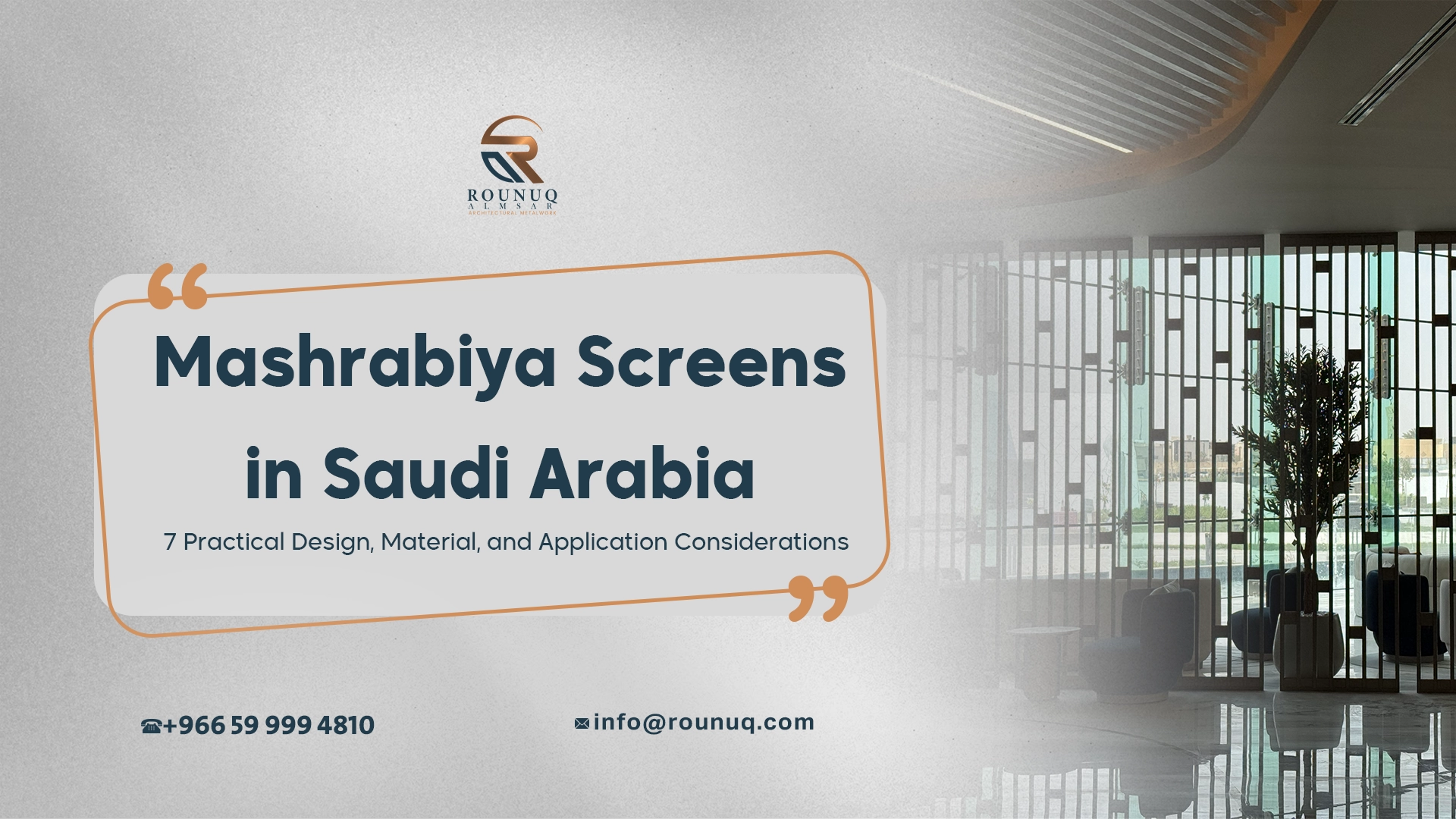
Mashrabiya Screens in Saudi Arabia: 7 Practical Design, Material, and Application Considerations
Mashrabiya screens are more than decorative patterned panels. They are architectural filters that can mediate privacy, daylight, airflow, solar exposure, and the visual relationship between a building and its surroundings. In Saudi Arabia, that combination makes the concept particularly relevant to façades, windows, balconies, courtyards, hospitality interiors, majlis spaces, and contemporary feature walls.
The important point is that a modern screen should not be selected by pattern alone. Opening size, screen density, depth, orientation, material, finish, fixing method, and the conditions behind the screen all influence how well it performs.
For an architect, designer, contractor, or property owner, the better question is not simply which pattern looks attractive. It is: what should the screen achieve, where will it be installed, and which material and geometry can deliver that result reliably?
What Are Mashrabiya Screens?
Mashrabiya screens are lattice or perforated architectural screens derived from a long tradition of Middle Eastern and Islamic architecture. Traditional examples were commonly made from timber and used around windows, projecting bays, balconies, and other openings.
Their defining idea is controlled permeability. A screen can allow daylight and air to pass while reducing direct views, glare, and exposure. Historic examples therefore combined architectural expression with practical environmental and privacy functions. Research on traditional examples in Jeddah describes components that controlled air and daylight while supporting privacy, and modern studies continue to examine mashrabiya-inspired systems as passive environmental strategies. A peer-reviewed study in Energies discusses the role of mashrabiya components in regulating daylight, airflow, and privacy in Jeddah examples. Peer-reviewed research on mashrabiya ventilation in Jeddah
The term is often used broadly today. A contemporary project may use a flat laser-cut metal panel, a three-dimensional screen, a framed perforated façade, or a responsive shading system inspired by the traditional form. These modern interpretations can preserve the underlying principle without reproducing historical construction literally.
For Saudi projects, this distinction matters. A modern architectural screen should be designed for the actual building, climate, viewing angles, maintenance requirements, and structural conditions rather than treated as a decorative copy of a traditional pattern.
Why Are Mashrabiya Screens Still Relevant in Saudi Architecture?
Saudi architecture has a strong relationship with privacy, filtered light, shade, and patterned façades. Historic Jeddah’s rawashin and mashrabiya demonstrate how openings could provide ventilation and visual privacy while responding to a demanding climate. Visit Saudi’s overview of Rawashin and Mashrabiya describes the traditional wooden screens as elements that supported ventilation and privacy in Historic Jeddah.
Modern architecture can reinterpret the same principles using contemporary fabrication. A perforated aluminum or stainless steel panel can create a secondary façade layer, screen a balcony, divide an interior, or provide a visual transition between public and private areas. In a contemporary mashrabiya facade, the screen can become a deliberate second skin rather than a decorative panel added after the façade is designed. mashrabiya facade guidance
This does not mean every patterned metal panel is automatically a mashrabiya. The strongest designs use pattern and geometry to solve a real architectural requirement.
In Saudi Arabia, the most useful requirements often include:
- Controlling direct sunlight and glare
- Increasing privacy without creating a solid wall
- Adding depth to a façade
- Creating filtered daylight
- Separating spaces while preserving visual connection
- Establishing a regional architectural identity
- Creating a decorative feature that can be fabricated consistently
- Providing a durable screen suitable for the installation environment
What Functions Can Mashrabiya Screens Provide?
A well-designed screen can perform several functions at the same time, but its effectiveness depends heavily on its geometry and location.
Privacy
Privacy is one of the clearest reasons to use a lattice screen. A dense pattern can reduce direct visibility into a room, balcony, courtyard, or outdoor seating area while still permitting some outward views.
Privacy is not determined by the pattern name alone. It changes with viewing angle, screen-to-window distance, lighting conditions, opening size, and the relative brightness of the inside and outside spaces.
For example, a pattern that feels private during the day may behave differently at night when interior lighting makes the room brighter than the exterior. Designers should therefore assess privacy under the actual expected lighting conditions.
Solar Shading
A screen can intercept part of the sun before radiation reaches glazing or an occupied space. The result depends on orientation, screen depth, openness, solar angle, and the relationship between the screen and the window.
A dense screen is not automatically better. Excessive density can reduce useful daylight and views, while a screen that is too open may provide little meaningful shading.
For façades, the screen should therefore be considered as part of the building envelope rather than as an isolated decorative layer.
Daylight Control
Mashrabiya-inspired patterns can transform direct sunlight into more diffuse, patterned light. This can reduce harsh contrast and create a changing shadow pattern throughout the day.
The desired daylight effect should be defined before selecting the pattern. A lobby feature wall may prioritize visual drama, while a bedroom or office façade may require more controlled glare and privacy.
Airflow
Traditional mashrabiya elements were associated with ventilation, but a modern fixed screen should not automatically be described as a ventilation system.
Air movement depends on the entire opening, the window configuration, pressure differences, wind conditions, and the building’s ventilation strategy. A perforated panel can remain permeable, but its actual ventilation contribution should be evaluated as part of the building design.
Architectural Identity
Pattern is often the most visible part of the system. Geometric repetition can give a façade rhythm, create depth, and establish a recognizable visual language.
The best results come when the pattern supports the scale and proportions of the building. A motif that works on a small interior partition may become visually noisy when repeated across a multi-storey façade.
Traditional vs Modern Mashrabiya Screens
Modern fabrication makes it possible to reinterpret the concept in ways that were difficult or impossible with traditional hand assembly. The key is understanding what should be preserved and what can change.
| Consideration | Traditional approach | Modern architectural approach |
|---|---|---|
| Typical material | Timber | Aluminum, stainless steel, steel, timber, or other specified materials |
| Pattern creation | Hand-crafted lattice or carving | CAD-driven CNC, laser cutting, routing, casting, or fabrication |
| Typical scale | Windows, bays, balconies | Partitions, façades, screens, ceilings, entrances, balconies |
| Main design drivers | Privacy, shade, airflow, craft | Privacy, solar control, appearance, fabrication, maintenance |
| Structural approach | Lightweight timber assemblies | Framed or engineered panel systems |
| Finish | Natural or painted timber | Powder coating, PVD, brushed, painted, anodized, or other specified finishes |
| Best design principle | Fine-grained, climate-responsive enclosure | Performance-led reinterpretation adapted to the building |
The modern version should not be judged by whether it looks exactly like a historic example. A successful contemporary interpretation retains the useful relationship between solid and void while meeting current project requirements.
Which Materials Are Best for Modern Mashrabiya Screens?
There is no single best material for every application. The right choice for Mashrabiya screens depends on whether the installation is indoors or outdoors, how large the panels are, how they will be supported, what finish is required, and how much environmental exposure they will receive.
Aluminum Screens
Aluminum is often attractive for large architectural screens because it combines relatively low weight with fabrication flexibility. It can be perforated, cut, folded, framed, and finished in different ways, making it suitable for customized Mashrabiya screens.
It can be a practical option for:
- Large façade screens
- Balcony privacy screens
- Exterior shading elements
- Interior partitions
- Ceiling features
- Lightweight decorative panels
For large exterior applications, the design still needs appropriate support, fixing, drainage, movement allowances, and finish selection.
Stainless Steel Screens
Stainless steel can be useful where the project needs a premium metallic appearance, robust surface characteristics, or decorative finishes such as brushed, hairline, mirror, or PVD.
It is particularly relevant to:
- Luxury hospitality interiors
- Feature entrances
- High-visibility partitions
- Feature walls
- Selected exterior applications
- Decorative façade accents
For exterior Mashrabiya screens, the appropriate stainless steel grade and finish should be selected according to the exposure conditions. Interior and coastal exterior environments are not equivalent.
Mild or Coated Steel
Steel can provide a strong and economical basis for certain architectural screens, particularly where the design calls for a painted or coated finish and the structure is appropriately protected.
The protection system matters. Outdoor steel screens need a coating or corrosion-protection strategy suitable for their environment, together with detailing that avoids water traps and premature coating failure.
Wood
Wood remains the material most closely associated with historic mashrabiya craftsmanship. It can provide warmth and authenticity, especially in interiors and heritage-inspired spaces.
However, exterior wood requires careful consideration of species, moisture, coatings, maintenance, detailing, and local exposure. It should not be selected simply because the traditional form was made from timber.
How Do You Choose the Right Mashrabiya Pattern?
Pattern selection should start with the intended function rather than appearance alone. When designing Mashrabiya screens, the pattern needs to balance privacy, daylight, solar control, visibility, and the overall architectural character of the building.
Ask five questions before choosing a motif:
- How much privacy is required?
- How much daylight should pass through?
- Is solar shading important?
- What viewing angles matter?
- What scale will the pattern have when fabricated?
Pattern Density
Higher visual density can improve privacy and reduce direct solar penetration, but it can also make a space darker and restrict views.
Lower density creates a lighter visual effect and allows more openness, but it may not provide enough privacy or shade. For this reason, Mashrabiya screens should be evaluated according to the actual room, façade orientation, and intended viewing conditions rather than by pattern appearance alone.
Opening Size
The size and shape of openings affect more than appearance. They influence visual permeability, shadow patterns, cleaning access, fabrication, and panel strength.
Very small openings can create more complex fabrication and cleaning requirements. Large openings can require more careful consideration of panel rigidity and support.
Pattern Scale
A pattern should be judged at its final physical size, not only on a computer screen. A motif that looks elegant in a small sample may lose its character when enlarged, while a very fine pattern may become visually heavy when repeated over a large façade.
For a project with a strong identity, it is sensible to review a physical sample or full-scale mock-up before approving production. This is especially important when Mashrabiya screens are being used across a large façade, where small changes in pattern scale can significantly affect the finished appearance.
Where Can Mashrabiya Screens Be Used?
The concept is flexible enough for both exterior and interior architecture.
Exterior Applications
Common uses include:
- Building façades
- Windows
- Balconies
- Courtyards
- Entrance screens
- Rooftop privacy elements
- Solar-control layers
- Outdoor seating areas
- Secondary façade skins
When used externally, the screen should be coordinated with the façade system, glazing, drainage, access for cleaning, wind loads, fixing points, and the expected environmental exposure.
Rounuq’s published exterior façade design guidance also identifies metal screens over glazing as a way to combine daylight, privacy, solar control, visual depth, and architectural identity.
Interior Applications
Inside buildings, screens can be used for:
- Hotel lobbies
- Restaurant partitions
- Reception areas
- Majlis spaces
- Offices
- Retail interiors
- Feature walls
- Staircase and circulation zones
- Decorative ceiling elements
Interior screens generally face fewer weather-related constraints, but high-traffic areas can place greater demands on surface durability and cleaning.
Mashrabiya Screens vs Solid Walls, Louvers, and Decorative Panels
A screen is not always the best solution. The choice depends on what the project needs.
| Solution | Privacy | Light filtering | Air permeability | Visual depth | Typical strength |
|---|---|---|---|---|---|
| Mashrabiya-inspired screen | High, depending on density | High | Moderate to high, depending on openness | High | Combined visual and environmental function |
| Solid wall | Very high | Very low | None | Moderate | Separation and enclosure |
| Fixed louvers | Moderate to high | High | High | Moderate | Directional solar control |
| Glass partition | Low to moderate unless treated | High | Low | High | Visual connection |
| Decorative perforated panel | Moderate to high | Moderate to high | Moderate | High | Pattern and separation |
This comparison highlights an important distinction: a patterned screen is most valuable when the project benefits from several functions at once. If complete acoustic separation or full enclosure is the priority, a screen may need to be combined with another system.
What Should Be Considered Before Fabricating Mashrabiya Screens?
A beautiful pattern can still become a poor architectural component if the technical details are left until the end.
Before fabrication, define:
- Overall panel dimensions
- Material and grade
- Thickness
- Pattern geometry
- Open-area ratio or visual density
- Edge conditions
- Frame or reinforcement
- Fixing method
- Support structure
- Joint locations
- Finish
- Access for cleaning
- Exposure conditions
- Lighting integration, if required
- Coordination with glazing, doors, ceilings, or adjacent finishes
For exterior applications, also consider wind loading, movement, corrosion exposure, drainage, and maintenance access. The screen should be designed as part of the complete assembly.
Rounuq’s laser cutting guide explains that material type, thickness, geometry, tolerances, finishing requirements, and later fabrication stages all influence whether a digital pattern can be successfully turned into a finished architectural component.
How Does Laser Cutting Change Modern Mashrabiya Design?
Laser cutting allows a digital pattern to be reproduced with high repeatability across multiple panels. That makes it useful for contemporary screens where consistent geometry is important.
The process can support laser-cut metal screens with:
- Complex geometric patterns
- Repeated façade modules
- Custom branding or abstract motifs
- Perforated feature walls
- Backlit screens
- Interior partitions
- Large decorative panels
However, not every digital pattern is fabrication-friendly. Extremely small bridges, sharp internal corners, excessive detail, unsuitable spacing, or an inappropriate material thickness can create problems during cutting, finishing, handling, or installation.
A practical workflow is to develop the design in CAD, review the geometry against the selected material and thickness, produce a sample when appearance is critical, and then coordinate the final panel system with its frame and fixing details.
How Much Do Mashrabiya Screens Cost?
There is no reliable universal price per square meter because a screen is a fabricated architectural system rather than a commodity panel.
The final cost can be affected by:
- Material and grade
- Panel thickness
- Screen dimensions
- Pattern complexity
- Open-area ratio
- Quantity
- Cutting method
- Bending or forming
- Frames and reinforcement
- Surface finish
- PVD or special coating
- Backlighting
- Substructure
- Installation height
- Site access
- Transportation
- Required mock-ups
- Project location
A simple interior divider and a large external façade screen may share the same pattern but have completely different engineering and installation requirements.
For that reason, the most useful quotation compares the complete specified system rather than only the visible panel area.
Common Mistakes When Specifying Mashrabiya Screens
Choosing the Pattern Before Defining the Function
Starting with aesthetics can lead to a screen that looks attractive but provides the wrong amount of privacy, shade, or daylight.
Define the required performance first, then select the geometry.
Using the Same Density Everywhere
A façade does not necessarily need one uniform opening ratio. Different orientations, room functions, and privacy requirements may justify different screen densities.
Treating a Screen as a Standalone Product
Exterior screens interact with glazing, structure, drainage, cleaning access, and building movement. Leaving these relationships until installation can create expensive revisions.
Selecting a Material Only by Appearance
Two materials can produce a similar visual effect but behave differently in weight, corrosion resistance, fabrication, finish, and maintenance.
Skipping Physical Samples
Metallic finishes and patterned shadows can look very different under actual project lighting. A physical sample is especially valuable when the screen is a prominent architectural feature.
Ignoring Maintenance
A dense screen can collect dust, especially in exposed environments. Cleaning access and the chosen finish should therefore be considered during design rather than after installation.
How to Specify Mashrabiya Screens for a Saudi Project
For a Saudi project, a practical specification should connect design intent with environmental exposure.
Start by documenting:
- Project location and exposure
- Interior or exterior application
- Required privacy level
- Solar-control objective
- Desired daylight effect
- Material preference
- Finish and color
- Panel dimensions
- Pattern and density
- Support and fixing concept
- Cleaning and maintenance access
- Mock-up or sample requirements
Coastal locations may require more careful consideration of corrosion exposure than protected inland interiors. At the same time, intense sun, dust, and frequent cleaning can influence finish selection and maintenance planning across many Saudi environments.
For architects and contractors, this specification approach also makes quotations easier to compare because each supplier is responding to the same technical brief.
Frequently Asked Questions About Mashrabiya Screens
What are mashrabiya screens used for?
They are used to filter light, improve privacy, create shade, add visual depth, separate spaces, and express architectural identity. Depending on the design, they can also support airflow and passive environmental strategies.
Are modern mashrabiya screens only made from wood?
No. Modern interpretations can use aluminum, stainless steel, coated steel, timber, and other materials. The material should be selected according to the application, environment, finish, weight, and fabrication requirements.
Are mashrabiya screens suitable for exterior façades?
Yes, when they are properly designed for the environment and integrated with the façade system. Exterior applications require attention to structural support, wind exposure, corrosion protection, movement, drainage, cleaning, and access.
Do mashrabiya screens reduce heat?
A screen can reduce direct solar exposure reaching a window or occupied space, but the actual thermal benefit depends on orientation, geometry, openness, depth, glazing, and the overall building-envelope design. It should not be treated as a guaranteed percentage reduction without project-specific analysis.
What is the best material for mashrabiya screens in Saudi Arabia?
There is no universal best material. Aluminum can be useful where low weight and large panels matter; stainless steel can suit premium finishes and selected exposed applications; protected steel and timber can also be appropriate when their environmental and maintenance requirements are addressed.
Can mashrabiya screens be customized?
Yes. Contemporary fabrication can produce custom geometric patterns, dimensions, densities, frames, finishes, and panel configurations. The design should still be checked for manufacturability before production.
Are mashrabiya screens suitable for interior partitions?
Yes. They can divide lobbies, restaurants, offices, majlis areas, retail spaces, and other interiors while preserving a visual connection and allowing filtered light.
How should I choose the screen pattern?
Start with the required privacy, daylight, solar-control, viewing, and maintenance performance. Then evaluate pattern density, opening size, scale, material, and finish together.
Conclusion: Design the Screen Around the Building
The strongest modern interpretation of a mashrabiya is not simply a traditional pattern reproduced in a new material. It is a screen designed around a real architectural requirement.
Privacy, solar control, filtered daylight, airflow, visual depth, cultural identity, fabrication, and maintenance can all influence the final solution. The right balance depends on where the screen sits, what is behind it, how it will be viewed, and how it will perform over time.
For Saudi projects, material and detailing deserve particular attention because exterior screens may face intense sunlight, dust, wind, and, in coastal areas, more demanding corrosion conditions.
If you are developing a project that requires a custom architectural screen, Rounuq Al Msar works with stainless steel, aluminum, and copper for decorative metal screens used in applications such as partitions, feature walls, ceilings, and façade accents. You can explore its stainless steel and decorative cladding solutions or contact the Rounuq Al Msar team with the project location, approximate dimensions, intended application, material preference, and design reference.