Laser Cutting: Complete Guide to Process, Materials & Applications
Laser-cut metal has become a familiar part of hotel lobbies, villa entrances and commercial facades across the Kingdom: a geometric screen, a perforated ceiling, a signage wall, a gate with a pattern that would have been impossible to make by hand. Laser cutting has made complex metal patterns affordable, and designers have noticed.
What gets less attention is the step between the drawing and the finished panel. Pattern details that look fine on screen can be too fine to cut cleanly, too weak to survive handling, or too open to perform as a shade screen. Material and finish choices made late can add cost or damage the surface.
This guide is for architects, interior designers, landscape designers and contractors preparing laser-cut metalwork for Saudi projects. It explains how the process works, what it can and can’t do, how to design patterns that cut well, and how to brief a fabricator so the panels match the renderings. At Rounuq Almsar, laser cutting is one of the core processes in our Riyadh facility, alongside CNC bending, rolling, welding and PVD finishing, so the advice here follows the questions that come up once drawings reach the workshop.
What Is Laser Cutting?
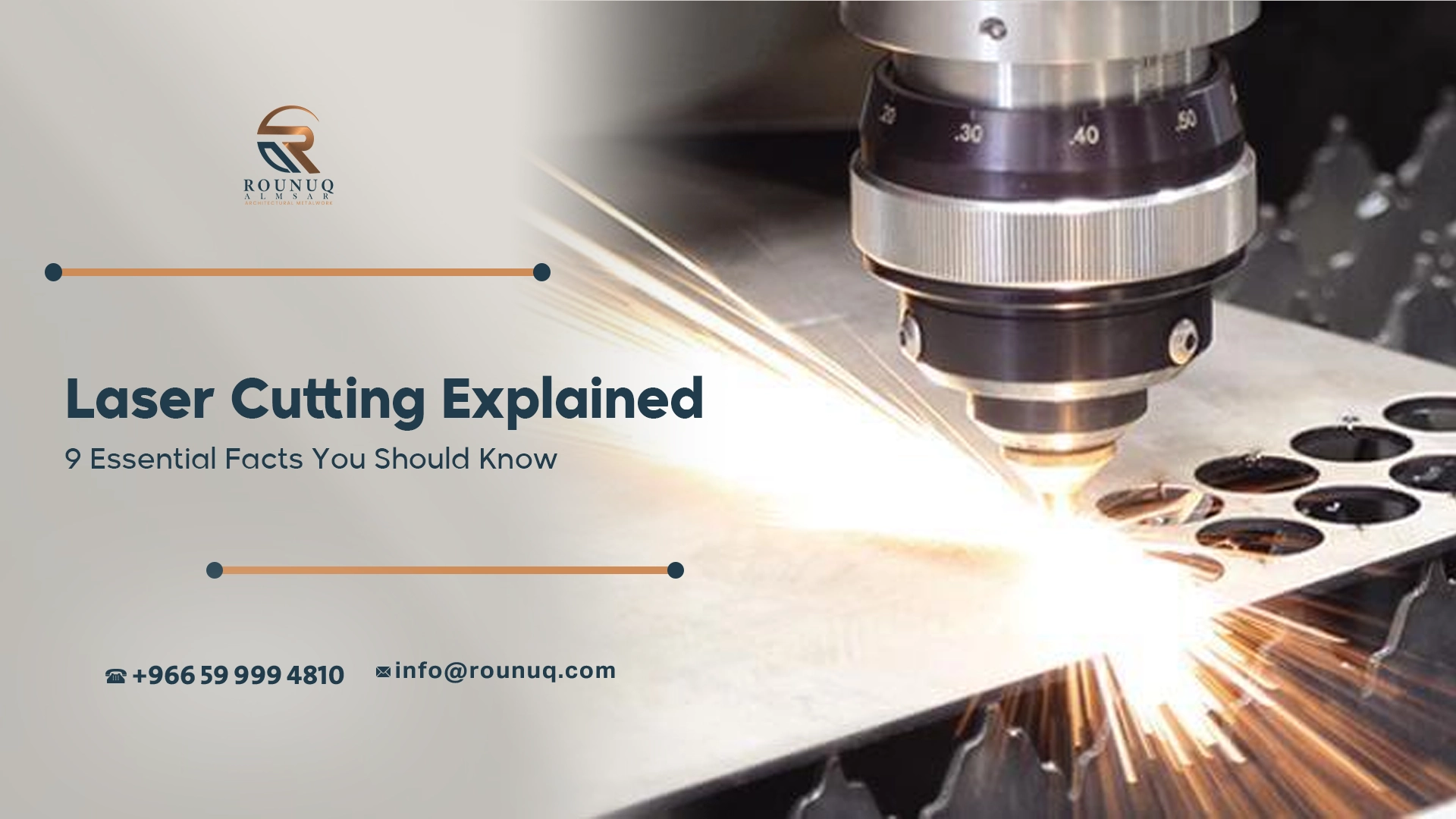
Laser cutting is a thermal cutting process that uses a focused, high-power laser beam, guided by CNC, to melt or vaporise metal along a programmed path. A jet of assist gas blows the molten material out of the cut, leaving a narrow, clean edge.
For architectural work, that means one thing above all: any shape you can draw as a closed line can be cut, with no tooling and no minimum order. The TWI guide to laser cutting notes that kerf widths, the width of material removed by the beam, can be as small as about 0.1 mm depending on thickness, which is why fine detail is possible.
Fiber vs CO2 Lasers
Most metal cutting today is done on fiber lasers. CO2 lasers dominated the industry for years and are still used, especially for non-metals, but fiber sources cut thin and medium sheet faster and cost less to run. TWI’s overview of laser cutting technology makes a point worth remembering: fiber edge quality on thin sheet is excellent, but it degrades as thickness increases. Thick plate usually shows more visible striations on the cut edge.
You don’t need to specify the laser type. You do need to specify the edge quality you expect on visible edges.
What Laser Cutting Is Used For in Saudi Projects
The process shows up across almost every architectural metal package:
- Facade screens and shading panels. Patterned panels in front of glazing cut solar gain while giving a building its identity. Geometric patterns inspired by traditional mashrabiya are especially popular here.
- Privacy screens. Courtyard walls, villa boundaries, balcony screens and rooftop enclosures.
- Interior feature walls and partitions. Lobbies, majlis areas, restaurants and retail.
- Ceilings. Perforated or patterned ceiling panels, often with acoustic backing.
- Gates and doors. Decorative infill panels for entrance gates and pedestrian doors.
- Signage and wayfinding. Cut lettering, logos, monument signs and backlit panels.
- Cladding components. Panel blanks, brackets and trims before folding.
- Stair and balustrade infill. Decorative panels between posts and stair side fascias.
If a panel’s pattern is regular and simple, standard perforated sheet may be cheaper. Our guide to perforated metal panels explains when a punched perforation pattern makes more sense than a laser-cut one.
Laser Cutting vs Other Cutting Methods
Laser isn’t the only way to cut patterns in metal. Here’s how it compares with the usual alternatives for architectural work.
| Method | Best for | Edge quality | Fine detail | Heat effect | Practical notes |
|---|---|---|---|---|---|
| Fiber laser cutting | Thin to medium sheet, complex patterns | Clean, narrow kerf | Excellent | Small heat-affected zone | Most flexible for bespoke designs |
| CNC punching / perforating | Repeating hole patterns in large runs | Clean, slight burr | Limited to tool shapes | None | Often cheaper for regular patterns |
| Waterjet cutting | Thick plate, heat-sensitive materials, stone and glass | Smooth, slight taper | Good | None | Slower and usually more expensive |
| Plasma cutting | Thicker structural plate | Rougher, wider kerf | Poor | Larger heat effect | Suits structural parts, not decorative faces |
| CNC routing | Aluminum composite panels, soft metals | Good | Limited by bit size | Minimal | Common for ACP facade panels |
For most decorative metal in stainless steel, aluminum, mild steel or corten in thin to medium thicknesses, laser cutting is the default choice.
Materials and What to Expect From Each
Stainless Steel
Stainless is the most common material for interior screens, cladding and signage. It cuts cleanly, and with nitrogen assist gas the edge stays bright rather than oxidised. Sheets are usually cut with the protective film still on the face, which keeps polished and PVD-coated surfaces clean during handling.
For finished panels, laser-cut stainless often becomes part of a wider cladding package. Our guide to stainless steel cladding covers grades and finishes in more detail.
Aluminum
Aluminum is lighter and widely used on facades. It’s more reflective and conducts heat faster than steel, so very fine details can be harder to hold at the same thickness. Laser-cut aluminum facade panels usually sit within a larger facade and glazing system, and they’re typically powder-coated or anodised after cutting.
Mild Steel
Mild steel is economical for gates, fences and structural brackets. It needs a protective finish after cutting, usually galvanising, powder coating or both for exterior work.
Corten Steel
Corten laser-cut screens are popular in landscape and villa projects. The cutting itself is straightforward, but corten’s suitability depends heavily on the site. Our article on corten steel in Saudi Arabia explains where it performs well and where it causes staining or corrosion problems.
Copper and Brass
Both cut well on modern fiber lasers and make striking feature panels. They’re softer and mark easily, so handling after cutting needs care.
Designing Patterns That Cut Well
Most problems with laser-cut panels start in the design file, not on the machine. A few rules prevent the majority of them.
Minimum Hole and Slot Size
Every internal cut starts with a pierce, and very small holes relative to the sheet thickness don’t cut cleanly. Published fabricator guidance varies, from about half the material thickness to one and a half times it. For architectural panels that need a clean, consistent look, a hole or slot at least as wide as the sheet thickness is a sensible starting point. On 3 mm aluminum, that means nothing narrower than about 3 mm.
Bridge Width Between Openings
The metal left between two openings, often called a bridge or web, holds the panel together. Bridges that are too thin will distort from heat during cutting, bend during handling or snap during installation. As a starting point, keep bridges at least equal to the sheet thickness, and wider on large panels or exterior screens that take wind load.
Floating Islands
Any shape completely surrounded by a cut will fall out. The centre of an “O”, the inside of a star within a circle, or the middle of a closed geometric motif will all drop through the sheet unless they’re connected by a bridge.
This matters a lot with Arabic lettering. Arabic script includes many dots and enclosed counters, and every one of them becomes a loose piece if the lettering is cut straight through. The usual solutions are adding small bridges in a stencil style, cutting the letters as raised pieces fixed to a backing panel, or mounting the cut sheet over a contrasting back plate so the dots are fixed separately.
Open Area
Open area is the percentage of the panel that’s removed. It controls how much light, air and view passes through, and how much shade and privacy the panel gives. For facade shading, it’s a performance decision, not just a visual one. A pattern that looks right at 1:50 may let far too much sun through at full size.
Distance From Edges and Fixings
Keep openings away from panel edges, folds and fixing points. Openings too close to a fold can distort it, and openings too close to a fixing weaken the connection.
Preparing Files for a Laser Cutting Fabricator
A clean file saves days of back-and-forth. Before sending drawings:
- Supply vector files. DXF or DWG, drawn at 1:1 scale in millimetres.
- Close every path. Open lines can’t be cut. Gaps as small as a fraction of a millimetre cause problems.
- Remove duplicate and overlapping lines. The machine will cut the same line twice, which burns the edge.
- Convert text to outlines. Fonts won’t transfer reliably between software.
- Separate layers. Put cut lines, fold lines, engraving and reference geometry on different layers.
- Mark the visible face. State which side of the sheet will be seen, especially for brushed or PVD finishes.
- Give panel sizes that suit standard sheets. Very large panels may need joints, so plan joint positions in the design rather than letting the fabricator decide.
Edge Quality, Tolerances and Standards
Laser-cut edges on thin sheet are usually clean enough to leave as they are. On thicker material or exterior panels, you may want light deburring, and for painted or powder-coated parts the edge preparation affects how well the coating holds at the edge.
If edge quality or dimensional accuracy matters contractually, reference a standard rather than writing “clean edge.” ISO 9013 classifies thermal cuts, including laser cuts, by quality and tolerance, and it can be cited on drawings or in the specification.
Finishing After Laser Cutting
The finish decision affects the cutting sequence.
Pre-finished sheet. Stainless can be polished, brushed or PVD-coated before cutting and protected by film. This works well for flat panels and large sizes.
Finish after cutting. Powder coating, galvanising, anodising and some PVD work happen after cutting and forming. This gives coating coverage on the cut edges, which matters for exterior mild steel and aluminum.
For premium interior stainless, the sequence is usually cut, fold, then final finish or touch-up. Our guide to vibration finish with PVD coating shows how that finishing stage is handled.
Folded laser-cut panels are common too. When the design calls for sharp returns on the panel edges, V grooving before folding produces a crisper corner than standard bending.
Saudi-Specific Considerations
Sun and shading. Many laser-cut facade screens in the Kingdom exist to control solar gain. Pattern, open area and orientation should be reviewed together, ideally with the facade consultant, rather than chosen purely for looks.
Dust and cleaning. Fine patterns and small openings collect sand and dust, and exterior screens get dusty quickly after sandstorms. Consider how panels will be cleaned, and avoid very small openings where access is difficult.
Exterior durability. Material and finish should match the site. Coastal projects need more corrosion-resistant choices than inland ones, and bare mild steel should never be used outdoors without a protective system.
Privacy. Villa and residential screens often need to block direct views while still letting air through. Smaller openings, angled viewing positions and layered screens all help, and a physical sample viewed on site is the best way to confirm it works.
Integration with structures. Laser-cut panels often form the infill of pergolas, canopies and shade structures. Our overviews of architectural canopies and steel pergolas and architectural structures cover how those frames and panels are designed together.
What Affects Laser Cutting Cost
Laser cutting is priced mostly on machine time and material. The main drivers are:
- Total cut length. Intricate patterns with thousands of small openings take much longer than simple shapes.
- Number of pierces. Every internal opening needs a pierce, and pierces add time.
- Material and thickness. Thicker sheet cuts slower, and some materials cost far more per sheet.
- Nesting efficiency. Panel sizes that fit standard sheets well waste less material.
- Secondary work. Folding, welding, finishing, packing and installation often cost more than the cutting itself.
A practical way to control cost is to simplify patterns where they won’t be seen up close, keep bridges and openings at sensible sizes, and design panel sizes around standard sheets.
How to Brief a Laser Cutting Fabricator
A complete enquiry includes vector files, material and grade, thickness, finish, quantities, visible face, and whether the panels are interior or exterior. Say whether folding, framing or installation is needed. Ask for a sample panel or a cut section of the pattern in the chosen material and finish before full production. For screens and facades, that sample tells you more than any rendering about how light, privacy and edge quality will actually look.
Frequently Asked Questions
What materials can be laser cut?
Stainless steel, aluminum, mild steel, corten, copper and brass are all commonly laser cut for architectural work. Non-metals such as acrylic and wood are usually cut on different machines.
How thick can laser cutting go?
It depends on the machine’s power and the material. For decorative architectural panels, most work falls in thin to medium sheet, where edge quality is best. Thicker plate can be laser cut, but edges become rougher as thickness increases.
What file format do I need?
DXF or DWG vector files at 1:1 scale are standard. PDFs and images usually need redrawing before they can be cut.
What is the smallest hole that can be laser cut?
It depends on the thickness. As a practical starting point for architectural panels, keep holes and slots at least as wide as the sheet is thick.
Can Arabic calligraphy be laser cut?
Yes, but the dots and enclosed shapes in Arabic letters need bridges, a backing plate or raised-letter construction, otherwise they fall out of the sheet.
Is laser cutting better than perforated sheet?
Not always. For simple repeating holes over large areas, standard perforated sheet can be cheaper. Laser cutting wins when the pattern is custom, irregular or changes across the panel.
Does laser cutting damage the finish on stainless steel?
Not when the sheet is cut with its protective film on and handled properly. The cut edge itself is affected by heat, which is why nitrogen-assisted cutting is used for bright edges.
Can laser-cut panels be used outdoors in Saudi Arabia?
Yes, provided the material and finish suit the site. Stainless steel, powder-coated aluminum and galvanised or coated steel are common choices, and coastal sites need more corrosion-resistant options.
Final Thoughts
Laser cutting gives designers almost unlimited freedom, but the best results come from designing with the process in mind. Sensible hole and bridge sizes, clean files, the right material for the site and a physical sample before production are what separate a panel that looks like the render from one that doesn’t.
If you’re planning laser-cut screens, facade panels, ceilings, gates or signage, send your drawings, material and finish requirements to the Rounuq Almsar team. We’ll review the pattern for cutting and performance, suggest adjustments where they help, and give you a fabrication quote based on your actual design.
6 Comments
Wave Pattern Metal Panels: Materials, Fabrication & Design
September 2, 2026
[…] published fabrication capabilities include processes such as laser cutting and CNC-based architectural metal fabrication, which can be relevant when wave pattern metal panels are combined with cut patterns, screens, or […]
Metal Room Dividers: How to Choose the Right Design
September 6, 2026
[…] visual privacy: Dense laser-cut patterns, overlapping elements, or more solid panels can create stronger […]
Mashrabiya Screens: 7 Essential Tips for Better Design
September 7, 2026
[…] laser cutting guide explains that material type, thickness, geometry, tolerances, finishing requirements, and later […]
Custom Metal Forming: 9 Key Processes & Expert Tips
September 7, 2026
[…] final design may combine forming with laser-cut patterns or concealed […]
Ceiling Baffle Systems in Saudi Arabia: A Complete Guide
September 27, 2026
[…] before production. Where the design includes detailed patterns or openings, Rounuq’s laser cutting process guide can help the project team understand the fabrication stage. Dimensions, module spacing, fixing […]
What Are Bespoke Structures? A Guide for Saudi Projects
October 12, 2026
[…] cutting for plates, gussets and decorative panels. Our guide to laser cutting for architectural metalwork explains how cut patterns and panels are […]