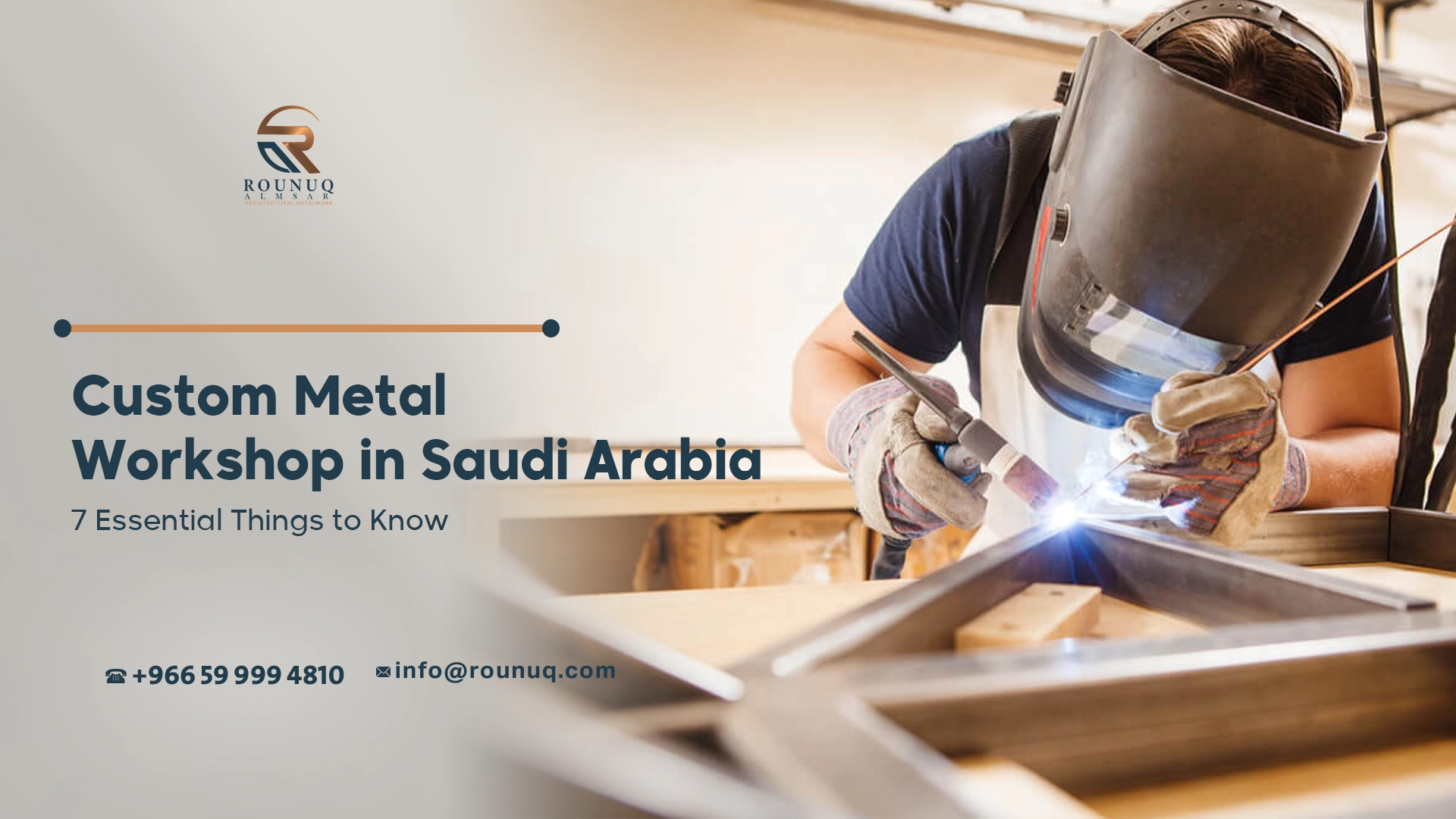
Custom Metal Workshop in Saudi Arabia: 7 Essential Things to Know
When an architectural project requires a metal element that cannot simply be purchased off the shelf, choosing the right custom metal workshop becomes an important project decision.
A custom fabrication partner may be responsible for much more than cutting and welding. Depending on the project, the scope can include design coordination, material selection, laser cutting, CNC bending, welding, surface preparation, decorative finishing, assembly, quality checks, delivery, and installation.
For architects, interior designers, contractors, developers, and fit-out companies in Saudi Arabia, the difference between a basic metal fabricator and a capable custom metal workshop can directly affect the appearance, coordination, durability, and installation of the finished work.
A good custom metal workshop should therefore be evaluated according to its ability to understand the design intent, select appropriate materials and finishes, manufacture accurately, and coordinate the final installation.
Rounuq Al Msar operates from Riyadh and describes its work as architectural and decorative metal solutions for fit-out projects, covering design coordination, fabrication, finishing, and installation. Its stated capabilities include stainless steel, aluminum, steel applications, PVD finishes, and bespoke architectural elements.
What Is a Custom Metal Workshop?
A custom metal workshop is a fabrication facility that produces metal components according to project-specific drawings, dimensions, specifications, patterns, or architectural requirements rather than relying exclusively on standardized products.
The important distinction is customization.
A standard metal product may have predetermined dimensions, profiles, finishes, and connection details. Custom fabrication allows those characteristics to be developed around the actual project.
For example, a project may require:
- A curved stainless steel feature wall.
- A decorative laser-cut partition.
- A bespoke metal ceiling.
- A custom staircase.
- A stainless steel reception counter.
- Architectural columns with PVD finishing.
- A special canopy or pergola.
- Custom handrails and balustrades.
- Decorative façade screens.
- Metal panels with specific perforation patterns.
- Bespoke gates, fences, or architectural details.
In these cases, the workshop needs to translate architectural intent into a manufacturable product.
That means the quality of the result depends not only on the raw material but also on detailing, fabrication methods, tolerances, finishing, assembly, and installation.
Why Custom Metal Fabrication Matters in Architecture
Architectural metalwork is different from ordinary industrial fabrication because the finished product is often highly visible.
A weld, joint, edge, bend, panel alignment, or surface inconsistency that might be acceptable in a hidden structural application can become very noticeable in a luxury interior.
A professional custom metal workshop therefore needs to consider both engineering requirements and visual quality.
For example, a decorative stainless steel wall may need to maintain consistent grain direction across several panels. A PVD feature may require careful handling to avoid visible scratches. A laser-cut screen needs accurate alignment between individual panels. A custom ceiling must coordinate with lighting, HVAC, access panels, and other building services.
The fabrication process is consequently part of the architectural design process, not merely the final manufacturing step.
What Services Should a Custom Metal Workshop Provide?
The exact scope differs between fabricators, but a strong architectural metal fabrication workflow commonly includes several interconnected stages.
Design Coordination
Before manufacturing begins, drawings and specifications need to be reviewed for practical fabrication requirements.
This can involve:
- Dimensions and tolerances.
- Material thickness.
- Joint locations.
- Fixing methods.
- Bends and radii.
- Access requirements.
- Panel divisions.
- Interfaces with other materials.
- Installation sequence.
- Finish requirements.
Design coordination can identify problems before material is cut.
This is particularly important for bespoke architectural work because a visually attractive concept may require modification to become practical to manufacture, transport, assemble, and install.
Material Selection
The right metal depends on the application.
Common materials used in architectural fabrication include:
| Material | Common Architectural Uses | Typical Considerations |
| Stainless steel | Cladding, feature walls, handrails, counters, decorative elements | Corrosion resistance, finish, appearance, maintenance |
| Aluminum | Ceilings, screens, façades, canopies, panels | Low weight, corrosion resistance, finish options |
| Mild steel | Structures, frames, gates, staircases, canopies | Strength, coating, corrosion protection |
| Copper | Decorative panels, feature elements, cladding | Appearance, patina, cost, detailing |
| Steel + other finishes | Structures and architectural details | Protection, finish compatibility, exposure |
Stainless steel specifications should not be selected simply because a project description says “stainless steel.”
The appropriate grade and product specification depend on the environment and application. ASTM A240/A240M, for example, covers chromium and chromium-nickel stainless steel plate, sheet, and strip for general applications including architectural, building, construction, and aesthetic applications.
For a custom metal workshop, material selection should therefore start with the project’s actual requirements rather than simply choosing the most familiar material.
Stainless Steel Fabrication and Architectural Finishes
Stainless steel is especially useful in architectural applications because it combines a metallic appearance with corrosion resistance and a wide range of possible surface finishes.
However, “stainless steel” does not describe the final appearance by itself.
The surface can be specified in different ways, including:
- Brushed finishes.
- Satin finishes.
- Mirror finishes.
- Hairline finishes.
- Textured finishes.
- Vibration finishes.
- Colored finishes.
- PVD finishes.
World Stainless identifies several established stainless steel surface finishes, including brushed/polished No. 4, satin No. 6, and bright polished No. 8 finishes.
This is one reason a capable custom metal workshop should discuss the finish during the early design stage.
A finish affects not only appearance but also how fingerprints, scratches, reflections, joints, and fabrication marks are perceived.
For large visible surfaces, specifying the finish after fabrication can be too late.
PVD Stainless Steel
PVD, or Physical Vapor Deposition, is a method of coloring stainless steel that can produce a wide range of architectural finishes and metallic appearances.
Architectural applications can include:
- Gold.
- Bronze.
- Black.
- Champagne.
- Rose gold.
- Aged metallic appearances.
Rounuq currently offers PVD-coated stainless steel as part of its architectural cladding work, including feature walls, columns, and ceiling elements.
The key consideration is that the finish should be selected according to the project’s visual requirements and expected exposure rather than simply choosing a color from a sample.
A custom metal workshop should also establish how samples, production pieces, edges, joints, and replacement panels will be handled so the finished installation remains visually consistent.
Aluminum Fabrication for Architectural Projects
Aluminum is another important material for custom architectural fabrication.
Its relatively low weight can make it useful for applications such as:
- Decorative screens.
- Ceiling systems.
- Canopies.
- Façade elements.
- Architectural panels.
- Pergolas.
- Lightweight decorative structures.
Rounuq’s architectural metal ceiling service, for example, describes custom systems using aluminum, stainless steel, and steel, with fabrication processes including CNC tube processing, fiber laser cutting, CNC bending, V-grooving, welding, assembly, and surface finishing.
For a custom metal workshop, aluminum fabrication also requires appropriate consideration of profiles, thickness, connections, finishing, movement, and the intended environment.
The material should be selected because it solves a project requirement—not simply because it is lightweight.
How Does a Custom Metal Workshop Turn a Design Into a Finished Product?
A professional custom metal workshop usually follows a controlled sequence from design review to final installation. Each stage has a specific purpose, helping ensure that the finished metalwork meets the project’s design, technical, and installation requirements.
Design Review
The custom metal workshop receives architectural drawings, shop drawings, sketches, models, specifications, or other project information.
The team reviews the design and identifies fabrication requirements, potential coordination issues, material requirements, and installation considerations before production begins.
Engineering and Detailing
The concept is translated into manufacturable details.
This can include:
- Panel dimensions.
- Bends.
- Profiles.
- Connection details.
- Reinforcement.
- Fixings.
- Mounting systems.
- Joint locations.
Good detailing helps bridge the gap between architectural intent and practical fabrication.
Material Preparation
Sheets, tubes, profiles, plates, or other materials are prepared according to the approved specifications.
Material preparation should account for the required thickness, grade, dimensions, quantity, and final application.
Cutting
Depending on the design, cutting may involve:
- Fiber laser cutting.
- CNC cutting.
- Saw cutting.
- Waterjet cutting.
- Other suitable fabrication methods.
Laser cutting is particularly useful when the project includes precise decorative patterns, perforations, or complex geometries.
For a custom metal workshop, accurate cutting is especially important when several panels need to align across a larger architectural installation.
Forming and Bending
CNC bending and other forming techniques are used to create the required geometry.
Accurate forming is particularly important when multiple panels, profiles, or sections must meet or align consistently.
Welding and Assembly
Components are joined and assembled according to the approved fabrication details.
For visible architectural work, weld preparation and post-weld finishing can have a major effect on the final appearance.
The custom metal workshop should also consider how individual components will be assembled and installed on site, particularly for large or complex architectural elements.
Surface Finishing
The component may then receive:
- Grinding.
- Brushing.
- Polishing.
- Powder coating.
- PVD.
- Other specified surface treatments.
The selected finish should match the project’s visual requirements, material specification, exposure conditions, and maintenance expectations.
Inspection
Dimensions, finish, alignment, assembly, and other project-specific requirements should be checked before delivery.
Inspection is particularly important for bespoke architectural metalwork because small dimensional or finishing inconsistencies can become highly visible after installation.
Installation
The final stage connects fabrication with the building.
Installation needs to account for site conditions, interfaces, fixing systems, tolerances, protection, and sequencing.
A custom metal workshop that can manage these stages as one coordinated workflow can reduce the risk of inconsistencies between design, manufacturing, finishing, and installation.
Custom Metal Workshop vs Standard Metal Fabricator
Not every metal fabricator offers the same level of customization.
| Factor | Standard Fabrication | Custom Architectural Fabrication |
| Product approach | Standard or semi-standard | Project-specific |
| Design coordination | Limited | Important part of workflow |
| Complex geometry | May be limited | Usually a core capability |
| Decorative finishes | Basic options | Wider finish selection |
| Laser-cut patterns | May be available | Commonly integrated |
| CNC forming | Depends on workshop | Often important |
| Architectural detailing | Limited to moderate | High importance |
| Installation coordination | May be separate | Often integrated |
| Bespoke cladding | Limited | Common |
| Project documentation | Varies | Usually more detailed |
This does not mean a standard fabricator is unsuitable for every project.
A straightforward steel frame may not require a highly specialized architectural fabrication partner.
The question is whether the project’s requirements match the workshop’s capabilities.
What Architectural Products Can Be Custom Fabricated?
A versatile custom metal workshop can support many different architectural applications.
Decorative Metal Screens
Laser-cut or perforated screens can create privacy, shading, visual separation, ventilation, or decorative identity.
Rounuq describes custom laser-cut screens in stainless steel, aluminum, and copper for feature walls, partitions, ceiling elements, and façade accents.
Metal Cladding
Custom cladding can be used on:
- Feature walls.
- Columns.
- Ceilings.
- Reception counters.
- Elevator interiors.
- Architectural details.
- Selected façade elements.
The construction should be designed around panel size, substrate, fixing, joints, access, movement, and environmental conditions rather than treating cladding as a simple sheet-metal covering.
Metal Ceilings
Custom metal ceilings can use linear tubes, panels, perforated elements, geometric patterns, and mixed-material systems.
The ceiling also needs to coordinate with lighting, HVAC, access, acoustics, and other services.
Staircases and Handrails
Custom staircases can combine structural requirements with architectural design.
Handrails and balustrades can similarly become part of the visual language of an interior rather than being treated as isolated safety components.
Canopies and Pergolas
Architectural metal structures can provide shade while also contributing to the building’s identity.
Rounuq describes bespoke canopy and pergola systems using steel, aluminum, and copper, including entrance structures, walkways, outdoor seating areas, and decorative elements.
Gates, Fences, and Bollards
These applications require a balance between security, durability, functionality, and appearance.
A custom approach can be particularly useful when gates or fences need to match the architecture of a villa, commercial development, hospitality project, or public space.
What Should You Ask Before Choosing a Custom Metal Workshop?
Choosing a custom metal workshop should involve more than asking for the lowest price.
Ask potential fabricators:
- Can you fabricate from our architectural drawings?
- Can you support shop drawing or design coordination?
- Which materials can you fabricate?
- Which finishes can you provide?
- Do you perform laser cutting and CNC bending?
- Can you handle complex or curved geometries?
- Can fabrication and finishing be coordinated under one workflow?
- Do you provide installation?
- How do you control dimensional accuracy?
- How do you protect finished surfaces before installation?
- How are samples and mock-ups approved?
- How do you manage changes after fabrication begins?
- What information do you need before preparing a quotation?
- Can you coordinate with the project’s other trades?
These questions help determine whether the supplier is genuinely suited to architectural fabrication or is primarily a conventional metal workshop.
How to Compare Quotations From Different Workshops
A low quotation is not automatically the best quotation.
Before comparing prices, make sure suppliers are pricing the same scope.
For example, one quotation may include:
- Material.
- Fabrication.
- Finishing.
- Packing.
- Delivery.
- Installation.
Another may include fabrication only.
The difference can make two apparently similar quotations impossible to compare fairly.
A useful comparison should examine:
| Item | What to Check |
| Material | Grade, thickness, profile and specification |
| Fabrication | Cutting, bending, welding and assembly |
| Finish | Brushed, mirror, PVD, powder coating, etc. |
| Drawings | Shop drawings and approval process |
| Samples | Whether samples/mock-ups are included |
| Installation | Included or excluded |
| Delivery | Location, packaging and handling |
| Changes | Treatment of design revisions |
| Warranty | Scope and applicable conditions |
| Lead time | Production and installation schedule |
A professional custom metal workshop should be able to explain what is included rather than giving a price with unclear assumptions.
Common Mistakes in Custom Metal Fabrication
Choosing the Finish Too Late
The finish should be part of the design decision.
For stainless steel, surface treatments have different visual characteristics, and established finish classifications exist for architectural applications.
Ignoring Joint Design
Large architectural surfaces need intentional joint layouts.
Poorly planned joints can create inconsistent lines or make installation unnecessarily difficult.
Designing Without Fabrication Constraints
A digital model can look perfect while containing bends, radii, connections, or tolerances that are difficult to manufacture.
Early coordination between the designer and custom metal workshop can solve many of these issues.
Treating Installation as an Afterthought
A component can be manufactured correctly and still become difficult to install because of site conditions, access, inaccurate substrates, or missing fixing details.
Comparing Only the Price
A cheaper quotation may exclude finishing, installation, drawings, material upgrades, packaging, or other important elements.
Failing to Approve a Physical Sample
For premium architectural finishes, a physical sample can be more informative than a digital rendering.
It allows the design team to assess:
- Color.
- Reflection.
- Texture.
- Grain direction.
- Edge quality.
- Surface appearance.
How to Improve Quality Before Fabrication Starts
One of the most effective ways to improve architectural metalwork is to resolve important decisions before production begins.
A project team should ideally establish:
Design → Material → Thickness → Geometry → Joints → Fixing → Finish → Sample → Approval → Fabrication → Inspection → Installation
This sequence creates a clearer connection between architectural intent and manufacturing.
A capable custom metal workshop should also be able to identify potential fabrication problems during the review stage instead of waiting until the components reach the factory floor.
For large projects, mock-ups can be especially valuable.
A sample section of a feature wall, ceiling, screen, or cladding assembly can reveal problems in finish, alignment, fixing, or proportion before the full quantity is manufactured.
Why Local Fabrication Can Be Valuable in Saudi Arabia
For projects in Saudi Arabia, working with a local custom metal workshop can provide practical advantages when the fabricator has the required capabilities.
These can include:
- Easier project coordination.
- Faster communication.
- Site visits.
- Physical sample review.
- Local installation support.
- Easier handling of design changes.
- Better coordination between fabrication and site teams.
Rounuq Al Msar identifies itself as a Saudi-based factory and lists its Riyadh facility in the New Industrial Area. Its website also describes integrated fabrication, finishing, and installation services for architectural metalwork.
Local production, however, should not be considered an advantage by itself. The workshop still needs to demonstrate that its equipment, people, processes, finishing capabilities, and project management match the project’s requirements.
When Should You Choose Bespoke Metalwork?
Bespoke Metal fabrication makes the most sense when the architectural requirement cannot be met effectively with standard products.
Typical situations include:
- A unique architectural concept.
- Non-standard dimensions.
- Complex geometries.
- Branded or decorative patterns.
- High-end interior finishes.
- Custom façade elements.
- Special ceiling designs.
- Integrated architectural details.
- Matching metal elements across multiple areas.
- A requirement for coordinated fabrication and installation.
For a simple application, standard products may be more economical.
For a highly visible architectural element, however, customization can provide significantly greater control over dimensions, appearance, finish, and integration.
What Makes a Good Custom Metal Workshop?
The strongest indicator of a custom metal workshop is not the size of the facility or the number of machines it owns.
It is the ability to consistently convert a design requirement into a finished product that works on site.
When evaluating a custom metal workshop, look for a combination of:
- Fabrication capability.
- Material knowledge.
- Accurate detailing.
- Appropriate machinery.
- Finishing expertise.
- Quality control.
- Installation capability.
- Communication.
- Project coordination.
- Realistic scheduling.
Rounuq’s stated production workflow includes design, fabrication, finishing, and installation, while its service portfolio covers architectural cladding, metal ceilings, canopies, façades, handrails, fences, gates, and other bespoke metal solutions.
That integrated approach is particularly relevant for architectural projects where several metal elements need to work together, because design coordination, fabrication, finishing, and installation can be managed as connected stages rather than isolated tasks.
Choosing the Right Material and Finish: A Practical Approach
Instead of beginning with the question “Which metal looks best?”, begin with four questions:
Where will the metal be installed?
Interior and exterior environments can impose different requirements.
What will the surface experience?
A frequently touched surface may need different finish considerations from a decorative surface that is rarely handled.
What appearance does the design require?
Determine whether the desired effect is:
- Reflective.
- Satin.
- Brushed.
- Textured.
- Colored.
- Matte.
- Industrial.
- Decorative.
How will the element be maintained?
The design should consider cleaning, accessibility, replacement, and potential damage.
This approach helps the custom metal workshop select fabrication and finishing methods based on the actual application rather than appearance alone.
Custom Metal Fabrication for Luxury and Commercial Projects
Architectural metalwork is particularly important in projects where visitors interact directly with the environment.
Examples include:
- Hotels.
- Restaurants.
- Retail stores.
- Corporate headquarters.
- Luxury villas.
- Offices.
- Airports.
- Shopping malls.
- Cultural spaces.
- High-end residential developments.
In these environments, metal can become part of the project’s identity.
A decorative screen may define an entrance. A PVD wall may establish the visual character of a lobby. A custom ceiling can organize a large interior space. A staircase can become a focal point.
The custom metal workshop is therefore not simply manufacturing an isolated component; it is helping translate the architectural concept into a physical result.
FAQ
What does a custom metal workshop do?
A custom metal workshop fabricates metal components according to project-specific dimensions, drawings, designs, materials, and finishes. Architectural workshops may also provide design coordination, finishing, assembly, and installation.
What materials can a custom metal workshop fabricate?
Depending on its capabilities, a workshop may work with stainless steel, aluminum, mild steel, copper, and other architectural metals. The appropriate material depends on the application, environment, structural requirements, appearance, and finish.
Is custom metal fabrication expensive?
The cost depends on material, thickness, geometry, quantity, finish, fabrication complexity, installation, and project requirements. Bespoke work generally requires more engineering and fabrication time than standardized products.
What is the difference between metal fabrication and architectural metalwork?
Metal fabrication is a broad term covering the manufacturing of metal components. Architectural metalwork focuses more heavily on visible design, detailing, finishes, dimensions, integration, and installation within buildings and architectural environments.
Can a custom metal workshop fabricate from architectural drawings?
Yes, provided the workshop has the required design coordination and fabrication capabilities. Complex projects may require shop drawings and fabrication details before production begins.
Is stainless steel suitable for exterior architectural applications?
Stainless steel is widely used in building exteriors because of its corrosion resistance, durability, and range of finishes. However, the appropriate grade, finish, detailing, exposure conditions, and maintenance requirements must be evaluated for the specific application.
What is PVD stainless steel?
PVD stainless steel uses a physical vapor deposition process to create a colored or decorative surface on stainless steel. It is commonly considered for premium architectural applications where a metallic color or distinctive finish is required.
Should I choose a workshop based only on its quotation?
No. Compare the material specification, fabrication scope, finish, drawings, samples, installation, lead time, quality controls, and exclusions before comparing prices.
Can custom metalwork include installation?
Yes. Some architectural fabricators provide fabrication and installation as an integrated service. This can simplify coordination because the team responsible for manufacturing can also understand the installation requirements.
Final Conclusion: Finding the Right Custom Metal Workshop
The right custom metal workshop should be able to do more than manufacture metal according to a drawing.
For architectural projects, the strongest partner understands the relationship between design, material, fabrication, finish, assembly, and installation.
Before appointing a supplier, confirm its ability to handle the materials and finishes you require, review examples of relevant architectural work, clarify the quotation scope, approve important samples, and establish how fabrication will be coordinated with the site.
For projects requiring architectural cladding, decorative metalwork, custom ceilings, staircases, canopies, screens, façades, handrails, or other bespoke elements, Rounuq Al Msar provides architectural metal fabrication and related services from its Saudi operation. Its published service portfolio covers stainless steel and decorative cladding, metal ceilings, architectural structures, façades, handrails, gates, fences, and other custom metal solutions.
If you have an architectural drawing, specific material, finish, or custom metal element in mind, share your project requirements with Rounuq Al Msar to discuss the fabrication approach, materials, finishes, and installation requirements for your project.
1 Comment
Custom Metal Projects in Saudi Arabia: A Practical Guide
September 8, 2026
[…] custom metal workshop guide also discusses factors such as fabrication capability, material selection, finishing, installation, […]