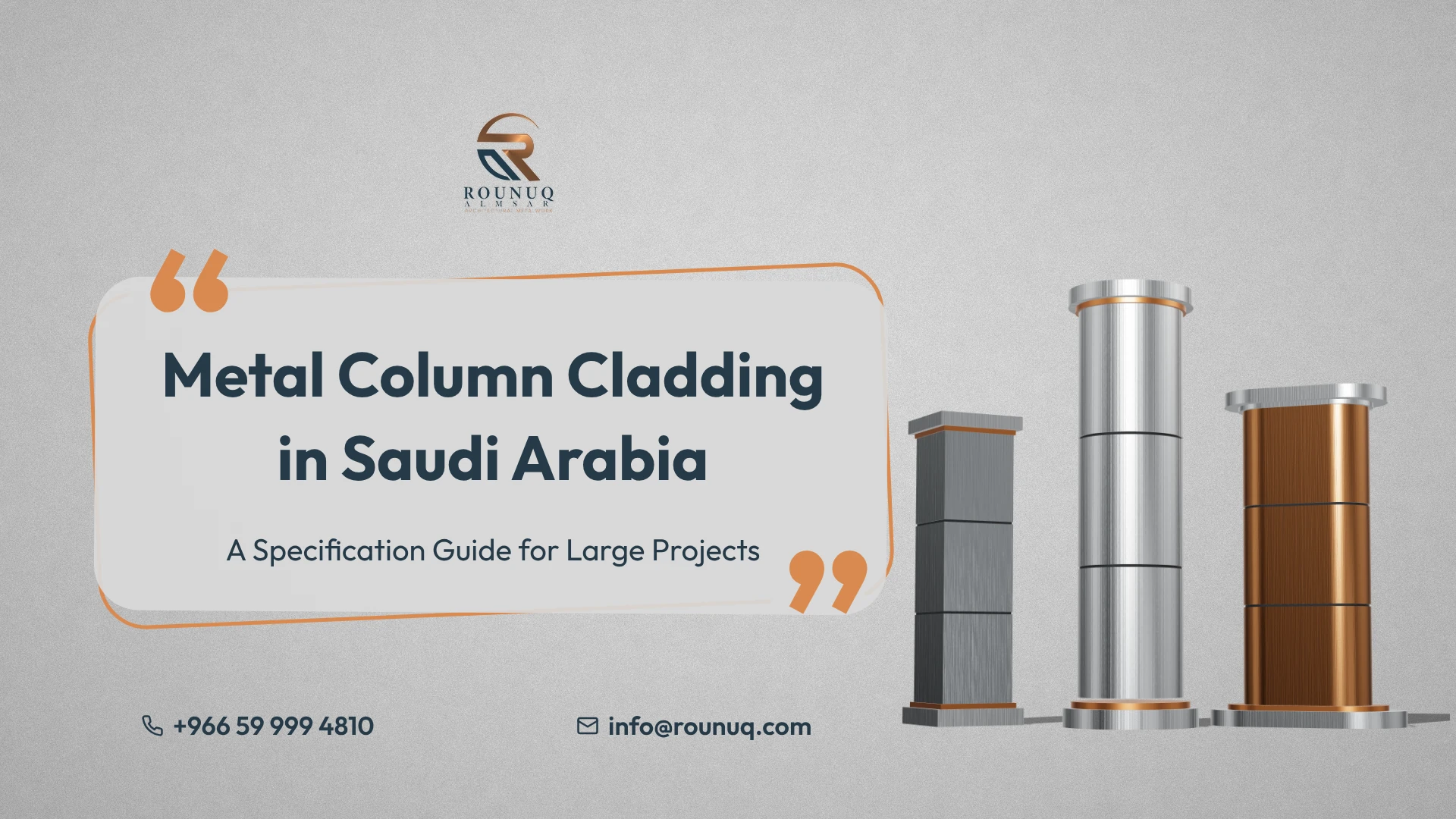
Metal Column Cladding in Saudi Arabia: A Specification Guide for Large Projects
Most columns in a hotel lobby, mall atrium or airport concourse are bare concrete or painted steel, and nobody wants to look at them for the next thirty years. Metal column cladding wraps that structure in a stainless steel, aluminium or brass skin that survives public traffic and gives the room a finished edge.
This guide comes from Rounuq Almsar, a metalwork fabricator in Riyadh, and it shows how to specify metal column cladding for Saudi projects: which metal, which finish, what thickness, how far the skin moves in the heat, and what to ask for in a quotation.
The sections below work through the arithmetic of metal column cladding (blank width, weight, thermal movement) instead of repeating general advice, and they tie each choice to Saudi conditions, from the Red Sea coast to inland Riyadh.
What Is Metal Column Cladding and Where Do Large Projects Use It?
Metal column cladding is a fabricated metal skin, typically between about 1.0 mm and 4.0 mm thick depending on the metal and the exposure, fixed around an existing structural column. The skin hides the concrete or steel, carries the finish, and can include trims, lighting and service access. The column carries the load. Metal column cladding carries the look.
Large projects use metal column cladding wherever columns repeat. A single lobby might have four. A mall or terminal can have hundreds, and that repetition is why the detailing, the mock-up and the tolerance strategy matter more than the catalogue photo. Treat metal column cladding as a package of metal, shape, finish, fixing and trim, because pricing and programme risk sit in the combination.
Column Cover, Column Casing and Pillar Cladding: Same Product, Different Names
Search for a column cover and you find stock aluminium products sold by catalogue. Search for a column casing and you find rolled stainless shells. Pillar cladding turns up mostly in South Asian trade listings. On a Saudi tender all three describe one scope: a metal enclosure wrapped around a structural column.
What differs is the engineering behind the name. A catalogue column cover suits a standard round column with a standard floor-to-ceiling height. A custom column casing for a six metre atrium needs shop drawings, movement allowances and an approved mock-up before anything is cut.
Older bills of quantities often list the scope as pillar cladding, so search tender archives under that term too. Consultants writing a modern specification prefer architectural column cladding, because the phrase signals that appearance is the point. A line item that reads only pillar cladding leaves every decision open, and architectural column cladding with no stated thickness is just as incomplete. Whatever the label, ask for the metal, the finish, the thickness and the movement detail.
Architectural Column Cladding Is Not Fire Protection
Architectural column cladding is a finish decision. When a structural steel column needs a fire rating, the rated system is a separate item that the fire consultant specifies under the Saudi fire code, SBC 801, and the metal skin goes over it. Before ordering metal column cladding, confirm in writing whether the skin forms part of any rated assembly or is purely decorative.
The edition of the code that governs your permit is a question for the project consultant. The Saudi Building Code Center is the official starting point for the current code set.
Stainless Steel, Aluminium, Brass and Corten Steel Column Cladding Compared
Four metals cover almost every brief. Stainless steel column cladding, aluminium column cladding, brass column cladding and corten steel column cladding each suit a different mix of traffic, weather, weight and ageing. Architectural column cladding specifications usually start with the metal and work outward to the finish, so settle the metal first for any metal column cladding package.
Stainless Steel Column Cladding for High-Traffic Lobbies
Stainless steel column cladding is the default where hands, trolleys and cleaning machines touch the column every day. It resists impact and wash-down better than any painted surface, and it takes brushed, mirror and PVD finishes. Rounuq’s cladding service covers stainless steel in brushed, mirror and PVD finishes, with an anti-fingerprint coating option. Specified well, stainless steel column cladding keeps its appearance for the life of the building, which is why it dominates lobbies and transport buildings.
The trade-off is weight. Stainless is roughly three times heavier than aluminium at the same thickness, which shapes the lifting plan, the fixing frame and the number of panels per column in any metal column cladding scheme.
Stainless Steel 304 vs 316 for Saudi Climate Zones
The grade question comes down to salt. In sea-influenced air, chlorides settle on the surface and cause brown tea staining. The Australian Stainless Steel Development Association reports in its tea staining guidance that staining occurs most often within about five kilometres of the surf, can reach 20 kilometres or more when wind, pollution and heat push it inland, and calls for grade 316 as a minimum close to the sea.
That puts metal column cladding in Jeddah and Yanbu on the Red Sea, and in Dammam, Al Khobar and Jubail on the Gulf, firmly inside the 316 conversation. Riyadh sits far from the coast, so sea salt is rarely the driver for metal column cladding there, though chloride-based cleaning products can still cause trouble.
A simple decision test for stainless steel 304 vs 316 on metal column cladding:
- Is the column within five kilometres of the sea, or in the open path of a sea breeze? Choose 316.
- Is it an air-conditioned interior, away from chloride-based cleaners? Grade 304 is the usual choice.
- Is it a splash or wash-down zone near the coast, such as a drop-off canopy? Ask the engineer about 316 with a smoother finish.
Our comparison of stainless steel 304 vs 316 goes deeper on cost and corrosion resistance. The point for columns is simple: stainless steel 304 vs 316 is a location decision first and a budget decision second.
Aluminium Column Cladding and Weight
Aluminium column cladding weighs about a third of stainless at equal thickness, which helps when a big cover has to be lifted over a lobby floor that is already finished. It takes powder coating or PVDF in a wide colour range, and it forms easily into curves. Most exterior aluminium column cladding sits in the 2.0 to 3.0 mm range, and the lighter skin also reduces the load on the fixing frame.
Metal column cladding in aluminium also expands more than stainless in the heat, so the movement detail needs more room. The worked example further down puts numbers on that.
Brass Column Cladding for Hospitality Lobbies
Brass column cladding brings a warmth that stainless cannot match, and it ages. Natural brass darkens over time unless it is lacquered, so the owner has to choose early between a living finish and a sealed one. Our brass cladding guide covers column wraps, alloys and finishes in detail, and the same column wraps logic applies to any lacquered metal.
Brass suits hotel and hospitality lobbies where the column is a feature and the maintenance routine is controlled. It is a poor fit for exposed, high-touch public areas unless the owner accepts visible wear. A brass column cladding specification should state the alloy, the finish and the lacquer system. Where a lobby combines brass column cladding with stainless trims, test the two metals side by side under the real lighting, because brass column cladding changes tone as it ages and stainless does not.
Corten Steel Column Cladding and Runoff Staining
Corten steel column cladding offers a rust-toned surface that settles as it weathers. The risk is runoff: rusty water can stain whatever sits below the column, including pale stone and terrazzo. Rounuq’s corten guide flags runoff staining and coastal exposure as the main Saudi concerns.
For a column, that means keeping corten away from light floor finishes unless the base detail captures the water. It tends to work better in exterior landscape zones than in polished interiors. A corten steel column cladding detail also needs a drip edge or sealed base so the first months of weathering do not mark the floor.
Round Column Cladding, Square Column Cladding and Other Shapes
Shape sets the panel count, the seam position and the fabrication cost of metal column cladding more than the alloy does. Settle it before the finish.
Round Column Cladding
Round column cladding is usually built as two half shells joined by vertical seams. The blank width of each half is half the circumference, which is why the sheet width available from the mill drives the whole layout. The worked example below shows how a 600 mm column turns into two panels of metal column cladding.
Place the seams where they are least visible, usually on the wall side or on a grid line the architect has already chosen. Round column cladding also needs a decision on the seam itself: a tight butt joint, a recessed reveal or a covered strip. Round column cladding on repeated columns should use the same seam logic every time, so the pattern reads as intentional.
Square Column Cladding
Square column cladding is typically four flat or folded panels. Sharp mitred corners look crisp, but they also reveal any out-of-plumb error in the structure underneath. A small radius on each corner hides more tolerance, and a recessed reveal between panels lets the eye read the joint as a design feature rather than a mistake.
Square column cladding on a retail concourse also needs a corner that survives a trolley, so thicker material or a rounded corner protects the edge. In a hotel corridor, square column cladding often carries the same finish as the wall panels beside it.
Oval Column Cladding and Racetrack Column Cover
Oval column cladding and the racetrack column cover (a flat-sided obround) appear when the structural core is a rectangle that the architect wants to soften. Both are formed in segments, and the long flat faces of a racetrack column cover are where oil canning shows first. Extra thickness, stiffeners or a slight crown in the face keep them flat.
Specify oval column cladding from a measured drawing of the real profile, because a hand-measured oval is rarely a true ellipse. A racetrack column cover is the easier of the two: two flat faces and two half-round ends can be formed from standard sheets. Where a project mixes oval column cladding with round and square runs, keep the finish and seam logic identical.
A well-made oval column cladding reads as one continuous curve, and each racetrack column cover still needs its own check on the flat faces.
Curved Column Cladding on Large Radii
Curved column cladding is the shape that most often separates a fabricator who rolls plate in house from one who buys sheet and folds it. Large-radius curves need controlled plate and roll forming, and the finish must run continuously around the curve without a visible change in grain. Our custom metal forming guide explains the plate and roll forming behind curved column cladding.
Curved column cladding also raises an installation question: the half shells must hold their radius until the frame takes the load. Where straight runs sit beside curved column cladding, the grain direction and finish batch must match across the transition.
Finishes for Metal Column Cladding That Survive Public Traffic
Metal column cladding takes more abuse than any wall. Bags, trolleys, cleaning machines and children all meet it at hand height. The finish decides whether metal column cladding looks new after a year or tired after a month.
The table below maps the stainless steel finish designations used on metal column cladding. The roughness ranges come from the International Molybdenum Association’s finish designation table.
| Finish | ASTM A480 | EN 10088 | Roughness Ra (µm) | Typical use on a column |
|---|---|---|---|---|
| Brushed | No. 4 | 2J | 0.18 to 0.64 | Lobbies, malls, general public areas |
| Coarse polish | No. 3 | 2G | 0.25 to 1.10 | Back-of-house, concealed or industrial areas |
| Fine polish | No. 7 | 2P | 0.06 to 0.20 | Feature columns, controlled lighting |
| Mirror | No. 8 | 2P | 0.02 to 0.10 | Statement columns, low-contact areas |
| Hairline | Not designated | Not designated | 0.14 to 0.20 | Fine linear look, interiors |
Brushed Stainless Steel Column Cladding
Brushed stainless steel column cladding is the workhorse finish, listed as No. 4 under ASTM A480. It hides fingerprints and light scratches better than a mirror, and it can be refinished on site if a panel is damaged. Our stainless steel finishes guide describes the main options for Saudi projects, including brushed stainless steel column cladding and its alternatives.
The classic failure is grain direction. When one panel is cut with the grain running vertically and its neighbour with the grain rotated 90 degrees, two panels cut from the same metal read as two different metals. The fix is a specification line that fixes grain direction on every panel, cuts all panels from the same coil lot, and marks each sheet before cutting.
A second trap appears near the coast. The Australian association’s guidance says a No. 4 finish is inadequate unless its roughness is also specified, and recommends staying at or below about 0.5 µm Ra for better corrosion resistance. The range for No. 4 in the table runs from 0.18 to 0.64 µm, so a specification that says only “No. 4” can deliver a surface rougher than that guideline.
Name the grade, the finish and a maximum Ra together. Brushed stainless steel column cladding on a large concourse should also be cut from one batch of sheet, because brushed sheet from two suppliers can differ slightly in line texture, and brushed stainless steel column cladding shows that difference at once.
Polished Stainless Steel Column Cladding
Polished stainless steel column cladding, in a No. 8 mirror finish, is the most corrosion-resistant mechanical finish according to the same association. It is also the least forgiving. A mirror reflects every ripple, so the flatness tolerance, the panel thickness and the viewing distance all go into the specification. Fingerprints show immediately, which is why many owners reserve mirror for feature columns and use brushed everywhere else.
Polished stainless steel column cladding looks best in controlled lighting, where reflections are designed rather than accidental. On a lobby column, polished stainless steel column cladding also mirrors the floor and ceiling, so the finish of those surfaces becomes part of the column’s appearance.
Embossed Stainless Steel Column Cover
An embossed stainless steel column cover carries a pattern pressed into the sheet. The texture hides scratches and small dents, which makes it a sensible choice for mall corridors where trolleys hit the lower metre. The pattern also needs matching at every seam, so the panel layout should be drawn with the pattern repeat in mind, not added afterwards.
Choose an embossed stainless steel column cover when scratch resistance matters more than a perfect reflection. An embossed stainless steel column cover also needs a pattern direction on the drawings, and its samples should be approved at full height, not as a small tile.
PVD Column Cladding
PVD column cladding applies a vacuum-deposited colour coating to stainless steel, in tones such as gold, bronze, black and rose gold. The colour follows the base finish, so a brushed base gives a brushed colour. Our guide to PVD finishes lists seven checks before buying that apply directly to PVD column cladding: grade, base finish, colour sample and cleaning.
Approve a full-size sample under the actual lobby lighting before production starts. PVD column cladding is a colour treatment on stainless, so the base grade and base finish still apply: PVD column cladding on 304 near the coast faces the same chloride question as any other 304 panel.
Powder Coated Aluminum Column Cover
A powder coated aluminum column cover trades the mirror and brushed looks of stainless for a wide colour range and a lighter weight. Ask the supplier which coating system is used and whether it suits exterior ultraviolet exposure, because interior and exterior coating specifications are not the same product.
A powder coated aluminum column cover should come with a stated coating thickness and an agreed touch-up method for site damage, and a powder coated aluminum column cover in a public concourse deserves a hard-wearing topcoat. See our architectural powder coating guide for coating systems that suit a powder coated aluminum column cover.
Column Cladding Thickness, Weight and Thermal Movement
On metal column cladding, thickness is where cost, flatness and handling meet. Thin skins save weight and money but dent and oil can. Thick skins stay flat but add cost and lifting effort.
Column Cladding Thickness by Location
Our specification guide on column cladding thickness and panel gauge gives starting points for the engineer, not final answers. For interior metal column cladding, the starting ranges are 1.0 to 1.5 mm for stainless steel and 1.5 to 2.0 mm for aluminium. For exterior faces, they rise to 1.5 to 2.0 mm for stainless and 2.0 to 3.0 mm for aluminium, and larger panels in high wind move higher still.
| Location | Stainless steel | Aluminium |
|---|---|---|
| Interior column | 1.0 to 1.5 mm | 1.5 to 2.0 mm |
| Exterior column | 1.5 to 2.0 mm | 2.0 to 3.0 mm |
| Large exterior or high wind | 2.0 mm or more | 3.0 to 4.0 mm or stiffened |
Panel size, supports, finish and wind load still need an engineer’s review. Treat the table as the first line of a discussion.
Worked Example: Blank Width and Weight of a 600 mm Round Cover
Take a round metal column cladding job: a 600 mm diameter column, 4,000 mm high.
- The blank width is the circumference: π × 600 mm = 1,885 mm.
- Many stock stainless sheets are 1,250 or 1,500 mm wide. A 1,885 mm blank does not fit in one piece, so split it into two half shells of about 943 mm each.
- In stainless steel at 2.0 mm, the volume is 1,885 × 4,000 × 2.0 mm = 15,080 cm³. At a density of about 7.93 g/cm³, that is 119.6 kg in total, or 59.8 kg per half shell.
- In aluminium at 3.0 mm, the volume is 22,619 cm³. At about 2.70 g/cm³, that is 61.1 kg in total, or 30.5 kg per half shell.
For this metal column cladding example, the decision follows from the numbers. Two vertical seams are unavoidable, so their position becomes a design decision. A 60 kg stainless half shell needs a lifting plan. A 30 kg aluminium half shell is much easier to handle. Check the mill certificate for the actual density and sheet size on your order.
Worked Example: How Much Does a 4 m Cover Move in Saudi Heat?
The formula is length change = original length × temperature change × expansion coefficient. AZoM’s technical note on stainless steel expansion gives 17.2 µm/m/°C for grade 304. A typical aluminium alloy is about 23 µm/m/°C.
Assume a 4,000 mm high run of metal column cladding. For an exterior column, assume a 70 °C swing between a cool winter night and a sun-heated surface in summer. This is an illustrative design range, so confirm the real figure with the façade engineer. For an air-conditioned interior, assume 10 °C.
| Metal | Exterior (70 °C swing) | Interior (10 °C swing) |
|---|---|---|
| Stainless steel 304 | 4.82 mm | 0.69 mm |
| Aluminium | 6.44 mm | 0.92 mm |
The aluminium cover moves about 1.6 mm more than stainless over the same height. That is enough to buckle a skin that is fixed rigidly at both ends. The usual answer is to fix the cover at one end and let the other slide in slotted holes, or to use a joint at the head or base sized for the movement plus a margin. Interior covers barely move, which is why a catalogue detail that works indoors can fail outdoors.
Hidden Fixing Column Cladding, Trims and Services
The fixing and trim details decide whether metal column cladding reads as a precise object or as a patched structure. Detail them before fabrication.
Hidden Fixing Column Cladding
Hidden fixing column cladding attaches the skin to a concealed frame or channel so that no fastener shows on the face. The frame also gives the installer adjustment, which absorbs the out-of-plumb error that most structural columns carry. Measure the as-built columns on site before fabrication, because drawings alone miss real variation, especially on irregular or oval cores.
Column Cover Top and Base Trim
The column cover top and base trim handles the two places where the cladding meets other trades. At the head, the ceiling system may sit at a slightly different height from the drawings, so a field-adjustable top or a shadow gap absorbs the difference. At the base, the column cover top and base trim also takes the knocks from cleaning machines, so many projects use a stainless base trim or a recessed base that can be scribed to the actual floor level.
Draw the column cover top and base trim in section for every condition on the project, not just the typical one. Coordinate the column cover top and base trim with the ceiling and flooring contractors early. A finished ceiling that lands 25 mm off is a common site error on a project with repeated columns.
Column Cladding with LED Lighting
Column cladding with LED lighting needs the electrical design from the start. Drivers and wiring need a concealed route and an accessible location, and the skin needs a removable panel or a service pocket so a failed driver does not mean removing the cladding. Column cladding with LED lighting also needs a light-leak detail at the joints, which should be tested in the mock-up under the real lobby lighting.
Retrofits are harder than new builds. Adding column cladding with LED lighting to an existing column means cutting the route through the fixing frame, so agree it with the lighting designer before shop drawings begin.
Access Panels and the Drum Effect
A hollow metal skin around a concrete column can resonate when a trolley brushes past. Neoprene isolators or sound-deadening pads between the metal and the structure reduce that drum effect, so the metal column cladding specification should include them, plus a service access panel wherever a valve, junction box or riser sits behind the column.
Lobby Column Cladding, Mall Column Cladding and Other Large-Project Uses
The same metal column cladding behaves differently depending on who touches it and how often. These are the settings where large Saudi projects specify it most.
Lobby Column Cladding
Lobby column cladding sets the first impression of a building. Match its finish to the neighbouring elements, such as lift doors, reception desks and wall panels, so the metal reads as one family. A lobby column cladding package often uses one finish at the entrance columns and a second finish for the inner columns.
Check every lobby column cladding sample under the final lobby lighting, because metal column cladding can look different in daylight. Brushed stainless suits most corporate and hotel lobbies, while polished stainless steel column cladding is better kept for a few feature positions, and PVD colour suits hospitality entrances where the owner wants a distinct tone.
Mall Column Cladding
Mall column cladding faces the hardest daily wear: trolleys, prams, cleaning machines and constant footfall. Choose a finish that tolerates scratches, such as brushed stainless or an embossed stainless steel column cover, and detail the lower metre so it can be replaced as a module without disturbing the rest of the column. A night-time maintenance window is easier when a damaged panel unclips rather than being welded.
Mall column cladding also sits next to shopfronts, so its finish has to coexist with tenant fit-outs. Specify a mall column cladding base zone that can be swapped without removing the full column, and keep that rule across all metal column cladding in the mall.
Airport Column Cladding
Airport column cladding runs at scale. A terminal can hold hundreds of columns, so the mock-up approval, the repeatable panel design and the installation sequence matter more than any single detail. Our airport metalwork guide covers airport column cladding and column covers, and explains how they protect surfaces and conceal construction interfaces in airport buildings.
Airport column cladding also faces operating constraints: work often happens at night and in restricted zones, so plan airport column cladding deliveries and lifts around the terminal’s access rules and the supplier’s metal column cladding programme.
Hotel Column Cladding
Hotel column cladding often mixes metals: stainless in the back-of-house corridors, brass or PVD in the lobby, and aluminium for the exterior porte-cochère. Our hotel metalwork guide covers hotel column cladding in lobbies alongside the zones, finishes and coordination points that matter for hotel projects in Saudi Arabia. Hotel column cladding also has to match the interior designer’s palette, so samples go through design approval before fabrication.
Hotel column cladding in the porte-cochère faces sun, traffic and a pool deck, and each of those asks something different of the metal column cladding.
Exterior Column Cladding vs Interior Column Cladding
Exterior column cladding faces ultraviolet light, heat swings, dust, wind and, near the coast, chlorides. Interior column cladding faces traffic, cleaning and lighting. The movement calculation above shows how different the two worlds are: the same cover moves almost seven times more outdoors than indoors.
Exterior column cladding needs the movement detail, a rated coating and, near the coast, the 316 decision. Interior column cladding needs the right finish for touch and light. Exterior column cladding in full sun should never share a detail with interior column cladding without a check, and exterior column cladding near the sea deserves a smooth finish.
Treat them as separate specifications. An interior column cladding detail with a thin skin, a rigid fixing and a standard coating rarely survives outdoors. An exterior detail applied indoors usually costs more than it needs to.
Column Cladding Installation From Survey to Handover
Good column cladding installation starts months before the first panel arrives. The sequence below keeps repeated metal column cladding consistent.
- Survey the as-built columns. Measure diameter, plumb and position on site, not from drawings.
- Draw shop drawings. Show panel splits, seam positions, fixing frame, trims, lighting routes and access panels.
- Approve a mock-up. Build one full column of metal column cladding in the real finish and approve it under the real lighting.
- Fabricate in controlled lots. Cut all panels for a finish from the same coil lot, and mark grain direction.
- Protect on delivery. Keep the protective film on until handover, and store panels away from carbon steel dust.
- Fix the frame. Set the frame to the survey, with adjustment for out-of-plumb.
- Install the panels. Align seams, check the reveal, and fix hidden fixings.
- Clean and hand over. Remove the film, clean with mild detergent and rinse, then hand over with a cleaning schedule.
Column cladding installation on a live site, such as a mall or terminal, runs in short windows, so the sequence above is usually repeated column by column. A clear column cladding installation method statement helps the main contractor plan access. Dedicated stainless tools matter during column cladding installation. Carbon steel particles from grinding or from contaminated tools can embed in the surface and rust, and the staining looks like a failure of the stainless itself.
Buying Metal Column Cladding in Saudi Arabia: What to Check
A Saudi tender has its own checklist. These points apply when comparing metal column cladding offers and column cladding price in Saudi Arabia from different suppliers.
Units, Currency and VAT
Work in millimetres and Saudi riyals (SAR) when pricing metal column cladding. VAT in the Kingdom is 15%, as set out in ZATCA’s guideline on tax invoicing and records. Check whether each quotation is shown with or without VAT before comparing them. A quotation of SAR 460,000 including VAT equals SAR 400,000 before VAT, with SAR 60,000 of VAT, so two quotes that look SAR 60,000 apart may in fact be identical.
Standards and Certificates
The Saudi Standards, Metrology and Quality Organization, known as SASO, sets standards and oversees quality and conformity in the Kingdom. Mill certificates for stainless and aluminium usually cite ASTM or EN grade standards. Ask the project consultant which standards list governs the tender, and ask the metal column cladding supplier in Riyadh or elsewhere to supply certificates that match.
What Drives Column Cladding Price in Saudi Arabia
No honest price for metal column cladding exists without drawings. The factors below move the number most.
| Price factor | Why it matters |
|---|---|
| Metal and grade | 316 costs more than 304, and brass costs more than both |
| Thickness | Weight and material volume scale with thickness |
| Shape | Curved, oval and racetrack covers need forming and more labour |
| Finish | PVD, mirror and custom colours add processing steps |
| Panel count and joints | More seams mean more fabrication and installation time |
| Lighting and access | Service pockets and removable panels add hardware |
| Height and site access | Tall atriums need scaffolding or lifts |
| Delivery city and programme | Transport and phasing change the logistics cost |
| Repetition | Identical columns lower the unit cost |
A Short Quotation Checklist
Ask each column cladding supplier in Riyadh, or elsewhere, to state in writing:
- the metal, grade and exact finish designation, with a maximum Ra where relevant
- the thickness of each panel and the fixing frame material
- the number of panels per column and the seam positions
- the movement allowance for exterior covers
- what the quotation includes: mock-up, shop drawings, installation, protective film, cleaning
- whether VAT is included
If you search in Arabic, the trade term is column cladding (تكسية الأعمدة). English tenders may say pillar cladding or column casing instead, and suppliers often mix English and Arabic terms, so match all of them when you compare scopes.
Which Metal Column Cladding Fits Which Project?
The table pulls the earlier sections on metal column cladding into one decision aid. Thicknesses for metal column cladding are starting points from the guide above, not final engineering.
| Project setting | Metal and grade | Finish | Starting thickness | Watch for |
|---|---|---|---|---|
| Inland hotel lobby | Stainless 304 or brass | Brushed, PVD or lacquered brass | 1.0 to 1.5 mm stainless | Colour sample under real lighting |
| Coastal exterior (Jeddah, Dammam) | Stainless 316 | Smooth finish with a maximum Ra | 1.5 to 2.0 mm | Tea staining, cleaning routine |
| Mall atrium, high impact | Stainless 304 | Brushed or embossed | 1.0 to 1.5 mm, thicker at the base | Trolley impact, modular base |
| Airport concourse | Stainless or aluminium | Brushed or powder coat | Per engineer, by panel size | Repeatability, mock-up, 24-hour access |
| Exterior in full sun | Aluminium column cladding, powder coated or PVDF | Coating system rated for exterior | 2.0 to 3.0 mm | Thermal movement, slotted fixings |
| Feature column | Brass or polished stainless | Mirror or lacquered | Per engineer | Flatness, fingerprints |
Metal Column Cladding FAQ for Saudi Projects
What is metal column cladding?
Metal column cladding is a fabricated metal skin fixed around a structural column to protect it and finish its appearance. It is usually stainless steel, aluminium, brass or corten steel, and it can include trims, lighting and access panels.
Which grade is better for column cladding: stainless steel 304 vs 316?
Grade 316 is the safer choice for metal column cladding within about five kilometres of the sea, and grade 304 is the usual interior choice. The stainless steel 304 vs 316 decision is a question of location, because chlorides drive the difference.
How thick should column cladding thickness be for a lobby?
For an interior stainless lobby column, starting thickness is usually 1.0 to 1.5 mm, and aluminium column cladding starts at 1.5 to 2.0 mm. Column cladding thickness rises for large panels, impact zones and exterior use, so the engineer sets the final figure.
Can hidden fixing column cladding fit columns that are out of plumb?
Yes, if the fixing frame is adjustable and the as-built survey is accurate. Hidden fixing column cladding absorbs plumb error in the frame, so the visible panels of metal column cladding still read as straight.
Is column cladding with LED lighting practical in a retrofit?
It is practical for metal column cladding when the lighting designer agrees the cable route and driver access before shop drawings. Column cladding with LED lighting is harder to add after fabrication, because the route has to pass through the fixing frame.
How is column cladding priced in Saudi Arabia?
Pricing for metal column cladding depends on metal, thickness, shape, finish, panel count and site access, and it is quoted in SAR with 15% VAT added. Request a written breakdown so you can compare column cladding price in Saudi Arabia on equal terms.
What is the difference between a column cover and a column casing?
In practice the two terms describe the same scope. A column cover often means a catalogue product, while a column casing often means a custom-formed shell, and both are metal column cladding.
Next Step for Your Metal Column Cladding Package
Metal column cladding works best when the metal, grade, finish, thickness and movement detail are fixed together, early, and tested in a mock-up. Rounuq Almsar’s cladding service covers feature columns in stainless steel, aluminium and other metals. Send your column schedule (shapes, heights, locations and finish intent) and the drawings, and the team will review the scope with you. You can contact Rounuq Almsar to start that conversation.