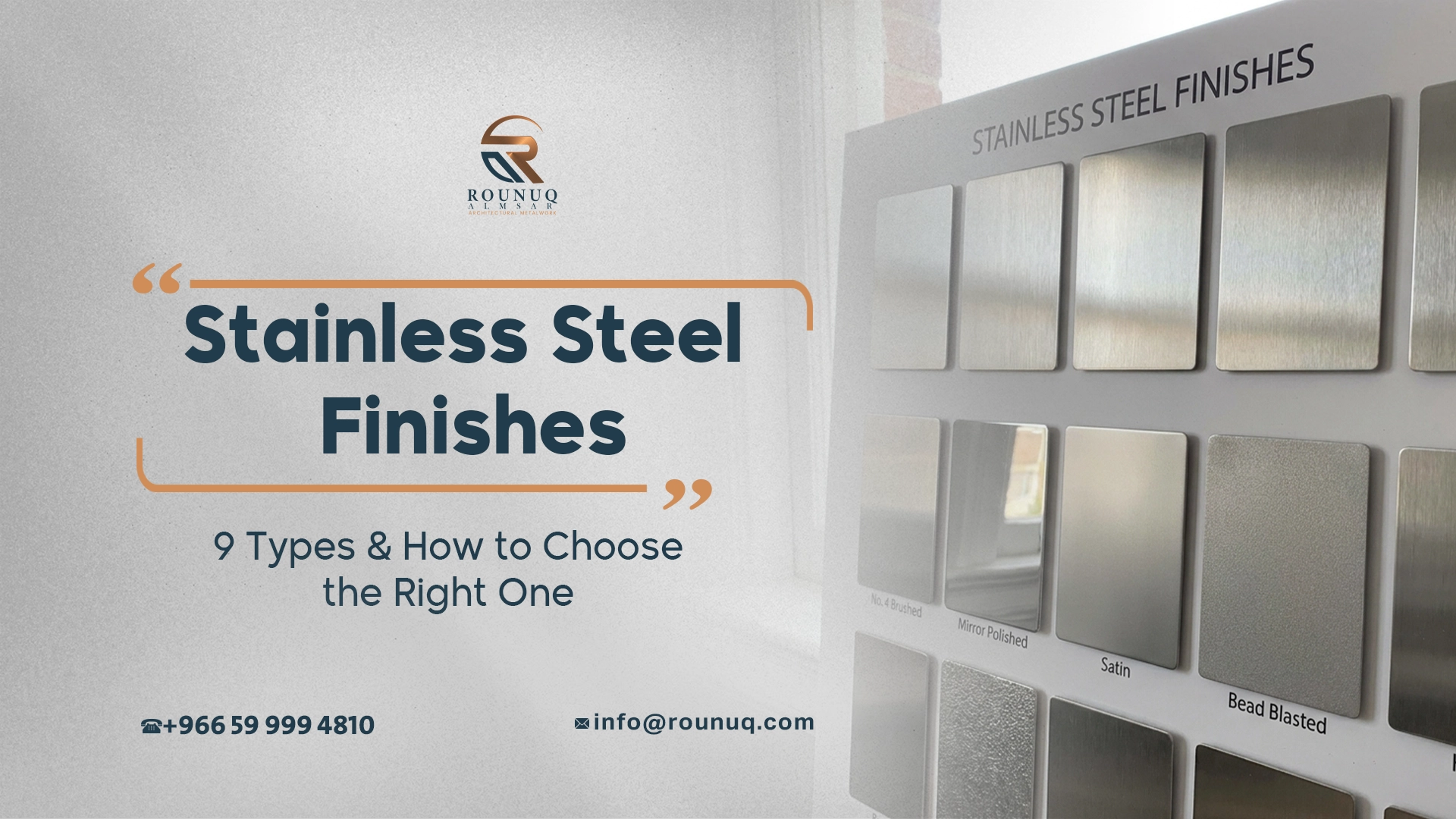
Stainless Steel Finishes: 9 Types & How to Choose the Right One
The same sheet of 304 stainless steel can look like a mirror, a soft grey satin, a fine brushed grain or a bronze-coloured feature wall. The difference is the stainless steel finish, and in architectural work it often matters more to the final result than the metal itself.
In Saudi projects, the choice carries extra weight. Mall columns and hotel lobbies in Riyadh are lit hard and touched constantly. Entrances collect dust every day and get wiped down every day. Exterior work in Jeddah, Dammam or Jubail faces humid, salty air that punishes the wrong grade and the wrong surface. A stainless steel finish that looks perfect on a sample board can look patchy, smudged or stained within months if it doesn’t suit the site.
This guide explains the nine stainless steel finishes we’re most often asked about, how they compare, and how to choose one for Saudi conditions. It draws on the stainless steel cladding, column covers and decorative work we fabricate and install from our factory in Riyadh at Rounuq Almsar.
What Is a Stainless Steel Finish?
A stainless steel finish is the surface condition of the sheet: how smooth, bright, textured or coloured it is. It comes from one of three routes:
- Mill finishes produced at the steel mill by rolling, annealing and pickling, such as 2B, 2D and BA.
- Mechanical finishes created afterwards by brushing, polishing, blasting or vibrating the surface, such as No. 4, hairline, satin, mirror and vibration.
- Coatings applied on top of a prepared surface, most importantly PVD for colour.
The finish is not the same as the grade. Grade (304, 316 and so on) is the alloy and decides corrosion resistance. The stainless steel finish decides appearance, reflectivity and how marks and dirt show. A good specification names both.
All 9 Finishes Compared
| Finish | Look | Reflectivity | Typical uses | Watch out for |
|---|---|---|---|---|
| 2B | Smooth, moderately bright | Medium | Hidden parts, base for further finishing | Not a decorative finish |
| 2D | Smooth, dull | Low | Formed industrial parts | Plain appearance |
| BA (2R) | Very smooth, bright | High | Trims, appliances, interiors | Marks show easily |
| No. 4 (brushed) | Directional grain | Medium-low | Walls, elevators, handrails | Grain direction |
| Hairline | Fine, long grain | Low-medium | Premium interiors, feature panels | Needs consistent finishing |
| Satin / No. 6 | Soft matte | Low | Glare-sensitive areas | Understated look |
| No. 8 (mirror) | Mirror | Very high | Statement features | Fingerprints, flaws show |
| Textured / patterned / vibration / blasted | Non-directional or embossed | Low to medium | High-traffic areas, feature walls | Pattern scale |
| PVD coloured | Gold, bronze, black, rose gold | Depends on base | Luxury interiors | Base finish changes result |
Treat this stainless steel finish comparison as a starting point. The final choice should always be made from a physical sample under the project’s real lighting.
Mill Finishes: 2B, 2D and BA
World Stainless, the international stainless steel association, describes these as the standard cold-rolled surfaces produced at the mill.
2B
2B is the most common cold-rolled stainless steel finish. It’s smooth and moderately bright, and it’s the usual starting sheet for fabrication. It isn’t meant as a decorative face. When a drawing just says “stainless steel”, 2B is often what arrives, which is why the finish should always be specified.
2D
2D is smoother than hot-rolled plate but duller than 2B. It’s used for formed industrial parts and as a base for further mechanical finishing. On visible architectural work it’s rarely the final surface.
BA (Bright Annealed, 2R)
BA is produced by annealing in a controlled atmosphere, giving a very smooth, bright surface. It reflects more than 2B and is useful for trims and details where a clean shine is wanted without the cost of full mirror polishing. It isn’t the same as a polished No. 8 mirror, so the two shouldn’t be treated as interchangeable in a specification.
Directional Finishes: No. 4 Brushed and Hairline
No. 4 Brushed
No. 4 is the classic brushed stainless steel finish, made with abrasive belts that leave a visible directional grain. It softens reflections and hides light marks better than bright finishes, which is why it’s the default for elevator walls, handrails, column covers and back-of-house surfaces.
Hairline
Hairline is a finer, longer, more even grain than standard No. 4. It reads as more refined and is the favourite for hotel lobbies, reception walls and premium retail in Saudi fit-out.
Why Grain Direction Matters
With any directional stainless steel finish, the grain has to run the same way on every panel. Turn one panel 90 degrees and it looks like a different colour under light. On large feature walls and elevator interiors, the drawings should state the grain direction for every panel, return and corner, and panels should be cut from the sheet with that in mind.
Low-Reflection Finishes: Satin, Sandblasted and Vibration
Satin (No. 6)
Satin is a soft matte stainless steel finish with lower reflectivity than brushed surfaces. It suits areas where glare is a problem, such as walls facing large windows or under strong spotlights.
Sandblasted
Blasting with fine media gives an even, non-directional matte surface. It’s calm and modern, but it can show handprints on light-touch areas and needs careful cleaning. Our guide to the sandblasted finish covers media, specification and maintenance in more detail.
Vibration
A vibration finish creates a random, swirling pattern of fine abrasion marks. Because there’s no single grain direction, scratches and handling marks blend in. That makes it one of the most forgiving stainless steel finishes for busy public areas. See our guide to vibration finish on stainless steel for how it’s produced and prepared before coating.
Mirror Finish (No. 8)
No. 8 is polished through progressively finer abrasives and then buffed to a mirror. It’s the most reflective stainless steel finish commonly produced, and it’s used where reflection is the point: statement columns, reception features, elevator interiors and luxury retail.
The trade-off is honesty. A mirror shows everything: fingerprints, fine scratches, weld marks, an uneven substrate and the reflection of whatever is opposite. In Saudi malls and hotels with strong lighting and heavy foot traffic, mirror works best above hand height or where cleaning staff can reach it several times a day.
Textured and Patterned Stainless Steel
Embossed, linen, leather-grain and other patterned sheets change how light breaks across the surface. They’re very forgiving. The Euro Inox Guide to Stainless Steel Finishes notes that in high-use areas such as building entrances, lift cages and airport terminals, patterned surfaces are less likely to show knocks and scratches.
Choose the pattern at full scale. A texture that looks subtle on a 100 mm sample can look busy across a 20 m² wall.
PVD Coloured Finishes
PVD (physical vapour deposition) is a coating, not a mechanical finish. A thin layer is deposited in a vacuum chamber on top of a prepared surface to give gold, champagne, bronze, black or rose-gold tones.
The key point is that PVD takes on the character of the finish underneath:
- Hairline + PVD bronze gives a soft, directional bronze
- Mirror + PVD gold gives a highly reflective gold
- Vibration + PVD black gives a textured, forgiving black
So a PVD sample should always state both the base finish and the colour. PVD is also usually applied after cutting and bending, because forming a coated sheet can mark or crack the coating. Our PVD finish guide explains the process in detail.
Grade vs. Finish: 304 or 316 in Saudi Conditions
No stainless steel finish can make up for the wrong grade.
- Grade 304 is the standard for dry, air-conditioned interiors across Riyadh and inland cities.
- Grade 316, which contains molybdenum, resists chlorides better and is the usual choice for exteriors in coastal cities like Jeddah, Yanbu, Jubail and Dammam, for indoor pools, and for areas cleaned with chlorine-based products.
Finish still plays a part. Smoother surfaces hold less dirt and salt, and the Euro Inox guide notes that smoother finishes are easier to clean and less likely to harbour contaminants. On coastal exteriors, a smooth brushed or polished surface on 316 generally performs better than a rough or deeply textured one.
Stainless sheet used in Saudi construction also falls under SASO’s technical regulation for metals and alloys in buildings, which covers stainless steel products and requires certificates of conformity. On commercial and government projects, ask for mill certificates confirming the grade.
Choosing a Stainless Steel Finish for Saudi Projects
Four questions narrow the choice quickly.
1. Where is it? Interior or exterior, inland or coastal, near a pool or kitchen.
2. How is it lit? Strong spotlights exaggerate mirror reflections and every brushing inconsistency. Grazing light shows texture. Check samples under the real fittings.
3. How often is it touched? Handrails, lift buttons and column bases in malls get touched thousands of times a day. Brushed, vibration and textured finishes hide this far better than mirror or BA.
4. How will it be cleaned? Saudi interiors fight dust daily. A finish that needs special products or careful cleaning along the grain only works if the cleaning team will actually do it.
| Application | Suggested finish direction | Why |
|---|---|---|
| Mall columns and escalator cladding | Hairline, vibration or textured | High traffic, hides marks |
| Elevator interiors | Hairline, vibration or patterned | Constant touching, close viewing |
| Hotel lobby feature wall | Hairline, mirror or PVD | Design-led, controlled cleaning |
| Villa majlis details | Hairline PVD gold or bronze | Warm, premium look |
| Restaurant cladding and trims | Brushed or hairline | Close viewing, frequent cleaning |
| Handrails | No. 4 brushed or satin | Grip marks, easy refinishing |
| Coastal exterior | Smooth brushed or polished on 316 | Sheds salt and dirt |
At KAFD in Riyadh, our scope included stainless steel cladding for columns, escalators and elevators, which is exactly the kind of high-traffic setting where the finish has to hold up to constant contact. Our work for two Sushi Sushi restaurant branches paired stainless steel cladding and trim with perforated aluminum, where the finish is judged from a metre away by seated guests. For wall-scale applications, our guide to metal feature walls shows how finish, panel size and lighting work together.
How Fabrication Affects the Finish
A stainless steel finish chosen on a flat sample has to survive cutting, bending, welding and installation.
- Bending can scuff or crack the visible face if tooling isn’t protected. Our guide to custom metal forming explains how protective film and tooling choice prevent this.
- Welding leaves heat tint and grinding marks that must be blended back into the grain. On mirror and hairline this takes skilled hand finishing.
- Corners and returns need the grain to wrap continuously, which means planning panel layout before cutting.
- Transport and site work can scratch finished faces, so protective film should stay on until the last trade has left.
Keeping Finishes Consistent Across a Project
Large Saudi projects often buy stainless sheet in several deliveries, sometimes from different mills. Even with the same name on the order, a stainless steel finish can vary in tone and grain from one batch to the next. On a hotel lobby or mall atrium, that shows up as panels that don’t quite match.
Three habits prevent it:
- Order visible sheet for one area in one batch, and keep a few spare sheets from that batch for repairs.
- Keep the approved sample on site and compare every delivery against it before cutting.
- Finish in-house where possible. When brushing, hairline or vibration is done in the fabricator’s own workshop, the same machine and operator produce every panel, which keeps the look consistent.
What Affects the Cost?
Price differences between stainless steel finishes are larger than most people expect. The main drivers are:
- Grade: 316 costs more than 304 because of its molybdenum content
- Finishing route: mill finishes are cheapest, hand-finished mirror and hairline cost more
- PVD: coating adds a separate process and batch cost
- Panel size and complexity: returns, corners and welded joints all need re-finishing
- Consistency requirements: matched grain and mock-ups add time
- Quantity: larger runs spread setup and sampling costs
In Saudi Arabia, fabrication quotations are normally in SAR, with 15% VAT on top. When comparing offers, check that each quote names the same grade, finish, grain direction, protection film and installation scope.
Maintaining Stainless Steel Finishes in Saudi Conditions
Stainless steel is low-maintenance, not no-maintenance.
- Remove dust regularly with a soft cloth. On directional finishes, always wipe along the grain.
- Use mild detergent and clean water, then dry to avoid water marks.
- Avoid chlorine bleach, hydrochloric-acid cleaners and steel wool, which can mark or stain the surface.
- On coastal exteriors, rinse periodically to remove salt deposits before they cause tea staining.
- Clean PVD with mild soap and a soft cloth only. Abrasive pads can cut through the coating.
How to Specify the Finish
A clear stainless steel finish specification avoids arguments on site. It should state:
- Grade: 304 or 316
- Thickness: per drawings
- Finish: for example hairline, No. 4, No. 8, vibration or a named pattern
- Grain direction: vertical or horizontal, per panel
- Coating: PVD colour, if any, and the base finish under it
- Sample: approved physical sample or mock-up before production
- Protection: film to remain until handover
For larger feature walls and elevator packages, a full-size mock-up panel gives the architect, contractor and fabricator the same benchmark before production starts.
Common Mistakes to Avoid
- Specifying only “stainless steel”. You’ll likely get 2B.
- Choosing mirror because it looks premium in a sample. Check touch, lighting and cleaning first.
- Treating all “brushed” finishes as identical. Suppliers’ brushed finishes vary. Approve a physical sample.
- Ignoring grain direction. One rotated panel can spoil a whole wall.
- Choosing PVD by colour chip alone. The base finish changes the result.
- Using 304 on the coast. The right finish won’t save the wrong grade.
Frequently Asked Questions
What are the most common stainless steel finishes?
2B, 2D, BA, No. 4 brushed, hairline, satin, No. 8 mirror, textured or patterned, sandblasted, vibration, and PVD coloured finishes.
Is brushed stainless steel better than mirror?
Neither is better overall. Brushed hides fingerprints and scratches better and suits high-touch areas. Mirror gives stronger visual impact but shows every mark.
What is the difference between hairline and No. 4 brushed?
Both are directional. Hairline has a finer, longer and more uniform grain, so it looks more refined. Because suppliers use the terms loosely, always approve a physical sample.
Which stainless steel finish hides fingerprints best?
Vibration, textured, patterned and fine brushed finishes hide fingerprints best. Mirror, BA and dark PVD show them most.
Is PVD a finish or a coating?
It’s a coating applied over a prepared finish. The base finish under it, such as hairline or mirror, strongly affects the final look.
Which stainless steel grade and finish suit coastal Saudi cities?
Grade 316 with a smooth brushed or polished finish is the usual choice for exteriors in Jeddah, Jubail, Yanbu and Dammam, with regular rinsing to remove salt.
Does the finish affect corrosion resistance?
Grade matters most, but smoother finishes hold less dirt and salt and are easier to clean, which helps long-term appearance.
Can PVD be applied over a brushed or hairline finish?
Yes. The grain shows through the colour, giving a directional bronze, gold or black. Confirm the result with a sample.
Choosing a Finish for Your Project?
Send us your drawings, the areas involved, lighting conditions and any reference images, and we’ll help you shortlist finishes and prepare samples before production. Our stainless steel and decorative cladding service covers brushed, hairline, mirror and PVD finishes for feature walls, columns, ceilings and façades, and our elevator cladding guide shows how finishes perform in one of the most demanding applications. Contact the Rounuq Almsar team to discuss your project.