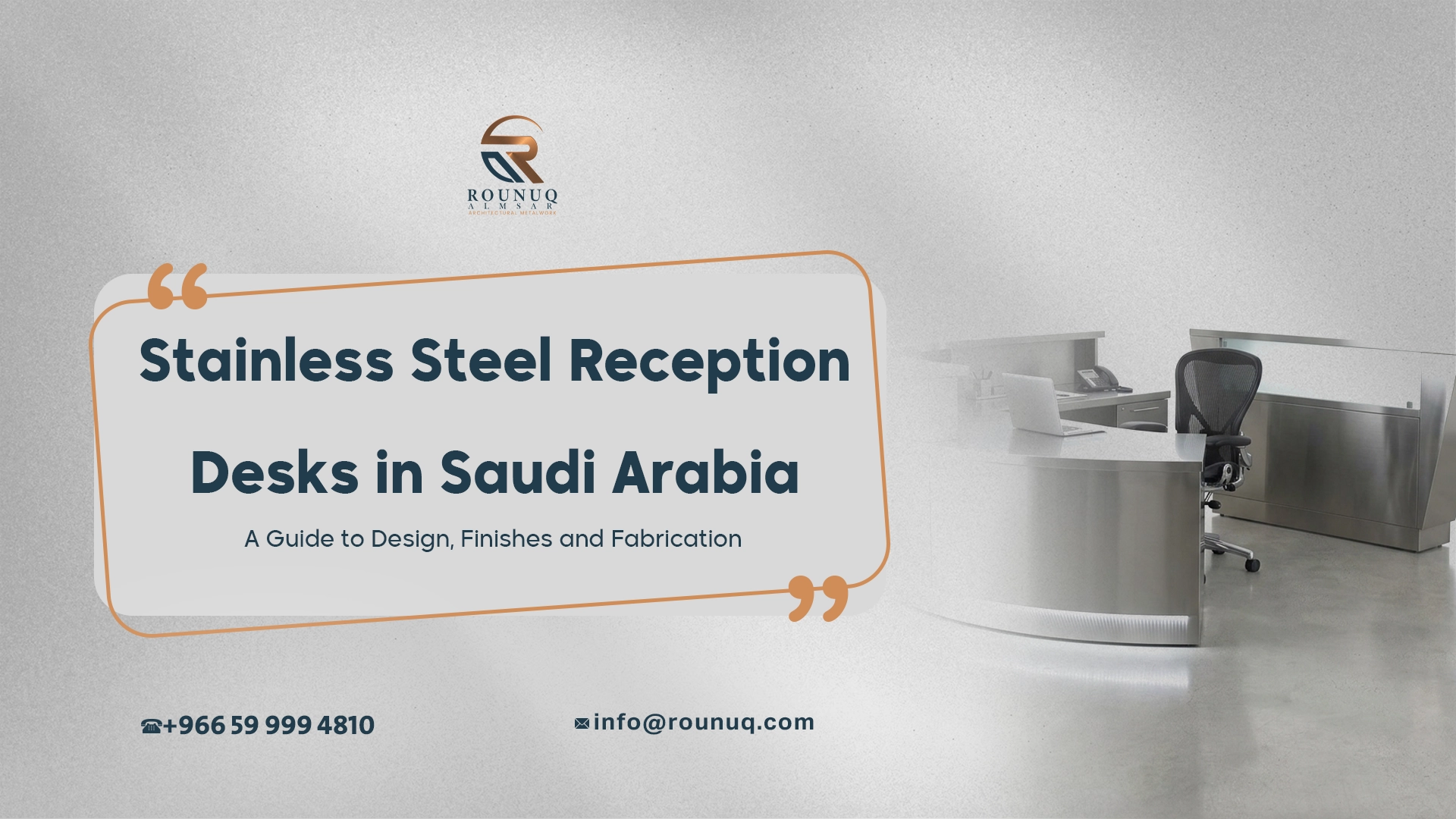
Stainless Steel Reception Desks in Saudi Arabia: A Guide to Design, Finishes and Fabrication
A reception desk gets judged in the first five seconds, and then it gets touched, leaned on and kicked for the next ten years. That combination is why stainless steel reception desks keep appearing in Saudi hotel lobbies, clinics, bank branches and corporate headquarters. The metal looks sharp under lobby lighting and it takes daily punishment better than most finishes.
The catch is that “stainless steel” covers a wide range of results. Two stainless steel reception desks drawn from the same concept can end up very different: one crisp and flat with a warm PVD gold band, the other wavy, covered in fingerprints and scratched within months. The difference is almost always in the grade, the sheet thickness, the finish and how the desk was built.
This guide is written for interior designers, fit-out contractors and owners specifying a stainless steel reception counter (كاونتر استقبال ستانلس ستيل) in Saudi Arabia. It covers what these desks are actually made of, which finishes hide fingerprints, how they’re fabricated, what drives cost in SAR and the mistakes that show up after handover.
What Stainless Steel Reception Desks Are Made Of
Most stainless steel reception desks aren’t solid metal. They’re a structure clad in stainless sheet.
A typical build has three layers:
- A substructure, usually a welded steel frame, sometimes a timber or MDF carcass for simpler desks.
- A backing layer that the stainless sheet is bonded or fixed to, which keeps large flat panels from flexing.
- The stainless skin, cut, folded and finished to the design, with the worktop in stainless, stone or solid surface.
This matters because the substructure decides how rigid the desk feels and how flat the panels stay. A thin sheet stretched over a weak frame will “oil-can”, meaning the panel shows a visible ripple when light rakes across it. On a lobby desk lit by downlights, that ripple is the first thing a visitor notices.
Front panels on curved desks are usually rolled, while straight desks rely on folded edges. Sharp, tight corners on folded panels often come from V grooving before press-brake bending, which lets the fold sit close to a true right angle instead of a soft radius.
Choosing the Right Stainless Steel Grade
Grade is the first line of the specification, and it’s where cheap desks cut corners.
Grade 304 is the standard austenitic grade for interior work. It resists everyday moisture, cleaning products and handling, and it’s what most interior stainless steel reception desks use.
Grade 316 adds molybdenum, which improves resistance to chlorides. It’s worth paying for when the desk sits somewhere that sea air reaches, such as an open-sided resort reception in Jeddah or on the Red Sea coast, a pool bar, or a lobby with large doors that stay open to the humid air in Dammam or Jubail.
Grade 430 is a ferritic grade that costs less and is weakly magnetic. It has noticeably lower corrosion resistance, and it’s a poor choice for high-touch surfaces that get wiped daily. If a quotation looks surprisingly low, ask which grade is being quoted.
A simple test on site: a magnet sticks firmly to 430 but only weakly or not at all to annealed 304 or 316. It isn’t a laboratory check, but it catches obvious substitutions. Cold-worked areas of 304 can show slight magnetism, so treat it as a warning sign rather than proof.
Finishes: Which Ones Hide Fingerprints and Scratches
Finish decides how the desk looks on day one and how it looks in year five. The table below compares the finishes most often used on stainless steel reception desks.
| Finish | Look | Fingerprint visibility | Scratch visibility | Best suited to |
|---|---|---|---|---|
| Hairline / brushed (No. 4) | Fine linear grain, soft sheen | Low to medium | Low if scratches follow the grain | Corporate offices, clinics, banks |
| Vibration | Random swirl texture, matte | Low | Very low | High-traffic lobbies, front panels |
| Bead-blasted | Uniform matte, satin | Low | Low | Contemporary interiors, kick zones |
| Mirror (No. 8) | Reflective, jewel-like | Very high | Very high | Feature bands, logos, trims only |
| PVD colored (gold, rose gold, bronze, black) | Colored metal on any of the above textures | Depends on base texture; dark colors show more | Depends on base texture | Hotels, luxury retail, showrooms |
| Anti-fingerprint (AFP) coated | Same as base finish, slightly softer sheen | Low | Same as base finish | Any high-touch surface |
Two practical rules come out of that table.
First, texture beats color for durability. A vibration or hairline base hides the small marks that a busy reception counter collects. Mirror finish looks spectacular in renders and lasts about a week in real use before the smudges show, so keep it to small accents.
Second, PVD is a coating on top of a texture. Gold PVD over a vibration finish behaves very differently from gold PVD over mirror. Rounuq’s guide to vibration finish with PVD coating explains why that pairing is popular for high-end reception areas: the swirl texture disguises fine scratches while the PVD layer carries the color. If you want to compare finish designations in more depth, the worldstainless guide to stainless steel finishes is a useful industry reference.
Stainless Steel vs. Other Reception Desk Materials
Stainless isn’t automatically the right answer. Here’s how it compares with the materials Saudi fit-out contractors usually weigh it against.
| Material | Durability at the counter edge | Maintenance | Look | Typical limitation |
|---|---|---|---|---|
| Stainless steel (304, textured) | Very high | Wipe clean; follow the grain | Modern, premium | Needs a rigid substructure to stay flat |
| Wood veneer or laminate | Medium; edges chip and swell | Low to medium | Warm | Edges and kick zones wear quickly |
| Solid surface (acrylic) | Medium; can scratch and scorch | Scratches can be sanded out | Joint-free, curved forms | Less premium feel up close |
| Natural stone (marble, granite) | High for tops, heavy for fronts | Sealing needed; marble stains | Luxurious | Weight, joints and cost on large fronts |
Many of the best stainless steel reception desks combine materials: a stainless front and plinth for impact resistance, with a stone or solid-surface worktop where guests actually write and rest their hands. Stainless also stays cool to the touch in an air-conditioned lobby, which some owners like and some don’t, so it’s worth deciding where people’s hands will rest.
Where Stainless Steel Reception Desks Work Best in Saudi Projects
The material earns its place in a few recurring settings:
- Hotels and serviced apartments: PVD gold, bronze or champagne tones are common in Saudi hospitality interiors, and the metal copes with luggage knocks at the front.
- Clinics and hospitals: a non-porous, easy-to-disinfect surface suits healthcare reception areas, as long as the cleaning products are compatible (see the maintenance section below).
- Banks, government service centers and corporate headquarters: brushed or bead-blasted stainless reads as formal and secure, and it integrates well with logos and signage.
- Car showrooms and luxury retail: mirror accents, LED lines and laser-cut logos turn the desk into part of the brand display.
In a lobby that already uses metal elsewhere, the desk should match. If the same space has stainless steel cladding on columns or feature walls, or elevator cladding in a matching finish, specify the desk finish from the same sample board so the tones don’t drift.
Design Details That Separate a Good Desk From a Poor One
Heights and Accessibility
Stainless steel reception desks usually combine a raised transaction ledge for standing visitors with a lower worktop for staff. Saudi accessibility guidance from the King Salman Center for Disability Research states that reception counters should include at least one section usable by someone seated in a wheelchair. Build that lowered section into the design from the first sketch. Adding it late usually means a clumsy cut-out in an otherwise clean stainless front.
Panel Flatness
Large flat stainless panels need thickness, backing and sometimes deliberate breaks such as folds, grooves or reveals. A textured finish also hides minor waviness far better than mirror. If the design shows a 3-meter unbroken mirror front, expect the fabricator to push back, and listen.
Lighting, Logos and Services
Stainless steel reception desks often carry LED strips under the ledge or behind a laser-cut logo. Decide early where the drivers sit and how they’re accessed, because a sealed stainless box with a dead LED driver inside is an expensive problem. The same applies to power sockets, data cables, card terminals and CCTV. Plan removable access panels on the staff side.
Laser-cut patterns or perforated metal panels can add depth to a front face, especially when backlit.
Kick Zones and Edges
On stainless steel reception desks, the bottom 150 to 200 mm of the visitor side takes shoe scuffs and trolley hits. A recessed plinth or a bead-blasted band there keeps the main front looking clean. Worktop edges should be folded or rounded so they don’t feel sharp against forearms.
How Stainless Steel Reception Desks Are Fabricated
Bespoke stainless steel reception desks usually follow this sequence:
- Site survey and shop drawings: dimensions, finishes, joints, services and access panels agreed before any metal is cut.
- Cutting: laser cutting for panels, openings and logos.
- Forming: V grooving, press-brake bending and rolling for curves.
- Welding and dressing: joints welded, ground and blended so they disappear into the finish.
- Surface finishing: hairline, vibration or bead blasting, then PVD coloring if specified.
- Assembly and dry fit: modules assembled in the workshop to check alignment.
- Protection, delivery and installation: protective film stays on until the end of the fit-out.
The order of steps five and six matters. Welding or heavy grinding after PVD damages the coating, so fabrication should be complete before final finishing. Rounuq’s stainless steel guidance makes the same point about finishing only after cutting, bending and welding are done.
One logistics point catches many Saudi fit-out projects: the desk has to get into the building. A long curved reception desk for a hotel on an upper floor must be split into modules that fit through the service lift, corridors and doors. Measure these routes during the survey, not after production.
Buying Stainless Steel Reception Desks in Saudi Arabia: Cost and Quotation Tips
Nobody can quote a fair price for a bespoke desk without drawings, so treat per-meter prices from catalogs with caution. For stainless steel reception desks, cost in SAR is mainly driven by:
- Grade (430, 304 or 316) and sheet thickness.
- Overall length, height and number of modules.
- Geometry: straight runs cost far less than curves, tapers or double curves.
- Finish: brushed and bead-blasted are simpler than vibration; PVD color adds a further process.
- Worktop material, such as stainless, stone or solid surface.
- Integrated extras like LED lighting, laser-cut logos, glass and cable management.
- Delivery city, floor level, site access and installation hours.
Imported, off-the-shelf desks can look cheaper on paper, but check whether the grade, finish quality and dimensions really match the space, and who handles installation and after-sales. Also confirm whether each quotation includes VAT at 15% so you’re comparing like with like.
To get an accurate quotation, send:
- Plan and elevation drawings, or at least overall dimensions and a reference image.
- Preferred grade, finish and PVD color, ideally with a physical sample.
- Worktop material and any lighting, logo or equipment requirements.
- The project city, the floor level and access route, and whether installation is included.
- The required completion date.
For premium lobbies, ask for a finish sample at real size. A 10 cm swatch of rose gold under showroom light can look quite different on a 4-meter front under your actual lobby lighting.
Cleaning and Maintenance
Stainless steel reception desks are easy to keep clean if staff use the right method from the start.
- Wipe with a soft cloth and mild soapy water, then dry to avoid water spots.
- On brushed and hairline finishes, always wipe along the grain.
- Avoid chloride-based cleaners and bleach, and never use steel wool or scouring pads, which leave iron particles that can later rust on the surface.
- For PVD finishes, check the finisher’s cleaning guidance, since abrasive products can wear through the colored layer.
The worldstainless cleaning and maintenance guidance covers fingermarks, stains and stronger cleaning methods in detail. In clinics, confirm that the disinfectants in use are compatible with stainless steel before handover.
Common Mistakes When Specifying a Stainless Reception Desk
Most disappointing stainless steel reception desks trace back to decisions made on paper.
Choosing mirror finish for the whole front. It looks perfect in the render and smudged within days.
Accepting “stainless steel” without a grade. Ask for 304 or 316 in writing.
Specifying thin sheet without backing. The panels ripple under lobby lighting.
Forgetting access panels. LED drivers and cables will need service.
Ignoring the delivery route. A desk that doesn’t fit the lift gets cut on site, and the joints show.
Leaving accessibility until the end. A lowered section added late rarely looks intentional.
Frequently Asked Questions About Stainless Steel Reception Desks
Are stainless steel reception desks durable?
Yes, when they’re built in 304 or 316 over a rigid substructure with a textured finish. The metal resists impact, moisture and cleaning far better than laminate or veneer edges.
Which finish is best for a busy reception desk?
A vibration, hairline or bead-blasted finish, optionally with an anti-fingerprint coating. Keep mirror finish to small accent bands.
Do stainless steel reception desks show fingerprints?
Mirror and dark PVD finishes show them clearly. Textured finishes and anti-fingerprint coatings reduce them a lot.
Is 304 or 316 better for a reception desk in Saudi Arabia?
304 suits most air-conditioned interiors. 316 is worth it for coastal, semi-outdoor or poolside receptions in cities like Jeddah, Dammam or Jubail.
Can stainless steel reception desks have gold or black colors?
Yes. PVD coating adds gold, rose gold, bronze, champagne or black to stainless steel, applied after fabrication on top of the chosen texture.
How much does a stainless steel reception desk cost in Saudi Arabia?
It depends on grade, size, geometry, finish, worktop, lighting and installation. Reliable prices in SAR come only from a quotation based on drawings.
Can a stainless reception desk be curved?
Yes. Curved fronts are rolled and then finished. Curves add fabrication time and usually require the desk to be split into modules for delivery.
How do I clean a stainless steel reception desk?
Use mild soapy water and a soft cloth, wipe along the grain, dry it, and avoid bleach, chlorides and abrasive pads.
Planning Your Reception Desk
A good stainless reception desk comes from a short list of decisions made early: the right grade, a textured finish that forgives daily use, a rigid substructure, service access and a delivery route that works. Get those right and the desk will still look sharp long after the rest of the lobby has been repainted.
Rounuq Al Msar works with stainless steel from its Saudi factory, using laser cutting, CNC bending, rolling, welding and PVD finishing for bespoke architectural and fit-out elements. If you’re planning a custom stainless reception counter, you can share your drawings and finish preferences with the team to discuss fabrication options.
1 Comment
Metal Feature Walls in Saudi Arabia: Design & Project Guide
October 13, 2026
[…] Consistency matters more than drama. The reception wall, the reception desk, the lift cladding and the door frames should all read as one material family. Mixed finishes in […]