
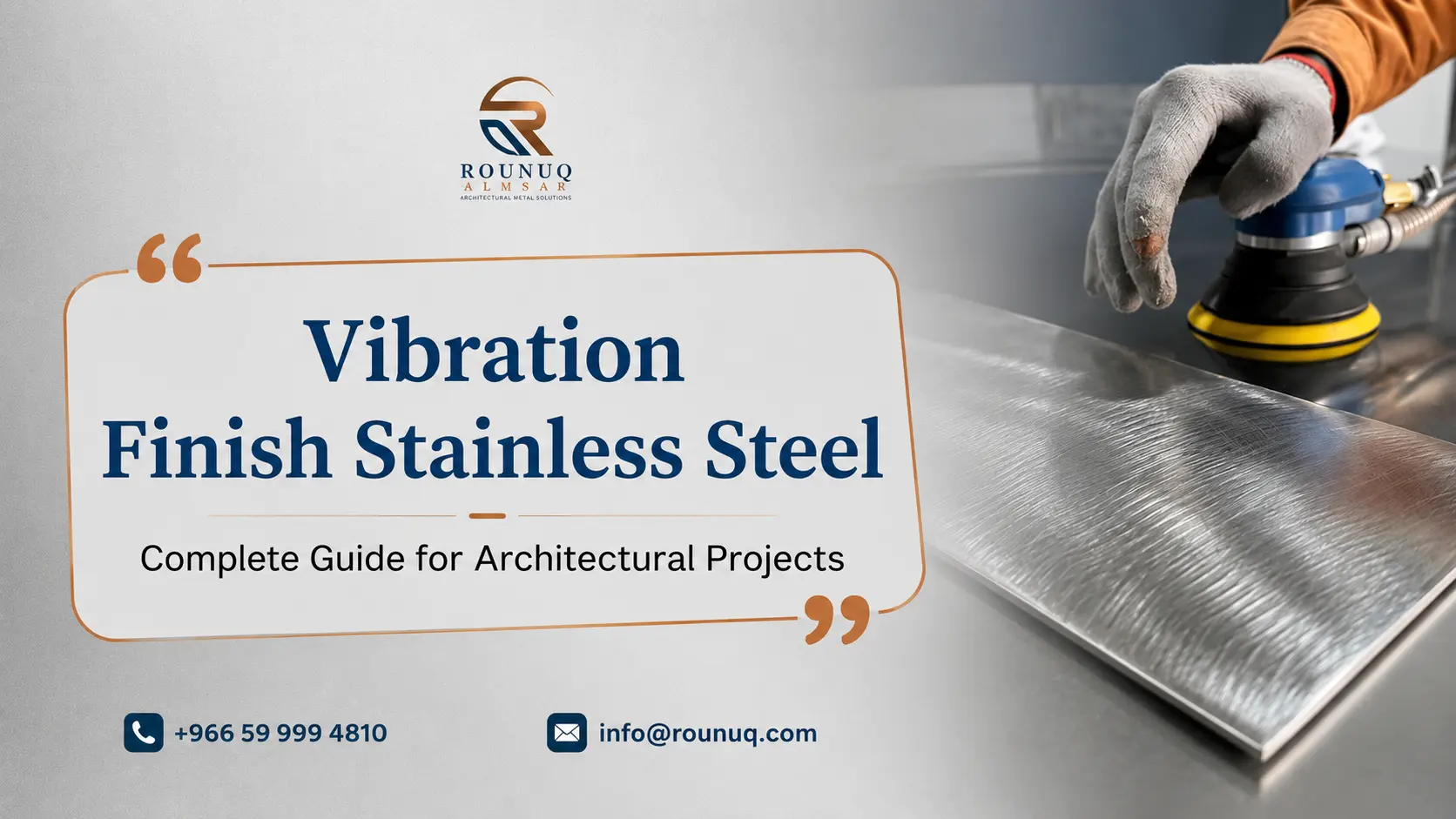
Vibration Finish Stainless Steel: Complete Guide for Architectural Projects
When stainless steel is specified for an architectural project, the material itself is only part of the decision. The surface finish can significantly change how the metal reflects light, how visible everyday marks are, how different panels relate to one another, and ultimately how the finished space feels.
One finish that has become particularly useful for contemporary interiors and architectural metalwork is the vibration finish.
A vibration finish is a mechanically created, non-directional surface texture made by working the stainless-steel surface with abrasive equipment. Instead of producing one continuous grain direction like a conventional hairline finish, the process creates overlapping marks that form a more random, multidirectional appearance. The result is generally softer and less reflective than a mirror surface while retaining the character of stainless steel.
This makes vibration-finished stainless steel particularly interesting for feature walls, columns, elevator interiors, reception areas, decorative panels, furniture elements, and other architectural applications where designers want texture without introducing a heavily patterned material.
For projects in Saudi Arabia, however, choosing the finish should not be based on appearance alone. The stainless-steel grade, application, lighting conditions, fabrication method, environmental exposure, coating system, and maintenance requirements all need to be considered together.
What Is Vibration Finish?
Vibration finish is a non-directional stainless-steel surface finish created through controlled mechanical abrasion.
During finishing, abrasive equipment moves across the stainless-steel surface in overlapping or multidirectional motions. Rather than creating a single straight grain, the process produces a subtle network of fine marks that gives the sheet a textured, dynamic appearance.
The exact appearance can vary depending on the abrasive process, equipment, pressure, movement pattern, base surface, and finishing specification. This means that two samples described generally as “vibration” should not automatically be assumed to look identical.
That point is important in architectural work.
A finish sample should be approved before production because the visual effect can influence the appearance of large wall panels, elevator cladding, columns, ceilings, and other continuous surfaces.
What does vibration finish look like?
A typical vibration finish has:
- A non-directional grain pattern
- Fine overlapping or circular marks
- Low to moderate reflectivity
- A textured but refined appearance
- A softer visual character than mirror-polished stainless steel
- A more dynamic surface than a conventional directional hairline finish
Depending on the process and substrate, the finish can range from relatively subtle to more pronounced.
The pattern also interacts with light differently from a uniform brushed surface. As the viewing angle changes, the overlapping texture can produce slight variations in reflection, giving the material more visual depth.
How Is Vibration Finish Created?
The basic principle is mechanical surface treatment.
A stainless-steel sheet is prepared and then processed with abrasive equipment that creates the characteristic multidirectional pattern. Manufacturers can adjust the process to influence the density, scale, and visual strength of the texture.
A simplified production sequence can look like this:
1. Select the stainless-steel substrate
The stainless-steel grade and starting surface need to be appropriate for the intended application.
Common architectural grades can include 304 and 316, although the appropriate grade depends on the environment and project requirements.
2. Prepare the surface
The sheet needs to be clean and properly prepared before finishing.
Contamination, scratches, dents, welding marks, or inconsistent preparation can affect the final appearance.
3. Apply the vibration process
Specialized abrasive equipment creates the multidirectional texture.
The process parameters influence how fine, dense, deep, or visible the resulting pattern becomes.
4. Inspect the finished surface
Inspection should consider:
- Uniformity
- Texture consistency
- Color consistency where applicable
- Scratches or unwanted marks
- Edge conditions
- Differences between samples and production panels
5. Apply additional treatment when specified
Vibration stainless steel can also be combined with other finishing technologies.
One important example is PVD coating, which can introduce colors such as bronze, gold, black, or other architectural tones while maintaining the underlying texture.
Rounuq Al Msar’s existing technical content also describes a workflow in which stainless steel is prepared, finished, cleaned, and subsequently treated with PVD for colored architectural applications.
Why Choose Vibration Finish Stainless Steel?
The strongest reason to choose a vibration finish is not simply that it “looks luxurious.” Its value comes from the combination of visual texture and practical surface behavior.
1. Non-directional appearance
A conventional brushed or hairline finish has a defined grain direction.
Vibration finish is different.
Because the pattern is multidirectional, the designer has greater flexibility when considering panel orientation and the visual continuity between pieces. Some manufacturers specifically describe this non-directional characteristic as an advantage during installation because there is less dependence on one grain direction.
This does not mean panel layout becomes irrelevant. Large architectural installations still require careful planning, particularly when samples, fabrication batches, or different production runs are involved.
2. Helps disguise minor surface marks
The texture can make small scratches, fingerprints, and everyday imperfections less visually obvious than they might be on highly reflective surfaces.
This is one reason textured stainless-steel finishes can work well in areas that receive regular contact or traffic.
However, it is important not to interpret this as “scratch-proof.”
Vibration finish can reduce the visual prominence of minor marks; it does not make stainless steel immune to scratching.
3. Creates visual depth
Mirror stainless steel produces strong reflections.
A vibration finish produces a much softer interaction with light.
The multidirectional surface can create subtle changes in brightness across the panel, helping a large metal surface feel more visually interesting without relying on a bold decorative pattern.
4. Works with contemporary architectural styles
The finish is particularly suitable where the design calls for:
- Minimalist interiors
- Luxury hospitality environments
- Contemporary retail
- Premium reception areas
- Modern elevator interiors
- Decorative wall panels
- Feature columns
- High-end furniture details
5. Can be combined with PVD
One of the most interesting possibilities is combining a vibration texture with a PVD coating.
PVD, or Physical Vapor Deposition, is a coating technology used to create colored and functional architectural metal surfaces. Outokumpu also identifies PVD/TiN coating as one of the further-processing options available for stainless steel.
The result can be a colored textured surface rather than conventional silver stainless steel.
For example, a vibration texture combined with a bronze or aged-brass appearance can create a warmer architectural finish while retaining the underlying texture.
Vibration Finish vs. Hairline vs. Mirror Finish
One of the most common specification mistakes is selecting a stainless-steel finish based only on a photograph.
Different finishes behave differently under lighting, and the difference can become much more obvious once the material covers a large surface.
| Finish | Surface Character | Reflectivity | Grain Direction | Appearance | Typical Architectural Uses |
|---|---|---|---|---|---|
| Vibration | Fine multidirectional texture | Low–moderate | Non-directional | Dynamic, refined | Feature walls, elevators, columns, decorative panels |
| Hairline | Long linear brushing | Low–moderate | Directional | Clean and linear | Cladding, columns, elevators, interiors |
| Mirror | Highly polished | High | No visible grain | Reflective and dramatic | Feature elements, luxury interiors, decorative panels |
| Satin/Brushed | Fine linear texture | Low–moderate | Usually directional | Soft and understated | Wall panels, handrails, architectural interiors |
| Bead Blasted | Fine matte texture | Low | Generally non-directional | Soft, diffuse | Architectural surfaces requiring reduced reflection |
| Patterned | Engineered decorative pattern | Varies | Depends on pattern | Strong visual identity | Feature walls, elevators, decorative applications |
Brushing and polishing are established methods for producing decorative stainless-steel surfaces, and the resulting surface characteristics can vary significantly depending on the process. Outokumpu, for example, describes brushing as producing a softer, less pronounced and longer scoring compared with polishing.
Which finish should you choose?
A useful rule is:
Choose vibration when you want texture and visual movement without a strong directional grain.
Choose hairline when you want a clean, linear architectural appearance.
Choose mirror when reflection itself is an important part of the design.
Choose matte or blasted finishes when controlling reflection is a higher priority.
The correct decision ultimately depends on the project rather than the finish name alone.
Vibration Finish and PVD: Why Combine Them?
The combination of vibration finish + PVD stainless steel is particularly relevant to luxury architectural projects.
The vibration process establishes the physical surface texture, while PVD can introduce a colored coating.
This creates two different design dimensions:
Texture: created through mechanical surface finishing.
Color: introduced through the coating process.
That distinction is important when specifying the material.
PVD should not be described as simply “painting stainless steel.” It is a physical vapor deposition process in which a coating is deposited onto the surface under controlled conditions. The technology is widely used for decorative stainless-steel applications and can provide a range of architectural colors.
Common design directions
Depending on the supplier and approved finish range, vibration stainless steel may be combined with colors such as:
- Gold
- Bronze
- Black
- Rose gold
- Aged-brass tones
- Other custom architectural colors
The final color should always be approved using a physical sample under representative lighting.
A screen image is not sufficient for final color approval.
Where Can Vibration Finish Stainless Steel Be Used?
Vibration finish is especially useful when the metal surface is intended to be visible rather than hidden.
Feature walls
Large feature walls can benefit from the texture because the surface changes subtly as lighting and viewing angles change.
This can prevent a large stainless-steel wall from appearing completely flat or excessively reflective.
Columns
Column cladding is another strong application.
The non-directional appearance can work particularly well on architectural columns where designers do not want a strong linear grain to dominate the form.
Elevator interiors
Elevator cabins are frequently exposed to fingerprints, contact, luggage, and daily traffic.
A textured, non-directional stainless-steel surface can therefore be an attractive alternative to a highly reflective finish. Architectural metal suppliers commonly list elevator interiors among the applications for vibration finishes.
Reception desks and counters
Vibration stainless steel can add texture to reception areas without requiring a heavily decorative pattern.
Where the surface will receive frequent contact, the specification should also consider cleaning, edge protection, fabrication details, and the suitability of the selected stainless-steel grade.
Decorative panels
The finish can be used for:
- Wall panels
- Door surrounds
- Lift surrounds
- Decorative screens
- Furniture details
- Feature elements
- Interior architectural metalwork
Ceilings
Vibration-finished stainless steel can also be considered for decorative ceiling elements where the design benefits from subtle reflection and texture.
Rounuq, for example, provides stainless-steel and other architectural metal ceiling systems with mirror, brushed, and PVD finish options.
Facade applications
Exterior use requires more careful specification.
The selected stainless-steel grade, environment, exposure, detailing, cleaning regime, and coating system all matter.
Stainless steel has inherent corrosion resistance, but the appropriate grade should be selected according to the environment rather than assuming that every stainless-steel grade performs identically. Outokumpu recommends considering the corrosivity of the built environment when selecting stainless steel for facades.
Is Vibration Finish Suitable for Saudi Arabian Projects?
It can be, but the finish should be specified together with the appropriate material and environmental requirements.
Saudi projects can include demanding conditions such as high solar exposure, dust, temperature variation, urban pollution, and—in coastal locations—salt-laden air.
The finish itself does not determine corrosion resistance.
The stainless-steel grade, environmental exposure, fabrication quality, cleaning, detailing, and any additional coating all contribute to long-term performance.
For exterior projects, the specification should therefore consider:
- Stainless-steel grade
- Project location
- Distance from the coast
- Environmental corrosivity
- Exposure to pollutants
- Drainage and water retention
- Contact with dissimilar metals
- Cleaning requirements
- PVD or other coating requirements
- Sample approval
Outokumpu notes that corrosivity can vary significantly by environment and identifies ISO 9223 as a useful framework for classifying atmospheric corrosivity.
This is why a finish should never be specified in isolation from the underlying material.
What Stainless-Steel Grade Should Be Used?
There is no single stainless-steel grade that is automatically correct for every vibration-finished application.
Grades such as stainless steel 304 and 316 are commonly encountered in architectural stainless-steel applications, but the final selection should be based on the project’s environment and technical requirements.
304 stainless steel
304 is widely used for architectural and interior applications and can be appropriate where the environment does not impose unusually aggressive corrosion conditions.
316 stainless steel
316 contains molybdenum and is generally selected where increased resistance to chloride-related corrosion is important.
This can make it worth considering for certain coastal or more aggressive environments.
However, choosing 316 solely because a project is in Saudi Arabia is also too simplistic. The actual exposure and design conditions should determine the specification.
ASTM A480/A480M covers general requirements for flat-rolled stainless and heat-resisting steel plate, sheet, and strip, but the specific product specification and project requirements still need to be established.
What Should Architects and Contractors Specify?
A good stainless-steel finish specification should contain more information than simply:
“Vibration stainless steel.”
That description leaves too many variables open.
A more complete specification can address:
- Base material
Specify the required stainless-steel grade. - Thickness
Define the required sheet thickness according to the application and fabrication system. - Surface finish
Specify vibration/non-directional finish and describe the required visual character. - Color
If PVD is required, specify the approved color or reference sample. - Gloss level
Where relevant, identify whether the finish should be matte, satin, or have another specified appearance. - Sample approval
Approve a physical sample before mass production. - Panel direction and joint strategy
Although vibration is non-directional, fabrication and panel layout can still affect visual consistency. - Fabrication requirements
Define bending, welding, folding, edge treatment, and other fabrication requirements. - Installation requirements
Confirm the substructure, fixing system, joints, tolerances, and protection. - Protection and cleaning
Establish how finished panels are protected during transportation and construction.
Why Sample Approval Matters
A physical sample is one of the most important steps in architectural metal finishing.
The reason is simple: a finish is visual and physical.
The appearance can change depending on:
- Lighting direction
- Light intensity
- Viewing angle
- Panel size
- Texture density
- Base material
- PVD color
- Gloss level
- Adjacent materials
A small sample may look different from a full-size panel under architectural lighting.
For a high-value interior or facade, it is therefore sensible to approve a representative sample or mock-up before committing to full production.
This is especially important when the finish combines vibration texture with PVD.
Common Mistakes When Specifying Vibration Finish
Mistake 1: Treating all vibration finishes as identical
The term describes a general surface treatment, but the exact visual result can vary.
Better approach: approve a physical sample.
Mistake 2: Choosing the finish from a website photograph
Online images are useful for understanding the general appearance, but they should not replace physical samples.
Lighting and screen settings can significantly alter the perceived finish.
Mistake 3: Focusing only on appearance
A beautiful finish can still be inappropriate if the underlying stainless-steel grade or fabrication system does not suit the environment.
Better approach: evaluate material, finish, exposure, fabrication, and maintenance together.
Mistake 4: Assuming vibration means scratch-proof
The texture can help make minor marks less noticeable, but stainless steel can still be scratched.
Mistake 5: Ignoring fabrication
Welding, bending, cutting, and handling can create visible differences.
The finishing sequence should therefore be coordinated with the fabrication process rather than treated as an isolated final step.
Mistake 6: Approving color without checking the actual installation lighting
A PVD color can appear different under daylight, warm interior lighting, cool LEDs, or different viewing angles.
Better approach: evaluate the sample under lighting conditions representative of the final space.
How Rounuq Al Msar Can Approach Vibration-Finished Architectural Metalwork
For a project that requires decorative stainless-steel cladding, the finish should be considered as part of the complete fabrication process rather than as a standalone surface choice.
Rounuq Al Msar provides architectural metal cladding solutions using stainless steel, aluminum, and copper, with applications including feature walls, columns, ceilings, facades, and custom architectural elements. Its service offering also includes PVD-coated stainless-steel cladding for high-end fit-out applications.
The practical workflow can be considered as:
Design → Material Selection → Fabrication → Surface Finishing → PVD/Coating Where Required → Inspection → Installation
This approach helps ensure that the appearance specified by the architect is considered throughout the manufacturing process.
For projects involving complex geometry, multiple panels, visible joints, or colored PVD surfaces, early coordination between the architect, interior designer, contractor, and metal fabricator can prevent expensive changes later.
Vibration Finish as a Design Choice, Not Just a Finish
The most useful way to think about vibration finish is as a balance between texture, reflection, durability, and architectural expression.
A mirror surface can make a dramatic statement, but it also emphasizes reflections and surface marks.
A hairline finish gives a clean linear appearance, but its grain direction needs to be managed.
A vibration finish sits in a different position.
Its multidirectional texture creates movement without introducing an obvious decorative pattern. It can make stainless steel feel warmer and more tactile while maintaining a contemporary architectural character.
That makes it particularly valuable when the design needs metal to be visible but not overwhelming.
Choosing the Right Finish: A Practical Decision Framework
Before approving a vibration finish, ask these questions:
What is the application?
Is it an elevator, wall, column, ceiling, reception desk, facade, or furniture element?
How much contact will the surface receive?
High-contact areas may benefit from a texture that visually reduces the prominence of minor marks, but maintenance requirements still need to be considered.
Is the surface interior or exterior?
Exterior applications require environmental and corrosion considerations beyond the visual finish.
Does the design require color?
If yes, investigate PVD or another appropriate coloring process.
Is a directional grain desirable?
If the answer is yes, hairline or another directional finish may be more appropriate.
How reflective should the surface be?
Vibration is generally more subdued than mirror-polished stainless steel.
Has a physical sample been approved?
If not, the specification is not yet visually complete.
Frequently Asked Questions
What is vibration finish on stainless steel?
Vibration finish is a non-directional mechanical surface treatment that creates overlapping, multidirectional marks on stainless steel. It produces a textured appearance with relatively subdued reflection.
Is vibration finish the same as hairline finish?
No. Hairline finishes generally have a visible directional grain, while vibration finish is typically non-directional and formed from overlapping marks.
Is vibration stainless steel suitable for elevators?
Yes. It is commonly used for elevator interiors and other architectural surfaces where a textured, refined appearance is desired.
Does vibration finish hide scratches?
It can make minor scratches and everyday surface marks less visually noticeable because of its textured appearance. It does not make the stainless steel scratch-proof.
Can vibration finish be combined with PVD?
Yes. Vibration texture can be combined with PVD coloring to create colored architectural stainless-steel surfaces. The exact available colors and appearance depend on the coating system and approved finish.
Is vibration finish suitable for exterior facades?
It can be, but exterior suitability depends on the stainless-steel grade, environmental exposure, detailing, maintenance, and coating requirements. The finish alone does not determine corrosion performance.
Is vibration finish matte or glossy?
It is generally less reflective than mirror-polished stainless steel and can have a matte to satin-like appearance. The exact appearance depends on the finishing process and substrate.
Which is better: vibration or hairline stainless steel?
Neither is universally better. Vibration is preferable when a non-directional textured appearance is wanted, while hairline is often preferable when a clean directional grain is part of the design.
What stainless-steel grade should be used for vibration finish?
304 and 316 are both used in architectural stainless-steel applications, but the appropriate grade should be selected according to the project environment and performance requirements rather than finish preference alone.
Should I approve a vibration finish sample before production?
Yes. A physical sample or mock-up is strongly recommended, particularly for large architectural surfaces and projects combining vibration texture with PVD color.
Conclusion: Is Vibration Finish Right for Your Project?
Vibration finish stainless steel is a strong option when a project needs refined texture, subdued reflection, and a non-directional architectural appearance.
Its main advantage is the balance it creates: the material remains recognizably stainless steel, but the surface becomes more visually complex and less dependent on a single grain direction.
For architects, interior designers, contractors, and project owners, the best results come from treating the finish as part of the complete specification.
The decision should consider:
- Stainless-steel grade
- Interior or exterior exposure
- Required appearance
- Lighting conditions
- Fabrication method
- PVD requirements
- Maintenance
- Sample approval
- Installation details
For projects where the finish needs to work together with custom fabrication and architectural cladding, early technical coordination is especially valuable.
If your project in Saudi Arabia requires vibration finish stainless steel, PVD stainless-steel cladding, feature walls, columns, ceilings, or other bespoke architectural metalwork, Rounuq Al Msar can discuss the required finish, material, application, and fabrication approach with your project team.
8 Comments
Metal Fabrication Projects: 9 Impressive Ideas & Examples
August 25, 2026
[…] Vibration finish […]
Manufacturing Companies in Riyadh: 7 Proven Selection Tips
August 25, 2026
[…] The company also has a technical article explaining vibration finishing before PVD coating. […]
Sandblasted Finish: A Practical Guide to Stainless Finishes
August 26, 2026
[…] existing Vibration Finish guide explains that vibration finishing produces a non-directional texture and can be used for feature […]
Metal Wall Panel: Essential Tips for Choosing the Right one
August 31, 2026
[…] vibration finish creates a non-directional textured […]
Architectural Powder Coating: 12 Essential Checks
August 31, 2026
[…] That places it in a different category from finishes that modify the metal surface itself. A vibration finish on stainless steel works the surface mechanically, and a sandblasted finish alters texture through abrasive impact. […]
What Is the Best Stainless Steel Finish for Saudi Projects?
September 7, 2026
[…] dedicated vibration finish stainless steel guide provides additional information about this surface treatment and its architectural […]
Custom Metal Projects in Saudi Arabia: 7 Stunning Examples
September 27, 2026
[…] and colored PVD finishes give very different results, and we’ve written a full guide to vibration finish with PVD […]
Custom Metal Forming in Saudi Arabia: 4 Essential Processes
September 27, 2026
[…] mirror, vibration and PVD stainless steel finishes all show tooling marks clearly. Our guide to vibration finish on stainless steel explains why surface preparation matters so much on premium […]