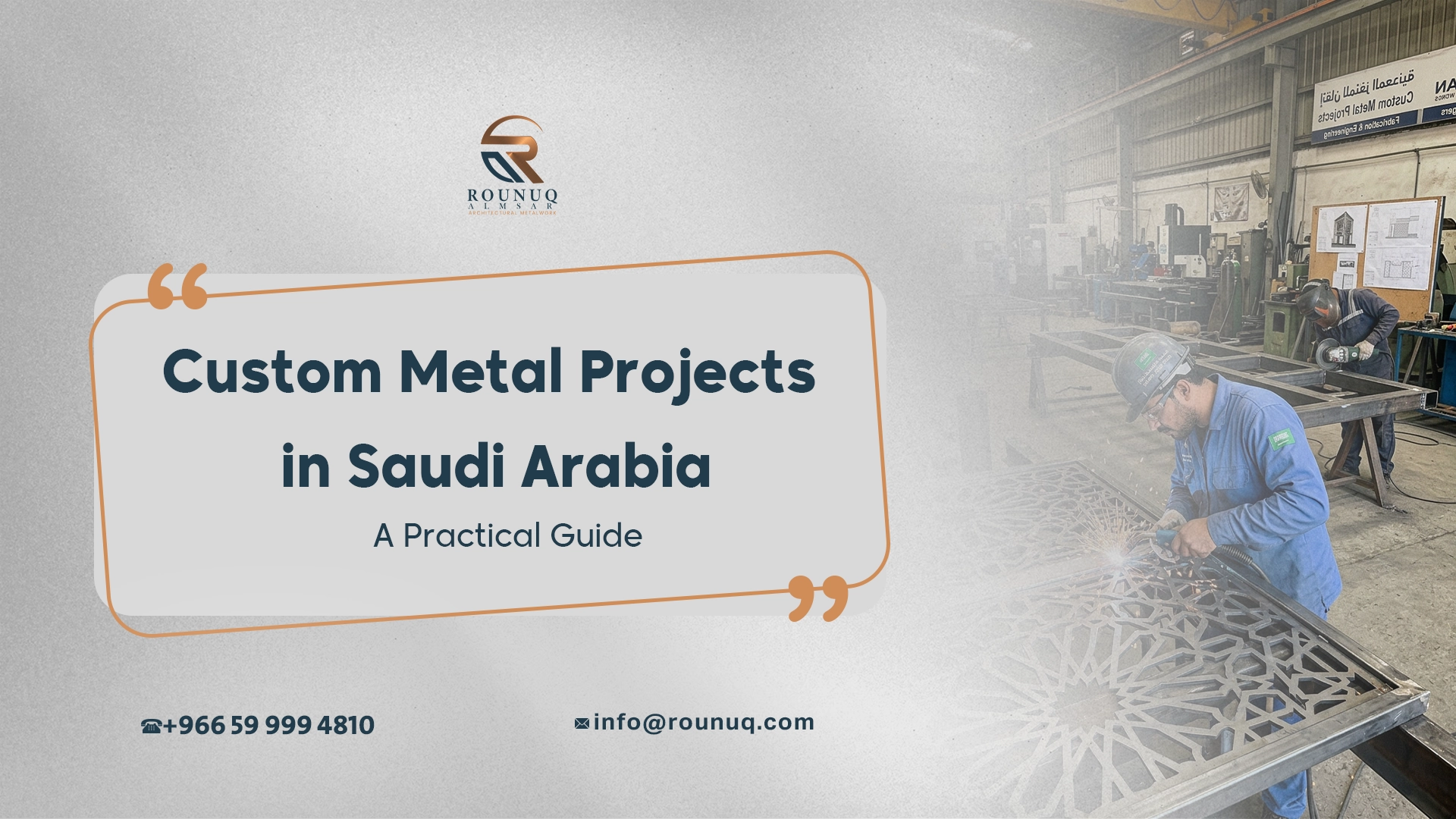
Custom Metal Projects in Saudi Arabia: 7 Stunning Examples
A custom metal project starts where a catalog product stops fitting. The wall is an odd length, the finish has to match a stair two floors up, or the pattern on a screen is part of the building’s identity. At that point someone has to turn a drawing into metal that can be cut, formed, finished, moved through a doorway and fixed to a real site.
That’s our work at Rounuq Almsar. Since 2015 we’ve delivered custom metal projects from our factory in Riyadh’s New Industrial Area, for malls, offices, restaurants, entertainment venues and private villas.
This page covers what custom metal projects involve and the projects we’ve delivered in Saudi Arabia. It also explains which materials and finishes suit which jobs, and how the local climate changes the specification.
What Are Custom Metal Projects?
They’re metal components or assemblies designed for one specific application instead of being picked from a standard range.
A project can start from full architectural drawings. It can also start from a sketch, a 3D model, a reference photo, or just a list of functional needs. Our job is to translate that into dimensions, material, fabrication details, finish and a fixing method that works on site.
Typical elements include stainless steel cladding, aluminum panels, laser-cut screens, metal ceilings, handrails, stair components, canopies, pergolas, gates, fences, feature walls and façade details.
Custom metal projects are worth it when they solve something: a dimension, a look, a coordination problem, an installation constraint. If a standard product already does the job, it’s usually cheaper and faster to use it.
Where Are Custom Metal Projects Used?
Feature Walls and Decorative Cladding
Reception areas, hotel lobbies, restaurants and shops use metal as the main visual surface. Stainless steel, aluminum, brass, copper and coated steel all read differently under the same lighting, and panel size and joint layout change the result as much as the material does.
In custom metal projects with visible surfaces, drawings need more than overall panel sizes. Corners, joints, access openings, fixing points and grain direction all have to be resolved before cutting. We cover this in more depth in our guide to stainless steel cladding.
Decorative Screens and Laser-Cut Panels
Screens are among the most requested custom metal projects we build. They handle privacy, shading and ventilation while carrying a pattern. Laser cutting lets us produce almost any pattern in sheet metal. But a pattern that looks right on screen still has to survive manufacturing.
The checks that matter most are material thickness, open-area ratio, the smallest cut feature, the supporting frame and wind load. An outdoor screen in Riyadh behaves very differently from a partition in an air-conditioned office.
Metal Ceilings
Ceilings look simple until you add everything above them. Lights, AC outlets, sprinklers, speakers and access panels all have to land in the right module. Our metal ceiling systems are built in aluminum, stainless steel and steel, and we plan module sizes so a single panel can come out for maintenance without disturbing its neighbors.
Handrails and Barriers
A handrail follows the stair, not the drawing. Curved stairs, glass infill and matching finishes make on-site measurement essential before fabrication. We build handrails in stainless steel, steel and glass for homes and commercial buildings.
Canopies and Pergolas
Outdoor structures carry the most engineering. Structural loads, wind, drainage, thermal movement and corrosion protection all shape the design, along with how it will actually be installed. Our canopies and architectural steel structures cover entrances, walkways and shaded outdoor areas.
Gates, Fences and Bollards
Custom gates make sense when standard sizes or styles don’t suit the façade. Hinges or sliding tracks, access control and drainage need to be fixed before fabrication, not after. We also build fences and bollards for architectural and site use.
Custom Metal Projects We’ve Delivered in Saudi Arabia
The custom metal projects below show how different the brief can be from one sector to the next.
Large Commercial Interiors
At King Abdullah Financial District (KAFD) in 2021, most of our work sat where thousands of people touch and look every day. We clad columns, escalators and elevators in stainless steel, then tied it together with handrails, wall panels, mirrors, skirting and metal strips. On escalators and elevators the cladding has to be cut around moving equipment and service access without breaking the finish line.
Al Nakheel Mall in Riyadh (2021) was built around a decorative spiral staircase. The stair was one of nine work packages, which ran from a decorative metal ceiling to shopfronts, metal-and-glass doors and a canopy. In a mall, everything stays on public display and takes heavy daily use, so finishes have to hold up long after handover.
Façades and Glazing
For Nawafez Trading Offices in 2023, the scope ran from the envelope inwards. Outside, we installed the curtain wall, structural glazing, aluminum cladding and a skylight. Inside came staircases, a bridge, and metal and glass handrails. Handling glazing and metal together kept the junctions between them under one team, and that’s where most site problems usually start.
Restaurants
Two Sushi Sushi branches in Riyadh, Al Olaya and Cordoba, both opened in 2025 with stainless steel cladding, stainless trim and perforated aluminum panels. The second branch was the real test. Steel from a different batch can shift in tone, and the perforation pattern still had to line up in a room with different dimensions.
Entertainment Venues
For Boulevard in 2025, we delivered metalworks for the France Zone and the Korean Tower. Seasonal venues open on fixed dates, so fabrication runs on the venue’s schedule.
Functional and Secure Sites
Not every project is decorative. At King Faisal Air Academy in 2021, the main item was a sliding gate on a controlled-access site, plus chequered plate. There, the track and fixings matter far more than the look.
Private Villas
Our 2026 luxury villa work in Riyadh combined stainless steel screens, cladding and partitions with shower glass, mirrors, wooden doors and a sliding gate. A villa owner lives with every detail, and having one contractor coordinate metal, glass and joinery means the edges meet cleanly.
At Palm View in Diriyah, we also delivered a custom metal ceiling.
| Project | Year | Sector | Main custom elements |
|---|---|---|---|
| Luxury villas, Riyadh | 2026 | Residential | Stainless screens, partitions, glass, sliding gate |
| Sushi Sushi (Al Olaya and Cordoba) | 2025 | Restaurant | Stainless cladding and trim, perforated aluminum |
| Boulevard (France Zone, Korean Tower) | 2025 | Entertainment | Metalworks |
| Nawafez Trading Offices | 2023 | Office | Curtain wall, skylight, bridge, glass handrails |
| KAFD | 2021 | Commercial | Stainless cladding, handrails, steel pergola |
| Al Nakheel Mall | 2021 | Retail | Spiral staircase, metal ceiling, shopfronts |
| King Faisal Air Academy | 2021 | Education | Sliding gate, chequered plate |
Which Materials Suit Which Custom Metal Projects?
No single metal wins across all custom metal projects. The right choice depends on exposure, loads, weight, finish and how much maintenance the owner will accept.
| Material | Main advantages | Common applications | Watch out for |
|---|---|---|---|
| Stainless steel | Corrosion resistance, premium look | Cladding, screens, handrails, interiors | Grade, finish, fingerprints, scratches |
| Aluminum | Light weight, good corrosion resistance | Screens, ceilings, façades, panels | Alloy, thickness, forming, connections |
| Mild steel | Strength, easy to fabricate | Structures, stairs, gates, canopies | Needs a proper coating system |
| Copper | Distinctive look that ages | Feature cladding | Patina, compatibility, cost |
| Brass | Warm decorative tone | Interior details | Finish stability, protection |
Stainless steel should never be specified as just “stainless steel”. Grade and finish change everything. Brushed, hairline, mirror, embossed, vibration and colored PVD finishes give very different results, and we’ve written a full guide to vibration finish with PVD coating.
Aluminum is the answer when weight matters, for large ceilings and façade panels especially. Alloy, temper and thickness still have to match the job.
Mild steel is strong and flexible to work, but outdoors it lives or dies by its coating. The coating system should match the real exposure, not just the color schedule. ISO 12944-2 classifies how corrosive an environment is, and ISO 12944-3 covers design details that reduce corrosion problems.
Copper and brass are picked for character. Agree up front how they should age, and check how they’ll react with neighboring metals, fasteners and cleaning chemicals.
How We Fabricate Custom Metal Projects
Every project moves through the same eight stages, even when the product is completely different.
- Project brief. Application, location, dimensions, quantity, material, finish, drawings and schedule. The more complete it is, the earlier we catch problems.
- Design and fabrication review. We check bend radii, sheet thickness, panel sizes, weld access, fixing points, tolerances and whether each piece can be transported and installed.
- Cutting. Laser cutting for patterns and precise profiles, or shearing, sawing and CNC processes depending on material and thickness.
- Forming. Bending, rolling and pressing, with allowance for springback, which catches a lot of aluminum work out.
- Welding and assembly. On visible metalwork, heat discoloration, distortion and grinding marks can survive finishing if they aren’t controlled. For structural steel, the AWS D1.1 Structural Welding Code is the standard reference.
- Surface finishing. Brushed, hairline, mirror, vibration, PVD, powder coat or wet paint. On premium jobs we recommend a physical sample, because lighting and reflections change how a finish reads once it’s installed.
- Quality control. Dimensions, hole positions, bend angles, weld quality, joint alignment, color consistency and surface protection are checked against approved drawings.
- Delivery and installation. A panel that can be built isn’t always a panel that fits through the door. Splitting assemblies into modules often solves that without changing the design.
What Affects the Cost?
In custom metal projects, raw material is only part of the price. Cost also depends on thickness, geometry, quantity, fabrication complexity, finish, engineering, mock-ups, packaging, transport, installation, site access and required tolerances. Changes after approval add to it as well.
Quantity changes unit cost a lot. A repeated panel gets cheaper as volume grows, because setup and programming are shared across more pieces. A one-off component with complex geometry can cost more than its weight suggests.
If you’re comparing offers from several workshops, compare the scope line by line, not the total. We cover that in detail in our guide to choosing a custom metal workshop in Saudi Arabia.
Designing Custom Metal Projects for Saudi Conditions
Exterior custom metal projects here deal with strong sun, high temperatures, dust, wind and humidity. Near the Red Sea or the Gulf, add salt exposure.
- Corrosion protection. Steel outdoors needs a coating system matched to its exposure. Poor detailing creates water traps and corners nobody can reach to maintain.
- Thermal movement. Large exterior panels expand and contract daily. Joints and fixings have to allow for it.
- Dust and cleaning. Intricate patterns, horizontal ledges and deep recesses collect dust. A feature that looks sharp at handover can become a maintenance headache.
- Coastal sites. Material grade, coating, fasteners and contact between dissimilar metals all need extra attention.
What to Send Us for a Quote
A useful quotation for custom metal projects needs the project location, drawings, dimensions, material and thickness, a finish reference, quantity, whether it’s indoors or outdoors, installation requirements, target date and any project specifications. Reference images help too.
If the design is still at concept stage, say so. A concept quotation will move once dimensions and quantities are fixed, so it shouldn’t be compared against a production-ready one.
Why Work With Rounuq Almsar
We cover the full range of architectural metalwork under one roof: cladding, ceilings, handrails, façades and glazing, canopies, pergolas, fences, bollards and bespoke elements. When several metal elements on one project have to match, that matters. The stair rail, the wall cladding and the ceiling trim come from the same shop, in the same finish batch, installed by the same team.
The custom metal projects above are the best way to judge whether we fit yours.
Frequently Asked Questions
What are custom metal projects?
Metal components designed and fabricated for one specific application instead of bought as standard products. Examples include cladding, screens, ceilings, handrails, canopies, gates and decorative elements.
What materials are used most?
Stainless steel, aluminum, mild steel, copper and brass. The choice depends on exposure, load, appearance and maintenance.
How much does a custom metal project cost?
There’s no fixed rate. Price depends on material, size, quantity, geometry, finish, engineering, delivery and installation.
How long does fabrication take?
It depends on how ready the design is, material availability, quantity, complexity, finish and approvals. A complete brief makes the schedule easier to set.
Can custom metalwork handle outdoor conditions in Saudi Arabia?
Yes, if it’s specified for the actual exposure: sun, heat, dust, wind, humidity and, near the coast, salt.
Should I ask for a finish sample?
For prominent surfaces, yes. A physical sample shows color, texture and reflectivity far better than a photo.
Do you install as well as fabricate?
Yes. Our projects run from design coordination and fabrication through finishing and installation on site.
Start Your Project
Send us your drawings, dimensions, material and finish preferences, quantity and location, and we’ll review the fabrication and installation requirements with you. Contact the Rounuq Almsar team to discuss your project.
1 Comment
Metal Feature Walls in Saudi Arabia: Design & Project Guide
September 29, 2026
[…] For teams evaluating a complete package rather than an isolated product, Rounuq also publishes information about its broader custom metal fabrication approach and project workflow. custom metal fabrication projects and project planning […]