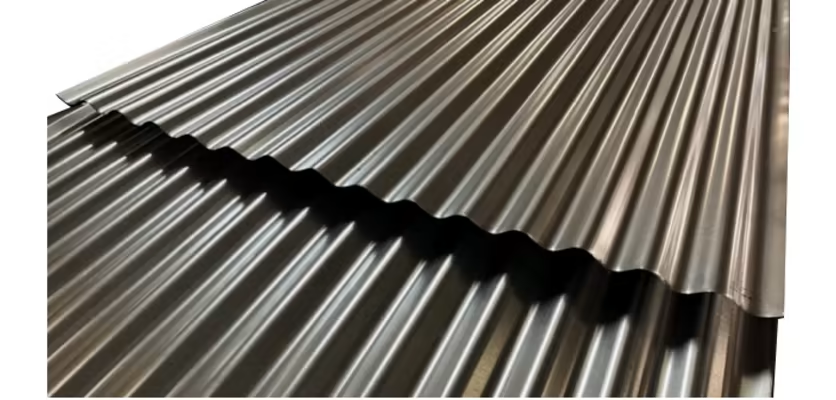
Metal Cladding: Types, Applications, Materials & Stainless Steel vs Aluminum
Metal cladding is an architectural solution that uses metal panels, sheets, or formed components as a finished layer over a building surface or architectural element. It can be used on façades, walls, columns, ceilings, entrances, canopies, and other interior or exterior features to create a distinctive appearance while providing a durable and functional surface.
However, metal cladding is not a single material. Aluminum, stainless steel, copper, galvanized steel, and other metals can be used for different applications. The right choice depends on the project’s location, exposure, appearance, panel geometry, weight, maintenance requirements, fabrication method, and budget.
For projects in Saudi Arabia, these considerations become particularly important. Exterior cladding may be exposed to intense sunlight, high temperatures, dust, wind, temperature movement, and—depending on the location—humidity and airborne salts.
So instead of asking which metal is universally “best,” a more useful question is:
Which metal cladding material and system provide the right combination of appearance, durability, weight, maintenance, fabrication, and performance for this application?
This guide explains the main types of architectural metal cladding, compares stainless steel and aluminum, covers PVD stainless steel finishes, and explains how to select a suitable cladding system for projects in Saudi Arabia.
What Is Metal Cladding?
Metal cladding is a layer of metal installed over a building surface or architectural element to create a finished appearance and, depending on the system, provide protection and functional performance.
A complete metal cladding system usually includes more than the visible panel. Depending on the application, it may contain:
- Metal panels or sheets
- Supporting frames or rails
- Brackets and fixing systems
- Joints and trims
- Insulation or backing components
- Drainage or ventilation provisions
- Sealants
- Movement allowances
- Decorative surface finishes
This distinction is important because the visible metal is only one component of the finished assembly.
For example, an exterior façade may use metal panels attached to a secondary support structure, while an interior feature wall may use decorative panels fixed over an existing substrate. Both can be described as metal cladding, but their engineering, fabrication, and installation requirements can be very different.
Technical resources from worldstainless also demonstrate how stainless steel can be incorporated into architectural envelopes and building exteriors as part of a complete cladding assembly.
Where Is Metal Cladding Used?
Architectural metal cladding can be used across both interior and exterior applications. The intended application plays a major role in determining the suitable material, thickness, finish, and fixing method.
Common applications include:
- Building façades
- Feature walls
- Columns
- Entrance features
- Elevator and lift surrounds
- Canopies
- Soffits
- Decorative screens
- Retail frontages
- Hotel interiors
- Restaurant interiors
- Corporate reception areas
- Ceiling elements
- Architectural signage
- Custom counters and furniture
The same metal can behave differently depending on its location.
A stainless steel feature wall inside a hotel does not face the same conditions as an exposed façade in a coastal environment. Interior applications may place greater emphasis on appearance, fingerprints, cleaning, and surface consistency, while exterior applications require additional consideration of environmental exposure, movement, drainage, support, and weathering.
For this reason, material selection should begin with the application and environment, rather than simply choosing a metal based on its appearance.
What Are the Main Types of Metal Cladding Materials?
There is no single material that is suitable for every architectural cladding project. Aluminum, stainless steel, copper, and coated steel each offer different combinations of weight, appearance, durability, fabrication characteristics, and maintenance requirements.
Aluminum Cladding
Aluminum is widely used in metal cladding systems where low weight, corrosion resistance, and fabrication flexibility are important.
Its relatively low density can simplify handling and installation compared with heavier metals. Aluminum can also be formed into different panel geometries and supplied with a range of finishes and coatings.
Typical applications include:
- Building façades
- Soffits
- Canopies
- Decorative panels
- Screens
- Ceiling systems
For large Saudi façade projects, aluminum can be particularly useful when controlling the weight of the visible cladding is an important design consideration.
Rounuq’s façade and glazing solutions include aluminum cladding applications with customizable panel sizes and finishes.
Stainless Steel Cladding
Stainless steel is commonly selected when a project requires a premium metallic appearance combined with corrosion resistance and a durable architectural surface.
It is suitable for applications such as:
- Feature walls
- Columns
- Entrances
- Elevator surrounds
- Decorative façades
- Hospitality interiors
- Retail environments
- Premium architectural details
One of its major advantages is the range of available surface treatments. Depending on the specification, stainless steel can have brushed, hairline, mirror, textured, or PVD finishes.
This makes it particularly useful when the metal surface is intended to become an important part of the architectural identity.
Rounuq provides stainless steel and decorative cladding solutions using stainless steel, aluminum, and copper for applications including feature walls, columns, ceilings, and façades.
Copper Cladding
Copper offers a distinctive architectural character and can develop a patina over time.
It can be considered when a project intentionally requires:
- A warm metallic appearance
- Natural color variation
- An evolving surface character
- A distinctive architectural identity
Because copper can change visually over time, the expected aging process should be discussed during specification. A naturally evolving surface may be desirable for one architectural concept and unsuitable for another.
Galvanized and Coated Steel Cladding
Steel can provide a robust solution where strength, rigidity, or a particular architectural expression is required.
For exterior applications, however, the base steel should not be evaluated separately from its protective system. Coatings, edges, joints, fasteners, drainage, and environmental exposure can all affect long-term performance.
Galvanized or appropriately coated steel can therefore be suitable when its structural and protective characteristics match the project requirements.
The key principle is to evaluate the metal and its protection system together.
Stainless Steel vs Aluminum Cladding: What Is the Difference?
Stainless steel and aluminum are two of the most commonly considered materials for architectural metal cladding, but they serve different project priorities.
| Consideration | Stainless Steel | Aluminum |
|---|---|---|
| Weight | Higher | Lower |
| Metallic appearance | Premium and highly defined | Clean and modern |
| Surface finishes | Brushed, hairline, mirror, PVD and others | Anodized, powder coated and other finishes |
| Corrosion resistance | Generally excellent, depending on grade and environment | Generally very good with suitable design and finish |
| Impact resistance | Generally robust | Depends strongly on thickness and panel design |
| Fabrication | Requires appropriate cutting, bending and finishing processes | Generally easy to form and fabricate |
| Large lightweight façades | Less advantageous | Often advantageous |
| Decorative finishes | Excellent | Very good |
| Typical applications | Feature walls, premium interiors, architectural details and selected façades | Façades, soffits, canopies and lightweight systems |
This comparison should not be treated as a universal ranking.
A well-designed aluminum system may be more appropriate than stainless steel for a large lightweight façade, while stainless steel may be the stronger choice for a luxury feature wall where the finish itself is central to the design.
The complete cladding assembly—not the material name alone—should determine the final specification.
Is Stainless Steel Better Than Aluminum for Cladding?
Not necessarily.
Stainless steel can be preferable when the project prioritizes premium surface quality, specific decorative finishes, robustness, or a particular architectural aesthetic.
Aluminum can be preferable when low weight, façade efficiency, handling, or extensive panel coverage are more important.
For example, a luxury hotel feature wall may benefit from the visual qualities of PVD stainless steel, while a large exterior façade may place greater emphasis on lightweight construction and therefore warrant an aluminum-based solution.
The correct decision depends on:
- Application
- Exposure
- Panel size
- Geometry
- Finish
- Weight
- Fixing system
- Maintenance
- Budget
The objective is not to select the strongest or most expensive metal. It is to select the material that best satisfies the project’s requirements.
What Makes Stainless Steel Cladding Different?
Stainless steel cladding combines a durable metal substrate with a wide range of architectural finishes, making it particularly useful for premium interior and exterior applications.
Stainless steel is an alloy containing chromium, which enables the formation of a passive surface layer that contributes to corrosion resistance.
However, stainless steel performance still depends on several factors, including:
- Stainless steel grade
- Environmental exposure
- Surface finish
- Fabrication quality
- Cleaning and maintenance
- Contamination
- Installation details
This is particularly important in Saudi Arabia.
An interior decorative application in Riyadh has different exposure conditions from an exterior façade near the Red Sea. Chlorides, airborne contaminants, deposits, and cleaning chemicals can influence the appearance and long-term performance of stainless steel surfaces.
Therefore, the stainless steel grade and finish should be selected according to the actual environment rather than assuming that all stainless steel products will perform identically.
What Stainless Steel Finishes Are Available?
The base stainless steel material does not determine the final appearance on its own. Surface treatment can significantly change the visual character of architectural cladding.
Common finishes include:
Brushed Finish
A brushed finish creates a controlled linear texture and is widely used for architectural interiors, feature walls, doors, columns, and other decorative elements.
Hairline Finish
Hairline stainless steel provides a fine directional texture with a more refined appearance than many standard brushed surfaces.
Mirror Finish
Mirror-polished stainless steel produces a highly reflective surface and can create a strong visual effect in entrances, luxury interiors, and decorative architectural elements.
PVD Finish
PVD can add decorative metallic colors to stainless steel, including gold, bronze, black, champagne, and rose gold.
The final appearance can vary depending on the substrate texture, lighting, viewing angle, and surrounding materials. For important projects, physical sample approval is therefore recommended.
What Is PVD Stainless Steel Cladding?
PVD stainless steel cladding is stainless steel with a decorative Physical Vapor Deposition coating applied to its surface.
PVD is a surface-finishing technology rather than a separate type of metal.
It can be used to create architectural finishes such as:
- Gold
- Bronze
- Black
- Champagne
- Rose gold
- Other metallic tones
One of the main advantages of PVD is the ability to combine a stainless steel substrate with a controlled decorative appearance.
However, the color alone does not fully define the finished product.
For example, bronze PVD applied over a brushed stainless steel substrate can look different from bronze PVD applied over a mirror-polished surface.
The specification should therefore consider:
Stainless steel grade + substrate finish + PVD finish + panel geometry + installation environment
Rounuq’s PVD finishing solutions can be considered for architectural applications where a decorative metallic appearance is required.
Why Should You Approve a Physical PVD Sample?
Digital images and screens cannot always reproduce metallic finishes accurately.
Lighting conditions, viewing angles, substrate texture, surrounding colors, and the size of the surface can influence how a PVD finish is perceived.
For high-visibility architectural projects, approving a physical sample before production helps establish the expected combination of:
- Color
- Texture
- Reflectivity
- Surface direction
- Overall appearance
A physical sample should therefore be treated as part of the specification process rather than simply a final design preference.
Metal Cladding in Saudi Arabia: What Should You Consider?
Metal cladding can be suitable for a wide range of Saudi Arabian projects, but material selection should account for local exposure conditions and the specific application.
Saudi projects can experience:
- High solar exposure
- Elevated temperatures
- Dust accumulation
- Wind
- Temperature-related movement
- Frequent cleaning requirements
- Coastal humidity and airborne salts in relevant locations
Environmental conditions can also vary significantly between cities.
An exterior façade in Jeddah, for example, may face different atmospheric exposure from an interior architectural feature in Riyadh. A coastal project may therefore require different material and maintenance considerations from an indoor commercial installation.
For Saudi projects, the design team should consider the environment before approving:
- Stainless steel grade
- Aluminum specification
- Surface finish
- Coating
- Panel thickness
- Joint details
- Fixing system
- Cleaning requirements
This approach helps prevent a common specification mistake: selecting a finish based on appearance without evaluating the conditions in which it will operate.
How to Choose the Right Metal Cladding Material
Choosing the right metal cladding material should begin with the project requirements rather than a particular metal.
1. Define the Installation Environment
Determine whether the cladding will be:
- Indoors
- Outdoors
- Partially exposed
- Near the coast
- In a high-traffic environment
- Near industrial or cooking processes
- Easily accessible for cleaning
The environment influences the suitable material, grade, finish, and maintenance strategy.
2. Define the Required Appearance
Identify the intended visual result before selecting the material.
Possible requirements include:
- Mirror reflection
- Brushed texture
- Hairline appearance
- Matte finish
- Colored metallic finish
- Natural metal appearance
- Textured or patterned surface
This helps narrow down the appropriate material and finishing process.
3. Consider Panel Size and Geometry
Panel geometry can significantly affect the practical choice of material.
Large panels, folded corners, curved surfaces, perforations, and complex three-dimensional forms can influence:
- Fabrication
- Material thickness
- Joint design
- Handling
- Installation
- Waste
- Supporting structure
For this reason, material selection and fabrication planning should be coordinated early in the project.
For projects requiring intricate patterns or custom metal components, laser cutting can be incorporated into the fabrication process where appropriate.
4. Evaluate Weight
Weight can become particularly important for:
- Large façades
- Suspended elements
- Canopies
- Soffits
- Applications with predefined support structures
Aluminum can offer a significant weight advantage, while stainless steel may provide stronger benefits where surface performance and architectural appearance are the primary priorities.
The panel, support structure, and fixing system should be considered together rather than evaluating panel weight in isolation.
5. Consider Maintenance
The maintenance requirements should be reviewed before the finish is selected.
Consider:
- Cleaning frequency
- Accessibility
- Fingerprint visibility
- Dust accumulation
- Water marks
- Cleaning chemicals
- Surface sensitivity
Highly reflective finishes can create a strong visual effect but may also make fingerprints and contamination more noticeable than brushed or textured surfaces.
6. Review the Fixing and Support System
The visible panel is only part of the cladding assembly.
Depending on the project, the system may require:
- Brackets
- Secondary frames
- Rails
- Fasteners
- Expansion allowances
- Movement joints
- Drainage
- Ventilation
- Substrate coordination
Exterior façades require particular attention because the cladding system is exposed to environmental loads and temperature changes.
7. Approve a Physical Sample
For decorative finishes, physical samples are one of the most useful specification tools.
The sample should represent the actual combination of:
Base material + surface finish + coating + texture + color
This is especially important for PVD finishes and other metallic surfaces where digital color references may not accurately represent the final appearance.
What Are the Advantages of Architectural Metal Cladding?
When properly designed and specified, architectural metal cladding can provide several advantages.
Design Flexibility
Metal panels can be cut, folded, perforated, curved, textured, or combined with other architectural elements.
Material Variety
Architects can select from aluminum, stainless steel, copper, galvanized steel, and other systems depending on the application.
Controlled Appearance
Fabricated panels can provide consistent lines, patterns, joints, and finishes across architectural surfaces.
Durable Architectural Surfaces
Appropriately selected materials and finishes can provide long-term performance when correctly fabricated, installed, cleaned, and maintained.
Integration With Other Building Elements
Metal cladding can be coordinated with:
- Glass
- Lighting
- Signage
- Ceilings
- Columns
- Doors
- Architectural screens
- Structural elements
Custom Fabrication
Metal cladding can be designed around the project’s dimensions and geometry rather than being limited to standard off-the-shelf components.
What Problems Can Occur With Poorly Specified Metal Cladding?
Many cladding failures are caused not by the material itself but by poor specification, fabrication, coordination, or installation.
Common issues include:
- Selecting a material based only on appearance
- Ignoring environmental exposure
- Choosing a finish without physical sample approval
- Poorly designed joints
- Insufficient allowance for movement
- Incorrect fixing details
- Inadequate drainage
- Incompatible metals at connections
- Unsuitable cleaning methods
- Poor coordination with glazing
- Inadequate support structures
- Treating decorative panels as structural components without appropriate engineering
For exterior façade applications, the metal panel should therefore be considered part of a larger building-envelope system.
The support structure, fasteners, joints, insulation, drainage, movement allowances, and installation details can be just as important as the visible finish.
How Much Does Metal Cladding Cost?
There is no reliable universal price per square meter for metal cladding because project specifications can vary significantly.
The final cost can depend on:
- Material type
- Stainless steel grade
- Aluminum specification
- Material thickness
- Panel dimensions
- Project quantity
- Surface finish
- PVD or other coatings
- CNC cutting
- Bending
- Curving
- Perforation
- Supporting structure
- Fixing system
- Site access
- Installation complexity
- Number of corners and transitions
- Project location
- Required detailing
- Maintenance and access requirements
A simple flat panel and a complex three-dimensional architectural element may both be classified as metal cladding while requiring completely different fabrication processes.
For this reason, comparing quotations solely by price per square meter can be misleading.
A better comparison is based on the complete specified system, including material, finish, fabrication, support, fixing, installation, and required detailing.
When Should You Choose Stainless Steel Cladding?
Stainless steel cladding is worth considering when a project requires a premium architectural finish, strong visual impact, and a durable metallic surface.
It can be particularly suitable when the design requires:
- Premium metallic appearance
- Brushed or hairline finishes
- Mirror finishes
- PVD decorative finishes
- High-visibility feature elements
- Luxury interiors
- Hospitality applications
- Retail environments
- Architectural details
- Selected exterior applications
Stainless steel becomes especially attractive when the metal surface is intended to be part of the architectural identity rather than simply a protective outer layer.
For Saudi projects, Rounuq provides stainless steel and decorative cladding for architectural applications including feature walls, columns, ceilings, and façades.
The final specification should still define the appropriate grade, thickness, finish, fabrication method, fixing system, and installation requirements for the specific project.
When Should You Choose Aluminum Cladding?
Aluminum cladding may be more appropriate when low weight, façade coverage, and fabrication flexibility are important priorities.
It can be useful when:
- Low weight is important
- Large façade areas are involved
- Lightweight panels are preferred
- Extensive forming is required
- A wide range of coating or color options is needed
- Handling and installation weight need to be controlled
Aluminum is particularly relevant to many façade, soffit, and canopy applications.
However, choosing aluminum simply because it is lighter would oversimplify the decision. The complete system should still be evaluated, including panel geometry, support structure, fixing method, finish, environmental exposure, and maintenance.
Metal Cladding Specification Checklist
Before approving a metal cladding system, make sure the project documentation clearly defines:
- Base material
- Material grade where applicable
- Panel thickness
- Surface finish
- Coating or PVD finish
- Panel dimensions
- Edge and folding details
- Joint configuration
- Supporting structure
- Fixing method
- Installation environment
- Cleaning and maintenance requirements
- Sample approval requirements
- Fabrication responsibilities
- Installation responsibilities
Instead of specifying only:
“Bronze stainless steel cladding”
a stronger specification would identify the stainless steel grade, substrate finish, decorative coating, panel thickness, dimensions, joints, and fixing arrangement.
The more precise the specification, the easier it becomes for architects, consultants, contractors, and fabricators to compare quotations accurately.
Frequently Asked Questions About Metal Cladding
Is metal cladding the same as stainless steel cladding?
No. Metal cladding is the broader category. Stainless steel cladding is one type of metal cladding, alongside aluminum, copper, galvanized steel, and other systems.
Which is better, stainless steel or aluminum cladding?
Neither is universally better. Stainless steel is often preferred for premium metallic finishes and high-visibility architectural applications, while aluminum can be advantageous where low weight and façade efficiency are important.
Can stainless steel cladding be used outdoors?
Yes. However, the stainless steel grade, finish, environmental exposure, detailing, installation, and maintenance requirements should be evaluated before specification.
What is PVD stainless steel cladding?
PVD stainless steel cladding is stainless steel with a decorative Physical Vapor Deposition coating. It can produce finishes such as gold, bronze, black, champagne, and rose gold.
Is metal cladding suitable for building façades?
Yes. Aluminum, stainless steel, copper, coated steel, and other metal systems can be used in façade applications. The cladding should be designed as part of the complete building-envelope system.
How do I choose the right metal cladding material?
Start with the environment and application. Then consider appearance, panel geometry, weight, fabrication, finish, maintenance, support, fixing, and budget.
How much does metal cladding cost?
There is no universal price because material, thickness, finish, fabrication, support, installation, geometry, and project requirements all affect the final cost.
Does thicker metal always mean better cladding?
No. Thickness should be selected according to panel dimensions, geometry, support conditions, loads, handling requirements, and the overall system design.
Should I approve a physical finish sample?
Yes. Physical samples are particularly important for PVD and other decorative finishes because lighting, viewing angle, substrate texture, and surrounding materials can affect the final appearance.
Can different metals be combined in one architectural project?
Yes, but connections between different metals should be carefully designed. Moisture and electrical potential can contribute to galvanic corrosion, so compatible fixings, isolation methods, and appropriate detailing should be considered.
Conclusion: Choose the Right Cladding System, Not Just the Metal
The best metal cladding solution is rarely determined by the material name alone.
A successful architectural cladding specification considers the environment, appearance, panel geometry, weight, finish, support system, fabrication, installation, and long-term maintenance together.
Stainless steel can be an excellent option when a project requires a premium metallic appearance, refined finishes, or a strong architectural identity. Aluminum can be highly effective when low weight, façade efficiency, and fabrication flexibility are priorities. Copper and appropriately protected steel can also be suitable when their specific visual and performance characteristics match the project requirements.
For projects in Saudi Arabia, environmental exposure should be considered from the beginning. Riyadh, Jeddah, and other locations can present different conditions, so material selection should be based on the actual application rather than a generic preference for one metal.
If you are planning an architectural project and need to move from a general material comparison to a specific cladding specification, Rounuq Al Msar provides architectural metal cladding solutions using stainless steel, aluminum, and copper, with fabrication, finishing, and installation capabilities.
You can explore Rounuq’s stainless steel and decorative cladding service or façade and glazing solutions to evaluate the options available for your project.
The goal is not to select the most expensive metal or the cheapest panel. The goal is to select the right material, finish, and complete cladding system for the conditions in which the finished architecture will operate.
4 Comments
Metal Wall Panel: Essential Tips for Choosing the Right one
August 31, 2026
[…] Metal cladding is a broader architectural concept describing a metal layer or system applied to a building element or surface. […]
Architectural Powder Coating: 12 Essential Checks
September 2, 2026
[…] does not fit the curing oven cannot be powder coated as one piece. This affects panel modules on metal cladding systems and long structural members. Confirm oven dimensions during design development, not during […]
Metal Room Dividers: How to Choose the Right Design
September 7, 2026
[…] can also make it easier to coordinate the divider with the wider architectural package, including metal cladding, glazing, handrails, ceilings, lighting, and other bespoke elements. This makes Metal Room Dividers […]
Elevator Cladding: 7 Expert Tips for a Premium Finish
September 23, 2026
[…] can all influence the specification. For broader material context, the site’s guide to metal cladding materials and applications is […]