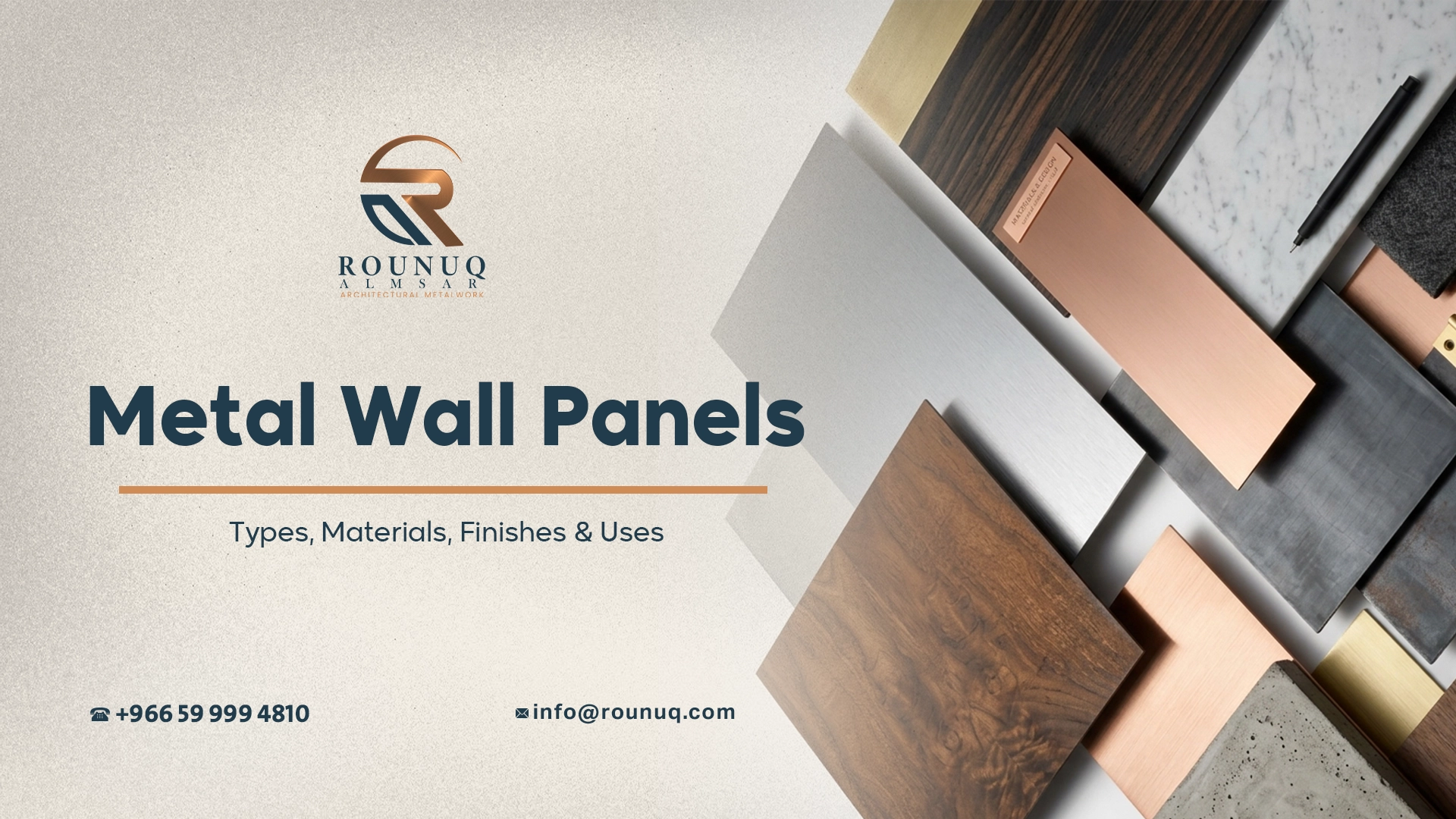
Metal Wall Panels: Types, Materials, Finishes & Uses
Metal wall panels can transform an ordinary wall into a strong architectural feature, but choosing the right system involves much more than selecting a color or finish.
The material, thickness, panel geometry, surface finish, fixing method, substrate, environmental exposure, maintenance requirements, and fabrication details can all affect the final result.
For projects in Saudi Arabia, these decisions become especially important. Interior feature walls have very different requirements from exterior applications exposed to intense sunlight, dust, temperature changes, wind, humidity, or coastal conditions.
This guide explains what metal wall panels are, where they are used, which materials are commonly selected, how finishes differ, how to compare options, what to consider before fabrication, and how to avoid common specification mistakes.
What is Metal Wall panel?
Metal wall panels are architectural panels made from metal or metal alloys and installed over a wall or supporting structure to create a finished surface.
Depending on the design, a panel can be:
- Flat
- Folded
- Bent
- Cassette-shaped
- Perforated
- Laser-cut
- Textured
- Patterned
- Ribbed
- Custom fabricated
The visible panel is only one part of the overall installation.
A complete wall panel system may also include:
- Supporting frames
- Rails or brackets
- Mechanical fixings
- Joints
- Trims
- Substrates
- Insulation or backing materials
- Sealants
- Movement allowances
- Edge and corner details
This distinction is important because a visually attractive panel can still perform poorly if the supporting system, joints, substrate, or installation details have not been properly considered.
For an interior feature wall, the priority may be appearance and detailing. For an exterior application, the design may also need to account for environmental exposure, movement, drainage, wind, maintenance, and the relationship between the panel and the building envelope.
Where Are Metal Wall Panels Used?
The application often determines the appropriate material and construction method more strongly than the appearance does.
Common applications include:
- Interior feature walls
- Hotel lobbies
- Restaurant interiors
- Retail spaces
- Office reception areas
- Elevator surrounds
- Columns
- Entrance portals
- Commercial interiors
- Exterior façades
- Decorative façade elements
- Partitions and screens
- Ceiling and wall transitions
- Custom architectural features
Interior Feature Walls
Interior walls are one of the most common applications for decorative metal panels.
They can be used behind reception desks, in hotel lobbies, restaurants, retail stores, offices, luxury residences, and other high-visibility spaces.
The main considerations are usually:
- Visual appearance
- Surface finish
- Panel alignment
- Joint design
- Cleaning requirements
- Resistance to fingerprints and abrasion
- Integration with lighting
- Coordination with doors, glazing, stone, wood, and other finishes
A feature wall should not be designed as an isolated surface. The panel layout should work with the architectural grid and the elements surrounding it.
Columns and Architectural Elements
Metal panels can also be fabricated around columns and other architectural elements.
This requires careful measurement because curved, angled, or irregular surfaces can make fabrication significantly more complicated than a simple flat wall.
Corner details, returns, access panels, and transitions should ideally be resolved before production.
Exterior Walls and Façades
Exterior applications require a broader technical assessment.
The designer or project team may need to consider:
- Solar exposure
- Temperature variation
- Wind
- Moisture
- Dust
- Corrosion
- Thermal movement
- Drainage
- Fixing systems
- Substructure
- Cleaning access
Rounuq’s published façade approach includes aluminum cladding panels, decorative façade elements, architectural fins, feature bands, and metal screens.
For exterior projects, the panel should therefore be treated as part of a coordinated system rather than simply a decorative sheet attached to a wall.
Which Materials Are Used for Metal Wall Panels?
There is no universally best metal for every project.
The most appropriate choice depends on the location, appearance, weight, fabrication requirements, environmental exposure, maintenance expectations, and budget.
Aluminum Wall Panels
Aluminum is widely considered when low weight and fabrication flexibility are important.
Its relatively low density can make handling and installation easier than heavier metals, while its formability allows manufacturers to create different panel geometries.
Common applications include:
- Façade panels
- Decorative wall panels
- Feature elements
- Screens
- Soffits
- Canopies
- Architectural fins
Aluminum can also accommodate a broad range of finishes and colors, depending on the selected coating or finishing process.
For large exterior areas, weight can become a significant consideration, making aluminum an attractive option when the complete system is appropriately engineered.
Stainless Steel Wall Panels
Stainless steel is often selected when the architectural design calls for a premium metallic appearance, refined surface finishes, or a durable visible surface.
Typical applications include:
- Feature walls
- Hotel interiors
- Restaurant interiors
- Elevator surrounds
- Reception areas
- Columns
- Entrances
- Decorative façades
- High-end retail environments
One of the main advantages of stainless steel is its range of available surface treatments.
Depending on the specification, it can be finished as:
- Brushed
- Hairline
- Mirror
- Vibration
- Textured
- PVD
Rounuq’s current stainless steel and decorative cladding service covers stainless steel, aluminum, and copper applications for feature walls, columns, ceilings, façades, and custom architectural elements.
The important point is that stainless steel should still be specified according to the actual environment and application. The term “stainless steel” alone does not define the complete specification.
Copper Panels
Copper provides a distinctive architectural appearance that can develop and change over time.
This evolving appearance can be desirable in projects where natural material aging is part of the design concept.
However, the expected surface development should be discussed before approval. A copper finish should not be selected simply because its initial appearance looks attractive in a sample.
Coated Steel Panels
Steel can also be used for architectural wall applications when strength, fabrication requirements, cost, or the desired coating system make it appropriate.
For exposed applications, corrosion protection becomes an important part of the specification.
The protection system should be selected according to the environment and project requirements rather than simply choosing a coating color.
ISO 12944 provides an established framework for corrosion protection of steel structures using protective paint systems and considers the relationship between protective systems and environmental exposure.
Metal Wall Panels vs Metal Cladding: What Is the Difference?
The terms are closely related, but they should not always be treated as identical.
Metal wall panels generally describes the physical panels installed on a wall.
Metal cladding is a broader architectural concept describing a metal layer or system applied to a building element or surface.
Cladding can be used on:
- Walls
- Façades
- Columns
- Ceilings
- Entrances
- Canopies
- Architectural features
A wall panel can therefore be part of a cladding system, but not every cladding application is a wall panel application.
This distinction matters when researching solutions.
Someone designing an interior feature wall may primarily need to understand panel material, finish, joints, and fabrication.
Someone designing an exterior façade may need to understand the complete building-envelope system, including support structure, drainage, movement, wind exposure, and other technical considerations.
Rounuq already has a broader guide covering metal cladding materials and applications, so this article focuses specifically on wall panels and the decisions involved in selecting and specifying them.
How Do You Choose the Right Metal Wall Panels?
The best approach is to start with the application rather than the material.
A practical selection process looks like this:
1. Define the Location
First determine whether the panels will be installed:
- Indoors
- Outdoors
- In a semi-exposed area
- Near the coast
- In a high-traffic environment
- Near food preparation
- In an area requiring frequent cleaning
The environment can influence the material, grade, finish, fixing system, and maintenance requirements.
2. Define the Function
Ask what the panel is actually supposed to do.
Is it primarily:
- Decorative?
- Protective?
- Part of a façade?
- A feature wall?
- A screen?
- A partition?
- A surface around an elevator?
- A visual element integrated with lighting?
The answer can change the specification considerably.
3. Select the Material
Compare aluminum, stainless steel, copper, or coated steel according to the project requirements.
Do not select the material based on appearance alone.
4. Select the Surface Finish
The finish influences how the panel reflects light, shows fingerprints, hides minor marks, and interacts with surrounding materials.
5. Define the Panel Geometry
Determine:
- Panel dimensions
- Thickness
- Folded edges
- Returns
- Curves
- Perforations
- Laser-cut patterns
- Joints
- Corner details
6. Choose the Fixing Method
The system may use visible mechanical fixings, concealed fixing, clips, rails, brackets, or another method depending on the application.
7. Approve a Physical Sample
A physical sample is particularly important for metallic finishes.
Lighting, viewing angle, grain direction, surface texture, and surrounding materials can all influence how the final finish is perceived.
8. Coordinate Before Fabrication
The panel layout should be coordinated with:
- Doors
- Glazing
- Lighting
- Electrical outlets
- HVAC
- Signage
- Stone
- Wood
- Other wall finishes
This reduces costly changes after fabrication begins.
Metal Wall Panels Comparison: Aluminum vs. Stainless Steel vs. Copper vs. Steel
| Factor | Aluminum | Stainless Steel | Copper | Coated Steel |
|---|---|---|---|---|
| Relative weight | Low | Higher | Medium | Medium to high |
| Appearance | Modern and versatile | Premium metallic | Distinctive and evolving | Depends on coating |
| Formability | Good | Good | Good | Good |
| Finish options | Broad | Very broad | Naturally distinctive | Broad coating options |
| Interior applications | Excellent | Excellent | Excellent | Good |
| Exterior applications | Common | Application-dependent | Application-dependent | Common when properly protected |
| Maintenance | Finish-dependent | Finish-dependent | Requires consideration of patina | Coating-dependent |
| Typical strength | Moderate | High | Moderate | High |
| Best known advantage | Low weight | Premium finish and durability | Unique character | Strength and coating flexibility |
There is no winner across every category.
The right material is the one that provides the appropriate combination of performance, appearance, fabrication requirements, maintenance, and project cost.
What Finishes Are Available for Metal Wall Panels?
A metal panel can look completely different depending on its surface treatment.
The finish should therefore be specified as carefully as the base material. The stainless steel surface treatment guidance from worldstainless explains common stainless steel finishes, including brushed, satin, mirror, and other surface treatments.
Brushed Finish
A brushed surface has directional lines that create a controlled metallic appearance.
It is commonly used when the design needs a refined surface without the strong reflection associated with a mirror finish.
Hairline Finish
Hairline finishes create a finer and more uniform directional appearance.
They can work particularly well in modern interiors where the designer wants the material to look sophisticated without becoming visually dominant.
Mirror Finish
Mirror stainless steel provides a highly reflective surface.
It can increase the perception of light and space, but reflections can also make fingerprints, scratches, and surface imperfections more noticeable.
Vibration Finish
A vibration finish creates a non-directional textured appearance.
It can be useful where the design requires visual texture and where a completely uniform directional grain is not desired.
PVD Finish
PVD stands for Physical Vapor Deposition.
It is a surface-coating process that can create decorative metallic colors on stainless steel.
Common architectural directions include:
- Gold
- Bronze
- Black
- Rose gold
- Champagne
- Antique metallic tones
One important point is that PVD is a finish, not a separate base metal.
The appearance depends on the stainless steel substrate and the surface treatment applied to it.
A bronze PVD finish over a brushed surface will not necessarily look identical to bronze PVD over a mirror surface.
Rounuq’s published service information includes PVD finishes such as gold, bronze, black, rose gold, and antique tones, along with mirror and hairline finishes.
For important projects, physical sample approval is therefore preferable to choosing a finish solely from a digital image.
Are Metal Wall Panels Suitable for Saudi Arabia?
Yes, but the correct specification depends heavily on where and how the panels are used.
Saudi projects can experience intense sunlight, high temperatures, dust, temperature changes, and, in coastal locations, higher exposure to humidity and salts.
These factors matter differently depending on the application.
Interior Applications in Saudi Arabia
For interior projects, the main considerations may include:
- Cleaning
- Fingerprints
- Abrasion
- Traffic levels
- Lighting
- Finish consistency
- Panel joints
- Coordination with other finishes
A hotel lobby, for example, can have very different maintenance requirements from a private residential corridor.
Exterior Applications in Saudi Arabia
Exterior panels require more careful consideration of:
- Solar exposure
- Wind
- Thermal movement
- Dust
- Moisture
- Corrosion
- Drainage
- Fixing
- Cleaning access
The coastal environment deserves particular attention because salt exposure can increase corrosion-related risks for susceptible materials and finishes.
For steel systems using protective paint, environmental classification is an important part of selecting the appropriate corrosion protection approach. ISO 12944 provides guidance for corrosion protection of steel structures using protective paint systems.
The key lesson is simple:
Do not specify exterior panels for Saudi Arabia based only on color, thickness, or appearance. Specify the complete system according to the environment.
How Are Metal Wall Panels Installed?
Installation depends on the panel design and the wall or structure behind it.
A simplified workflow may include:
- Site measurement
- Substrate inspection
- Shop drawing coordination
- Support preparation
- Panel fabrication
- Trial fitting or quality inspection
- Installation of the support system
- Panel installation
- Joint and edge detailing
- Final inspection
Visible vs. Concealed Fixing
Visible fixing can be appropriate when fasteners are intentionally incorporated into the design.
Concealed fixing is often preferred when the goal is a cleaner and more continuous appearance.
Neither method is automatically better.
The appropriate choice depends on:
- Panel size
- Panel weight
- Substrate
- Location
- Accessibility
- Design requirements
- Maintenance
- Structural considerations
Why Are Joints So Important?
Joints can make or break the final appearance.
A technically good panel can still look poor if:
- Joints are inconsistent
- Panel alignment changes
- Corner details are poorly resolved
- Grain direction is inconsistent
- Gaps vary visibly
- Transitions to other materials are not coordinated
For large architectural walls, the joint layout should ideally be considered during design rather than left entirely to installation.
What Should Be Considered at Corners and Edges?
Corners often reveal the quality of fabrication more clearly than the center of a panel.
Depending on the design, a corner may be:
- Folded
- Welded
- Mechanically joined
- Made with a separate trim
- Formed as a return
- Fabricated as a custom three-dimensional element
The best solution depends on the material, finish, geometry, and desired visual effect.
This is particularly important for stainless steel because grain direction and surface preparation can affect the visual continuity across folded or joined surfaces.
How Does Fabrication Affect Panel Quality?
Custom wall panels typically involve more than cutting a sheet.
Depending on the design, fabrication may include:
Design coordination → cutting → grooving → bending → welding → grinding → surface finishing → coating → inspection → packaging → installation.
Each stage affects the next.
For example, incorrect dimensions at the cutting stage can create problems during bending.
Poor coordination of grain direction can create visible inconsistencies in stainless steel.
Inadequate protection during transportation can damage a finished surface before installation even begins.
Rounuq’s published manufacturing information describes processes including laser cutting, CNC bending, welding, finishing, PVD coating, quality inspection, packaging, and installation as part of architectural metalwork workflows.
This is why a custom metal wall project should be managed as a coordinated fabrication process rather than as a simple material purchase.
What Are the Most Common Metal Wall Panel Mistakes?
Choosing the Material Based Only on Appearance
A finish can look perfect in a sample but still be unsuitable for the actual environment.
Material selection should come first.
Choosing a Finish Without a Physical Sample
Digital images can be misleading because metallic surfaces interact strongly with light and viewing angle.
For PVD, mirror, brushed, and other reflective finishes, sample approval is especially valuable.
Ignoring the Substrate
The wall behind the panel affects the installation.
A panel cannot automatically correct an uneven or unsuitable substrate.
Comparing Quotes Only by Square Meter Price
A quote for flat panels without installation or support structure is not directly comparable with a complete fabricated and installed system.
Leaving Corner Details Until Installation
Corners, returns, joints, and transitions should be resolved before fabrication.
Ignoring Grain Direction
Directional finishes such as brushed and hairline stainless steel can look inconsistent if the grain direction changes unintentionally between adjacent panels.
Mixing Metals Without Considering Compatibility
When different metals come into contact in certain environments, galvanic corrosion can become a consideration.
The fixing system and material interfaces should therefore be reviewed as part of the overall specification.
Treating Decorative Panels as Structural Elements
A decorative panel should not automatically be assumed to provide structural capacity.
Where structural performance is required, the system should be designed and verified accordingly.
How Much Do Metal Wall Panels Cost?
There is no single reliable price for metal wall panels.
The final cost can depend on:
- Material
- Grade
- Thickness
- Panel dimensions
- Quantity
- Number of unique panels
- Surface finish
- PVD coating
- Laser cutting
- Perforation
- Bending
- Welding
- Support structure
- Fixing method
- Site access
- Installation complexity
- Project location
- Number of corners and transitions
- Protection and packaging requirements
A simple flat aluminum panel and a custom PVD stainless steel feature wall may both be described as metal wall panels, but their fabrication requirements can be completely different.
For this reason, comparing suppliers only by price per square meter can lead to the wrong conclusion.
A better comparison asks:
Are both quotations based on the same material, thickness, finish, panel geometry, support system, installation scope, and quality requirements?
If not, the prices are not truly comparable.
What Should Be Included in a Metal Wall Panel Specification?
Before fabrication, the specification should be clear enough that the manufacturer does not have to make assumptions.
At minimum, consider including:
- Base material
- Material grade where applicable
- Panel thickness
- Panel dimensions
- Panel geometry
- Surface finish
- Color or PVD finish where applicable
- Grain direction
- Perforation or laser-cut pattern
- Joint width
- Corner details
- Fixing method
- Substrate requirements
- Sample approval requirements
- Installation scope
- Cleaning and maintenance requirements
The more clearly these items are defined, the lower the risk of disagreements between the architect, contractor, fabricator, and installer.
How Do You Choose a Metal Wall Panel Manufacturer?
The manufacturer should be evaluated based on more than product photographs.
Ask whether the company can handle the complete requirements of the project.
Important questions include:
- Can they fabricate the specified material?
- Can they produce custom dimensions?
- Can they execute the required bends and details?
- Can they provide the specified finish?
- Can they produce samples?
- Can they coordinate shop drawings?
- Can they manage quality inspection?
- Can they protect finished panels during transportation?
- Can they coordinate installation?
- Can they work with the architect and contractor?
Rounuq describes its architectural metalwork workflow as covering design coordination, fabrication, finishing, and installation, with capabilities across stainless steel, aluminum, and steel applications.
Its published cladding service also covers custom stainless steel, aluminum, and copper applications for feature walls, columns, ceilings, façades, and other architectural elements.
For a project that requires custom fabrication rather than off-the-shelf panels, this type of integrated workflow can be more relevant than simply comparing raw material prices.
Aluminum or Stainless Steel: Which Is Better for Wall Panels?
Neither material is automatically better.
Aluminum may be preferable when low weight, fabrication flexibility, and large-area applications are important.
Stainless steel may be preferable when the architectural design depends heavily on premium metallic appearance, refined finishes, or a highly visible decorative surface.
The decision can change depending on whether the project is:
- Interior or exterior
- Coastal or inland
- Decorative or functional
- Small or large scale
- Flat or geometrically complex
- Low traffic or high traffic
The correct question is therefore not:
“Which metal is the best?”
It is:
“Which material provides the right combination of appearance, performance, fabrication, maintenance, and cost for this application?”
How Can You Get Better Results From a Metal Wall Panel Project?
A strong project usually begins with clear decisions before fabrication.
A practical checklist is:
- Define the application.
- Confirm the environment.
- Select the base material.
- Specify the material grade where required.
- Select the finish.
- Approve a physical sample.
- Establish the panel module.
- Resolve corners and joints.
- Coordinate openings and adjacent finishes.
- Confirm the fixing system.
- Review shop drawings.
- Confirm installation requirements.
- Define cleaning and maintenance expectations.
This process may take more time during design, but it can reduce much more expensive corrections during fabrication and installation.
Frequently Asked Questions About Metal Wall Panels
Are metal wall panels suitable for interior walls?
Yes. They are commonly used for feature walls, hotel lobbies, restaurants, reception areas, retail interiors, elevator surrounds, columns, and other high-visibility architectural spaces.
What is the best material for metal wall panels?
There is no universal best material. Aluminum is often attractive when low weight is important, while stainless steel is frequently selected for premium metallic finishes and high-visibility architectural applications. Copper and coated steel can also be appropriate depending on the project.
Can metal wall panels be used outdoors?
Yes, but exterior applications require consideration of the environment, fixing system, movement, drainage, corrosion, solar exposure, and maintenance.
Are PVD panels suitable for feature walls?
PVD stainless steel can be a strong option for feature walls where the design requires decorative metallic colors such as gold, bronze, black, or rose gold. A physical sample should be approved before production.
Can metal wall panels be custom designed?
Yes. Custom panels can be fabricated in different sizes, shapes, folds, perforations, patterns, and finishes depending on the material and fabrication requirements.
Are metal wall panels expensive?
The cost varies significantly. Material, thickness, finish, geometry, fabrication, support structure, fixing system, installation, and project conditions can all affect the final price.
Do metal wall panels require maintenance?
Yes. Maintenance requirements depend on the material, finish, location, traffic, and exposure. Exterior panels may require more frequent cleaning than some interior applications.
Is stainless steel better than aluminum?
Not necessarily. Stainless steel can be advantageous for premium architectural finishes and highly visible applications, while aluminum can be attractive when low weight and fabrication flexibility are important.
Should I compare metal panel suppliers by price per square meter?
Not by itself. The comparison should include material, thickness, finish, panel construction, support system, installation, detailing, and quality requirements.
Conclusion: Choose the Complete System, Not Just the Panel
Metal wall panels can provide a durable and visually distinctive architectural surface, but the quality of the final result depends on much more than the visible metal.
The material, finish, panel geometry, joints, corners, fixing method, substrate, environmental exposure, fabrication process, and installation should work together.
For Saudi projects, exterior applications deserve particular attention because heat, sunlight, dust, temperature changes, and local environmental conditions can influence material and finish selection.
For interior applications, the priorities may shift toward appearance, touch resistance, cleaning, lighting, joint alignment, and integration with other architectural finishes.
The most reliable approach is to define the application first, select the material second, and then develop the finish, panel design, fixing system, and installation details around the actual project requirements.
If your project requires custom architectural metalwork, you can explore Rounuq Al Msar’s Stainless Steel & Decorative Cladding solutions, which cover stainless steel, aluminum, and copper applications for feature walls, columns, ceilings, façades, and custom architectural elements.
The most important step before fabrication is simple: make sure the material, finish, dimensions, joints, fixing method, and installation scope are clearly defined and approved.
If you are planning a project that requires custom metal wall panels, the next step is to discuss the material, finish, panel design, and installation requirements with a specialist. Rounuq Al Msar can help you explore suitable architectural metalwork solutions based on your project’s specific requirements.
Have a Metal Wall Panel Project in Mind?
Share your project requirements with the Rounuq Al Msar team and discuss the right material, finish, design, and fabrication approach for your application.
1 Comment
Wave Pattern Metal Panels: Materials, Fabrication & Design
September 2, 2026
[…] broader architectural applications, it is also useful to understand how custom metal wall panels are designed and fabricated as complete architectural elements rather than simply as decorative […]