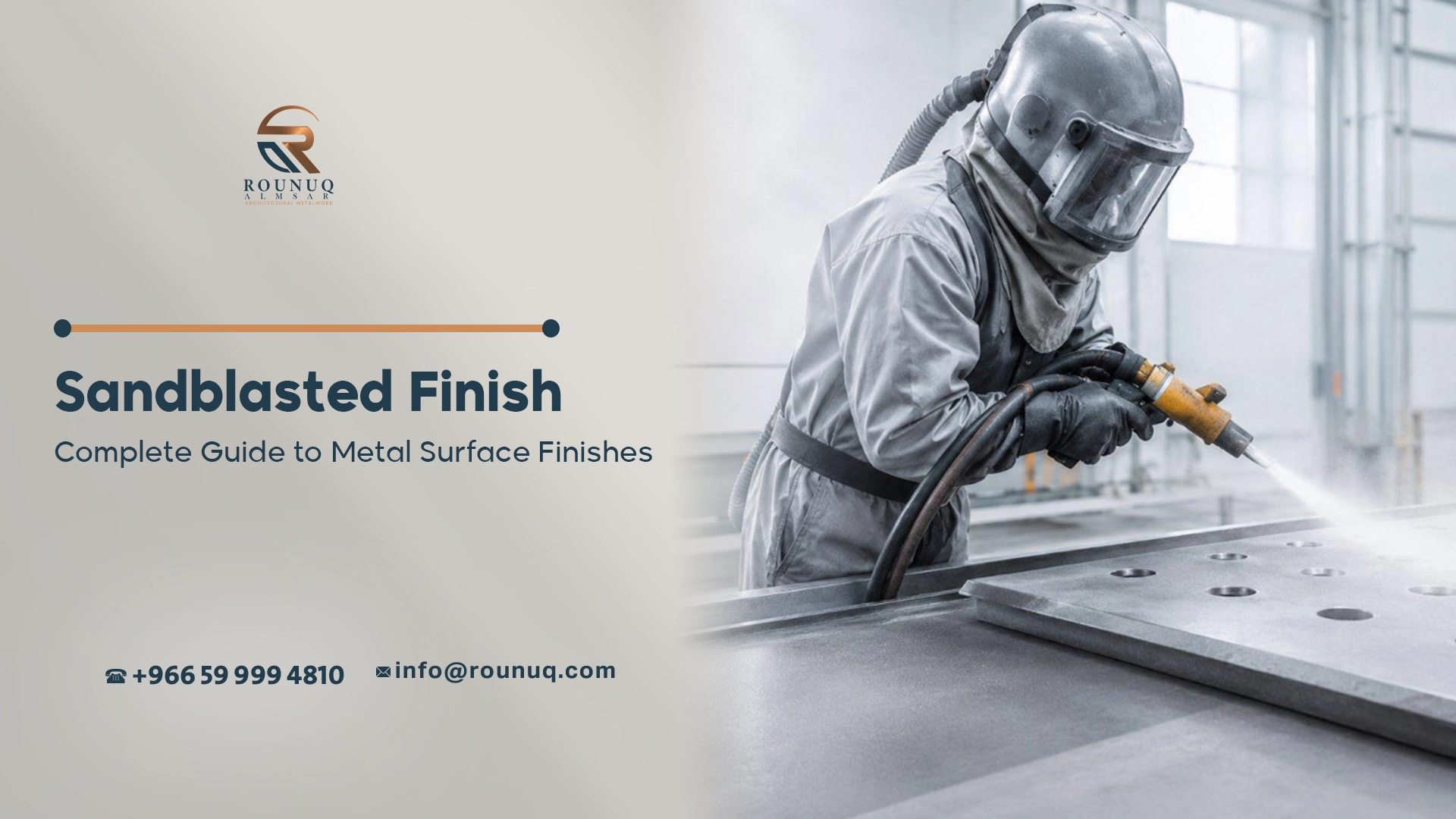
Sandblasted Finish: Complete Guide to Metal Surface Finishes
A Sandblasted Finish gives stainless steel a distinctly different appearance from polished or directional finishes. Instead of a highly reflective surface or visible linear grain, blasting can create a matte, low-reflectivity and generally non-directional appearance.
For architects, interior designers, contractors, and fit-out teams, however, choosing the finish should involve more than appearance alone. The blast media, process intensity, surface preparation, stainless steel grade, panel thickness, fabrication sequence, environmental exposure, lighting, and maintenance requirements can all influence the final result.
This matters particularly in architectural projects in Saudi Arabia, where an interior feature wall may face very different conditions from an exterior façade exposed to dust, humidity, sunlight, and, in coastal locations, chloride-containing environments.
This guide explains what the finish is, how it is produced, how it compares with other popular stainless steel finishes, when it makes sense, and what should be included in a project specification.
What Is a Sandblasted Finish?
A Sandblasted Finish is a surface treatment created by projecting an abrasive or blasting medium against metal under controlled conditions to modify its surface texture and appearance.
On stainless steel, blasting can produce a matte, textured and low-reflectivity surface. The exact result depends heavily on the medium, particle characteristics, process intensity, coverage, original surface, and finishing method.
The term itself can therefore be too broad for a technical specification.
The British Stainless Steel Association explains that bead- and shot-blasted finishes are produced by the impact of a hard medium on stainless steel and can create uniform, non-directional matte surfaces with low reflectivity. It also notes that different media can produce significantly different surface characteristics.
This means that two panels both described simply as “sandblasted stainless steel” should not automatically be expected to look identical.
What does sandblasted stainless steel look like?
Depending on the process, the surface may appear:
- Matte or satin-like
- Low in reflectivity
- Non-directional
- Fine or coarse in texture
- Softer visually than a mirror finish
- More uniform than a strongly directional brushed surface
The final appearance is also affected by lighting. A panel can look relatively subtle under diffuse light and much more textured when directional light strikes the surface.
For that reason, a physical sample is usually more useful for architectural approval than a digital image.
How Is the Finish Produced?
The process starts before blasting.
The stainless steel should first be inspected and prepared so that manufacturing defects, oils, dirt, contamination, and unsuitable surface conditions are addressed before the final treatment.
A typical workflow may include:
- Material inspection – Confirm the stainless steel grade, thickness and initial surface condition.
- Surface preparation – Remove contaminants and address defects that should not remain beneath the final finish.
- Media selection – Select a suitable blasting medium according to the required appearance and technical requirements.
- Process control – Control pressure, intensity, movement and exposure to achieve consistent coverage.
- Cleaning – Remove residues and contaminants after treatment.
- Inspection – Compare the finished surface with the approved sample.
- Protection – Protect the finished panels during handling, transport and installation.
The blast medium is particularly important.
BSSA identifies glass, ceramic or lead bead, silicon carbide, aluminium oxide, stainless steel shot and ground quartz among blasting media, while noting that media characteristics affect the resulting surface. It also stresses the importance of avoiding contamination.
Why does blast media matter?
The medium can influence:
- Surface texture
- Visual brightness
- Coarseness
- Surface profile
- Cleaning characteristics
- Consistency
- Potential contamination risks
For architectural stainless steel, the choice should therefore be made deliberately rather than treated as a generic workshop step.
BSSA specifically warns that contamination of blasting media can contribute to staining or corrosion-related problems and recommends careful cleaning before and after blasting.
What Is the Difference Between Blasting and Peening?
These terms are sometimes used interchangeably, but they describe different effects.
In blasting, the impacting medium can remove small amounts of material from the surface.
In peening, rounded particles impact the surface and deform it, creating small dimples rather than primarily cutting material away.
That distinction matters because the resulting surface profile, appearance and properties can differ.
BSSA notes that peening can introduce surface work hardening and compressive stresses, while blasting and peening also differ in the way they interact with the stainless steel surface.
For a project specification, it is therefore better to define the intended process and final appearance rather than simply using “sandblasted” as an all-purpose description.
Sandblasted vs Vibration vs Hairline vs Mirror Finish
There is no universally “best” stainless steel finish. The correct choice depends on the visual effect, environment, application and maintenance expectations.
| Finish | Surface Character | Direction | Reflectivity | Typical Architectural Effect |
|---|---|---|---|---|
| Sandblasted | Matte/textured | Generally non-directional | Low | Calm, understated, textured |
| Vibration | Overlapping abrasive marks | Non-directional | Low to moderate | Dynamic, contemporary |
| Hairline | Fine linear grain | Directional | Low to moderate | Clean, precise, linear |
| Brushed | Visible linear brushing | Usually directional | Low to moderate | Soft metallic appearance |
| Mirror | Highly polished | No visible grain | Very high | Reflective, dramatic, luxurious |
The worldstainless guide to stainless steel surface treatment illustrates how different finishing processes create substantially different surface appearances, including satin and mirror-polished finishes.
Sandblasted vs Vibration Finish
A Vibration Finish is created through controlled mechanical abrasion that produces overlapping, multidirectional marks.
The resulting appearance has more visible movement than a typical blasted matte surface.
Rounuq’s existing Vibration Finish guide explains that vibration finishing produces a non-directional texture and can be used for feature walls, columns, elevator interiors, decorative panels and other architectural applications.
A useful rule of thumb is:
Choose blasting when the goal is a subdued matte texture. Choose vibration when the design needs more visible multidirectional surface movement.
The two should not be treated as interchangeable finishes.
Sandblasted vs Hairline Finish
Hairline has a clear directional grain.
That makes it particularly useful when the design depends on visual direction, such as long vertical wall panels, elevator interiors, doors, columns, or trim.
A blasted finish is generally more forgiving of directional changes because its appearance does not depend on one continuous grain direction.
If the architectural design relies on strong vertical or horizontal lines, Hairline may therefore be the more appropriate choice.
Sandblasted vs Mirror Finish
Mirror stainless steel is highly reflective and can dramatically interact with lighting and surrounding materials.
That can be an advantage in luxury interiors, feature areas and statement elements.
However, highly reflective surfaces can also make fingerprints, scratches, dents and surface irregularities more visually obvious.
A matte blasted surface creates almost the opposite visual effect: it reduces reflection and emphasizes texture rather than reflection.
Where Is a Sandblasted Finish Used?
Blasted stainless steel can be used in many architectural applications where a low-reflectivity metallic surface is desirable.
Potential applications include:
- Feature walls
- Decorative columns
- Elevator surrounds
- Interior wall panels
- Reception areas
- Hotel interiors
- Retail interiors
- Architectural sculptures
- Decorative elements
- Selected façade applications
- Exterior architectural features
- Custom fabricated metal components
The finish is particularly useful when the designer wants stainless steel to remain visually recognizable without creating a strong mirror effect.
For example, a hotel lobby may benefit from a subtle metallic wall that reflects enough light to maintain depth without competing with lighting, furniture and artwork.
A retail environment may use the finish on selected architectural elements to introduce texture while keeping the overall design restrained.
Is It Suitable for Exterior Projects in Saudi Arabia?
It can be considered for exterior architectural applications, but the finish alone should never determine whether a stainless steel system is suitable for a particular façade.
The specification should consider:
- Stainless steel grade
- Chloride exposure
- Coastal conditions
- Humidity
- Dust and airborne contaminants
- Solar exposure
- Cleaning requirements
- Drainage
- Joints and connections
- Fixing system
- Panel geometry
- Access for maintenance
The same finish may behave very differently in an interior Riyadh application and an exposed coastal façade.
The material grade should therefore be selected according to the environment rather than simply choosing a finish first.
Rounuq’s current stainless steel cladding guidance similarly emphasizes the importance of combining material grade, finish, fabrication, environmental conditions and installation rather than treating cladding as only a decorative surface.
Can Sandblasted Stainless Steel Be Combined With PVD?
Yes. A textured or prepared stainless steel surface can be part of a system that subsequently receives PVD treatment when the complete process is suitable for the project.
The important concept is:
The surface treatment determines the underlying texture, while PVD can determine the decorative color and visual character.
This means that “Bronze PVD” is not always a complete finish specification.
The final appearance may also depend on the stainless steel substrate and its surface treatment.
For example:
Stainless Steel + textured surface + Bronze PVD
can look substantially different from:
Stainless Steel + Mirror Finish + Bronze PVD
Rounuq’s PVD Finish guide specifically explains that the final appearance of PVD can vary with the base finish, lighting, viewing angle, panel size, surface texture and surrounding materials.
For large architectural projects, a physical sample should therefore be approved before production.
What Should Be Included in the Specification?
One of the biggest practical mistakes is specifying only:
Stainless steel, Sandblasted Finish.
That description leaves too many variables open.
A stronger Sandblasted Finish specification should address the following.
Stainless Steel Grade
Specify the required grade according to the environment and project requirements.
304 may be appropriate for many interior applications, while more demanding chloride or coastal environments may require a different grade or specification.
The Sandblasted Finish should not be used as a substitute for correct material selection.
Material Thickness
Panel thickness should be coordinated with:
- Panel dimensions
- Forming requirements
- Support system
- Fixing method
- Expected loads
- Fabrication process
Thin sheets require particular attention during aggressive surface treatments because distortion can become an issue.
BSSA specifically notes that blasting can cause distortion and advises caution with thin stainless steel sections.
Surface Finish
Describe the intended appearance rather than relying only on the words Sandblasted Finish.
Where relevant, specify:
- Medium
- Process
- Intensity
- Coverage
- Surface roughness
- Reference sample
- Acceptance criteria
Not every blasting finish maps neatly to the standard mill-finish categories used for stainless steel sheet.
BSSA notes that bead-blasted and peened finishes are not covered as special finish types in BS EN 10088-2 in the same way as many conventional sheet finishes, so project-specific agreement with the finishing specialist can be important.
Sample Approval
For visible architectural surfaces, sample approval is one of the most important controls.
The sample should be reviewed for:
- Texture
- Uniformity
- Color
- Reflectivity
- Surface defects
- Edge treatment
- Lighting response
Large-format mock-ups are particularly valuable when the finished surface will be a major architectural feature.
Common Mistakes to Avoid
Specifying Only the Finish Name
Specifying Sandblasted Finish alone does not fully describe the final surface.
Better approach: define the intended appearance and agree on a physical reference sample.
Choosing the Finish Before the Material Grade
A beautiful Sandblasted Finish on an unsuitable stainless steel grade is still an unsuitable specification.
Better approach: evaluate environment, grade and finish together.
Ignoring Contamination
Stainless steel can be contaminated by inappropriate tools, media or workshop practices.
Better approach: control the cleanliness of the process and prevent iron contamination.
BSSA specifically highlights contamination as an important consideration for blasted stainless steel.
Assuming the Finish Is Scratch-Proof
A Sandblasted Finish can make some marks less visually obvious because of its textured surface, but that does not mean it cannot be scratched.
Better approach: consider traffic, contact, handling and cleaning methods.
Approving a Digital Image Instead of a Sample
Screens and photographs cannot reliably reproduce the texture and appearance of a Sandblasted Finish.
Better approach: approve a physical sample under representative lighting.
Treating Fabrication and Finishing as Separate Jobs
Cutting, bending, welding and grinding can influence the final appearance of a Sandblasted Finish.
Better approach: coordinate the fabrication sequence with the finishing process from the beginning.
How Does Surface Roughness Affect the Decision?
Surface roughness is a technical characteristic, but it should not be treated as a substitute for visual specification.
Two surfaces can have similar numerical roughness values while producing different visual effects because the texture geometry and finishing process differ.
For architectural work, the specification of a Sandblasted Finish may therefore need both:
A measurable technical requirement
and
a visual reference sample.
This is particularly important when the finish will cover large areas where small differences between panels become noticeable.
The worldstainless technical material also distinguishes among different surface-treatment processes and explains the relationship between finish type and surface characteristics.
How Should Sandblasted Stainless Steel Be Maintained?
Maintenance begins with protecting the surface during construction.
Once installed, Sandblasted Stainless Steel can be affected by:
- Dust
- Construction residue
- Fingerprints
- Oils
- Cleaning chemicals
- Abrasion
- Water deposits
- Airborne contaminants
A practical maintenance approach includes:
- Protect the finished panels during transportation and installation.
- Remove construction contamination promptly.
- Use cleaning methods compatible with stainless steel and the specified Sandblasted Finish.
- Avoid introducing iron contamination from unsuitable tools.
- Inspect high-contact areas periodically.
- Follow the manufacturer’s or fabricator’s maintenance recommendations where available.
A finish should therefore be selected with its future cleaning environment in mind, not only its appearance on day one.
How Do You Choose the Right Finish for an Architectural Project?
A practical selection process is:
1. Start With the Design Intent
Ask whether the project needs:
- Matte texture
- Directional grain
- Strong reflection
- Subtle metallic depth
- Decorative color
- Non-directional texture
2. Consider the Environment
Identify whether the surface is:
- Interior
- Exterior
- Coastal
- High traffic
- Frequently touched
- Frequently cleaned
3. Select the Stainless Steel Grade
Do this based on exposure and project requirements, not appearance.
4. Select the Surface Treatment
Compare Sandblasted Finish, Vibration, Hairline, Brushed, Mirror and other finishes against the design intent.
5. Consider PVD if Color Is Required
If the project needs bronze, gold, black, rose gold or another decorative metallic appearance, determine the base surface before specifying PVD.
6. Approve a Physical Sample
Review the Sandblasted Finish sample under the lighting and viewing conditions closest to the final installation.
7. Coordinate Fabrication
Confirm that cutting, folding, welding, grinding, finishing, protection and installation will preserve the approved appearance.
When Is Sandblasted the Better Choice?
A Sandblasted Finish is particularly compelling when the project requires:
- Low reflectivity
- A matte architectural appearance
- Non-directional texture
- A restrained metallic aesthetic
- Less visual emphasis on reflection
- A surface that works well with contemporary interiors
- A distinctive finish without an obvious linear grain
It may be less appropriate when the project specifically requires:
- A highly reflective surface
- Strong linear grain
- A very polished appearance
- A clearly defined directional visual pattern
The decision should therefore be made by comparing the Sandblasted Finish against the design objective rather than asking whether it is objectively “better” than another finish.
How Rounuq Can Support the Architectural Application
For architectural projects, the finish is only one part of the final product.
The finished element may also require material selection, fabrication, forming, welding, surface treatment, coating, protection, installation and coordination with other trades.
Rounuq’s Stainless Steel & Decorative Cladding solutions cover architectural applications using stainless steel, aluminum and copper, including feature walls, columns, ceilings, façades and custom architectural elements. The service also includes PVD stainless steel cladding and other decorative metal solutions.
Rounuq’s broader architectural metalwork services include design, fabrication, finishing and installation for architectural projects in Saudi Arabia.
For a project involving custom panels or complex geometry, the Sandblasted Finish should be discussed alongside the fabrication method rather than after fabrication has already been finalized.
Final Takeaway
A Sandblasted Finish is not simply a way of making stainless steel “look matte.”
It is a controlled surface treatment whose final appearance depends on the blasting medium, process, surface preparation, material, coverage, intensity and lighting.
For architectural applications, the best specification considers the complete system:
Stainless steel grade + thickness + fabrication + surface treatment + color/coating + environment + installation + maintenance.
Compared with Hairline, Sandblasted generally provides a less directional appearance. Compared with Mirror, it dramatically reduces reflection. Compared with Vibration, it can provide a more subdued textured effect rather than the more visibly dynamic pattern associated with multidirectional mechanical abrasion.
For projects in Saudi Arabia, environmental exposure should also influence the decision, particularly for exterior and coastal applications.
The safest approach is simple: define the desired appearance, select the material and process accordingly, and approve a physical sample before committing to full production.
If your project requires custom stainless steel cladding, decorative panels, feature walls, columns, ceilings or PVD finishes, Rounuq can evaluate the architectural application and coordinate the required material, fabrication and finishing approach.
Frequently Asked Questions About Sandblasted Finish
What is a Sandblasted Finish on stainless steel?
It is a surface treatment produced by projecting an abrasive medium onto stainless steel to create a textured, generally matte and low-reflectivity appearance. The exact result depends on the blasting medium and process.
Is Sandblasted Finish the same as bead blasted stainless steel?
Not necessarily. “Sandblasted” is a broad term, while bead blasting uses specific bead-shaped media and produces its own characteristic surface. The specification should identify the intended process and final appearance.
Is Sandblasted Finish matte?
Generally, yes. Blasted finishes are typically low-reflectivity and matte or satin-like, although the exact appearance depends on the medium, process intensity and original surface.
Is Sandblasted stainless steel suitable for outdoor façades?
It can be used for selected exterior applications, but the stainless steel grade, environment, detailing, contamination control, cleaning and installation system must all be considered.
Can Sandblasted Finish be combined with PVD?
Yes. A prepared stainless steel surface can be combined with PVD when the complete finishing system is appropriate. The base texture affects the final appearance, so a physical sample should be approved.
Which is better: Sandblasted or Hairline?
Neither is universally better. Sandblasted is generally more suitable for a matte, non-directional appearance, while Hairline is better when a fine directional grain is part of the design.
Which is better: Sandblasted or Vibration Finish?
They create different visual effects. Sandblasting generally produces a matte, low-reflectivity surface, while Vibration Finish produces overlapping multidirectional abrasive marks and a more dynamic texture.
Does Sandblasted stainless steel resist scratches?
The finish should not be described as scratch-proof. Its texture may make certain marks less noticeable, but scratching and abrasion can still occur.
Why is a physical sample important?
Because surface texture, reflectivity and color can look different depending on lighting, viewing angle, panel size and surrounding materials. A physical sample gives the design team a more reliable basis for approval.
What should an architect specify for a blasted stainless steel finish?
At minimum, consider the stainless steel grade, thickness, intended appearance, finishing process, media where relevant, surface requirements, sample reference, protection, fabrication requirements and installation conditions.
2 Comments
Architectural Powder Coating: 12 Essential Checks
August 31, 2026
[…] metal surface itself. A vibration finish on stainless steel works the surface mechanically, and a sandblasted finish alters texture through abrasive impact. Neither adds a separate protective layer. Powder coating […]
What Is the Best Stainless Steel Finish for Saudi Projects?
September 3, 2026
[…] has a dedicated guide to the sandblasted finish for architectural metal surfaces, including specification and maintenance […]