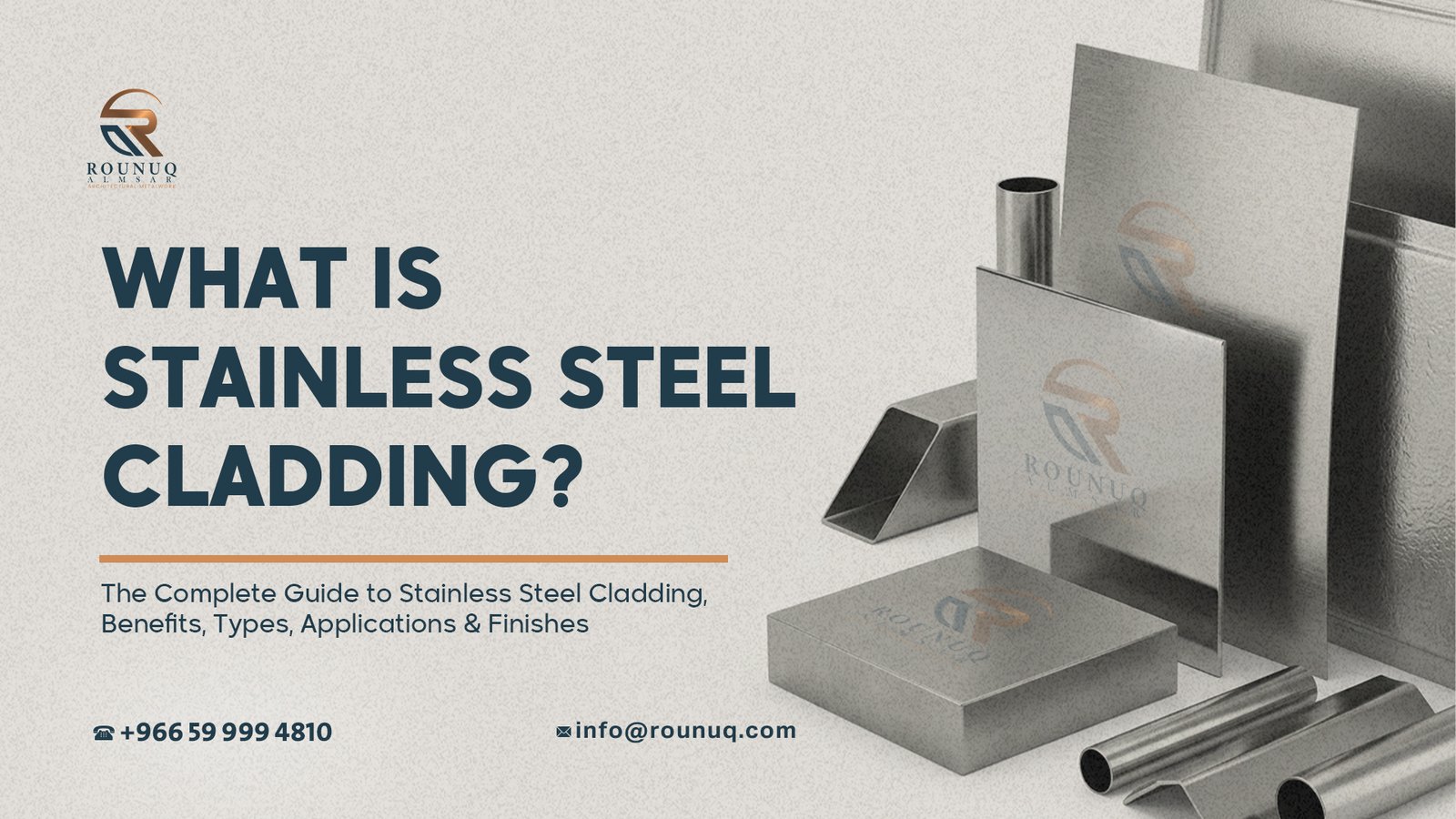
Stainless Steel Cladding in Saudi Arabia: Complete Guide
Stainless steel cladding is an architectural finishing system that uses stainless steel panels, sheets, or fabricated components as a protective and decorative layer over a wall, column, facade, ceiling, entrance, or other architectural surface.
Unlike ordinary painted finishes, stainless steel cladding combines a distinctive architectural appearance with the durability and corrosion resistance associated with stainless steel. It can be manufactured in different grades, thicknesses, surface finishes, textures, colors, patterns, and panel configurations, making it suitable for both modern interiors and demanding exterior applications.
Today, stainless steel cladding is widely used in commercial buildings, luxury hotels, restaurants, retail spaces, corporate offices, residential developments, transportation facilities, and high-end fit-out projects.
For architects, interior designers, contractors, and developers, the real value of stainless steel cladding is not simply the appearance of the metal. A successful cladding system depends on the correct combination of material grade, fabrication method, surface finish, panel design, fixing method, substrate preparation, environmental conditions, and installation quality.
This guide explains what stainless steel cladding is, how it works, where it is used, which finishes are available, how PVD cladding differs from conventional finishes, and what should be considered before specifying a stainless steel cladding system.
What Is Stainless Steel Cladding?
Stainless steel cladding is the use of stainless steel as an architectural surface layer over an existing or engineered substrate.
The stainless steel itself may be supplied as flat sheets, formed panels, cassette panels, trims, column covers, fabricated sections, or other custom components. These elements are then cut, bent, welded, finished, and installed according to the architectural design.
The purpose of cladding can be primarily aesthetic, functional, protective, or a combination of all three.
For example, stainless steel can be used to:
- Create a premium feature wall
- Protect high-traffic surfaces
- Finish columns and structural elements
- Create decorative wall panels
- Upgrade elevator interiors
- Form architectural facade elements
- Finish reception counters
- Create ceiling features
- Cover architectural details and transitions
- Produce custom
- Ornamental metal works
- Add a durable surface to commercial interiors
The final appearance can range from highly reflective mirror stainless steel to brushed, hairline, vibration, textured, or PVD-coated finishes.
At Rounuq Al Msar, stainless steel is part of a broader architectural metalwork approach that covers design coordination, fabrication, finishing, and installation for high-end fit-out and architectural projects in Saudi Arabia.
How Does Stainless Steel Cladding Work?
A stainless steel cladding system generally consists of several components rather than simply a sheet of metal attached to a wall.
The exact construction depends on the project, but a typical system may include:
- Existing wall or structural substrate
- Support or framing system
- Backing or substrate layer
- Stainless steel panels or sheets
- Mechanical or concealed fixing system
- Joints and movement allowances
- Trims, corners, reveals, and edge details
- Surface finish or coating
The design of these components must account for the size of the panels, the location of the installation, the required appearance, access for maintenance, environmental exposure, and the tolerances of the building.
This is why professional stainless steel metal works and cladding require more than cutting a sheet and fixing it to a wall.
The fabrication process has a direct effect on the final appearance.
Cutting, bending, welding, grinding, polishing, surface preparation, coating, assembly, and installation must all be coordinated to prevent visible inconsistencies between panels.
Why Is Stainless Steel Used for Architectural Cladding?
Stainless steel is particularly attractive for architectural applications because it offers a combination of visual quality, durability, and design flexibility.
1. Durability
Stainless steel can provide a long-lasting architectural surface when the appropriate grade, finish, detailing, and maintenance strategy are selected for the environment.
This makes it suitable for areas exposed to frequent contact, moisture, cleaning, and general wear.
2. Corrosion Resistance
The corrosion resistance of stainless steel is one of its major advantages.
However, it is important not to assume that every stainless steel grade performs identically in every environment.
The material grade should be selected according to factors such as:
- Indoor or outdoor exposure
- Humidity
- Chloride exposure
- Coastal conditions
- Pollution
- Cleaning chemicals
- Temperature
- Contact with other metals
For demanding environments, material selection should be part of the engineering and specification process rather than an afterthought.
3. Design Flexibility
Stainless steel can be fabricated into a wide range of forms.
Depending on the project, panels can be:
- Flat
- Folded
- Bent
- Curved
- Perforated
- Laser-cut
- Fabricated into custom shapes
- Combined with other architectural materials
This allows designers to create both minimal surfaces and highly detailed architectural features.
4. Premium Appearance
Stainless steel has become strongly associated with contemporary and luxury architecture.
A mirror finish can create a reflective appearance, while a brushed or hairline finish provides a softer architectural character.
PVD finishes can introduce colors such as bronze, gold, black, and other decorative tones without losing the visual identity of stainless steel.
Rounuq’s architectural cladding service includes mirror, brushed, hairline, and PVD-related finishing options for custom architectural applications.
Stainless Steel Cladding vs. Other Cladding Materials
Stainless steel is only one option available to architects and contractors.
Depending on the design and performance requirements, projects may also use:
- Aluminum
- Mild steel
- Copper
- Aluminum composite panels
- Stone
- Glass
- Ceramic
- Timber
- Fiber cement
- Other engineered facade materials
The correct choice depends on the application.
For example, aluminum can be attractive when low weight is a major consideration. Stone may be preferred when a natural material appearance is required. Stainless steel becomes particularly compelling when the design calls for a combination of durability, precision fabrication, metallic appearance, and premium finishes.
The important question is therefore not simply:
“Which material looks best?”
It is:
“Which material and cladding system are appropriate for the project’s environment, design intent, performance requirements, and maintenance strategy?”
Stainless Steel Cladding vs. Other Cladding Materials
The right cladding material depends on the project’s design requirements, environment, performance expectations, maintenance strategy, and budget. The following comparison provides a general overview of how stainless steel compares with several commonly used architectural cladding materials.
| Cladding Material | Durability | Corrosion Resistance | Design & Finish Options | Typical Applications | Maintenance |
|---|---|---|---|---|---|
| Stainless Steel Cladding | Excellent | Excellent with the appropriate grade | Very High – brushed, hairline, mirror, vibration, PVD and custom finishes | Luxury interiors, facades, hotels, restaurants, retail, commercial projects | Low to Moderate |
| Aluminum Cladding | Very Good | Very Good | High – anodized, painted, powder-coated and other finishes | Building facades, curtain wall systems, commercial buildings | Low |
| Mild Steel Cladding | Very Good when properly protected | Moderate without suitable protection | High – paint, powder coating and custom finishes | Architectural features, structural elements, decorative metalwork | Moderate to High |
| Copper Cladding | Excellent | Excellent, with natural patina development | High – natural copper appearance and patinated finishes | Premium facades, roofs, decorative architectural elements | Low to Moderate |
| Stone Cladding | Excellent | Depends on stone type and environment | High – natural colors, textures and patterns | Facades, feature walls, luxury interiors | Moderate |
| Glass Cladding | Good | Excellent | Very High – clear, tinted, reflective and patterned options | Facades, entrances, interiors, commercial buildings | Moderate |
| Ceramic Cladding | Very Good | Excellent | High – many colors, textures and patterns | Facades, walls, bathrooms, commercial interiors | Low to Moderate |
Which Cladding Material Is Best?
There is no single cladding material that is best for every project.
Stainless steel cladding is particularly suitable when a project requires a combination of durability, corrosion resistance, precision fabrication, premium metallic appearance, and a wide range of architectural finishes.
Aluminum may be preferred when weight reduction is an important consideration, while stone can be selected when a natural material appearance is the primary design objective. Glass is often used where transparency and light are important, whereas copper may be chosen for its distinctive appearance and natural patina.
The final material selection should be based on the project’s location, exposure conditions, architectural requirements, maintenance expectations, and budget rather than appearance alone.
Types of Stainless Steel Cladding
There is no single type of stainless steel cladding.
Architectural systems can be categorized according to their application, fabrication method, panel configuration, finish, or installation method.
1. Stainless Steel Wall Cladding
Stainless Steel Wall Cladding is one of the most common interior applications.
It can be used on:
- Feature walls
- Reception areas
- Hotel lobbies
- Retail interiors
- Restaurants
- Corporate offices
- Elevator surrounds
- Corridors
- Columns
- Commercial interiors
Large-format panels can create a clean architectural appearance, while smaller modules can introduce rhythm, joints, patterns, and geometric details.
Wall cladding can also be designed around lighting, doors, signage, display systems, and other architectural elements.
2. Stainless Steel Cladding Panels
Stainless Steel Cladding Panels are fabricated panels designed to cover a specific architectural surface.
Depending on the project, panels may be fabricated as:
- Flat panels
- Folded panels
- Cassette panels
- Box panels
- Column covers
- Custom fabricated shapes
Panel dimensions and joint locations should be coordinated with the architectural drawings before fabrication.
This is particularly important when the cladding is installed around corners, doors, lighting, signage, or irregular architectural geometry.
3. Architectural Stainless Steel Cladding
Architectural Stainless Steel Cladding refers to stainless steel systems designed specifically as part of an architectural concept rather than simply as a protective covering.
The design can incorporate:
- Custom profiles
- Decorative patterns
- Laser-cut details
- Curved panels
- Feature walls
- Column treatments
- Ceiling elements
- Integrated lighting
- Contrasting finishes
- PVD colors
The objective is to make the metal part of the architectural identity of the space.
Interior Stainless Steel Cladding
Interior Stainless Steel Cladding is especially popular in luxury and high-traffic environments.
Common applications include:
Hotels
Stainless steel can be used in:
- Lobby feature walls
- Elevator interiors
- Reception counters
- Columns
- Decorative partitions
- Ceiling details
Restaurants
Restaurants often use stainless steel for:
- Feature walls
- Counters
- Decorative panels
- Columns
- Bar fronts
- Signage
- Architectural details
Retail
Retail environments can use stainless steel to create a premium and contemporary appearance through reflective surfaces, metallic textures, and custom details.
Corporate Interiors
Stainless steel can be integrated into reception areas, meeting spaces, elevator lobbies, corridors, and branded architectural elements.
For interior applications, designers have greater flexibility in selecting decorative finishes because the material is often protected from direct weather exposure.
Exterior Stainless Steel Cladding
Exterior Stainless Steel Cladding requires more careful technical consideration.
Exterior applications can expose the material to:
- Rain
- Humidity
- Dust
- Pollution
- UV exposure
- Temperature changes
- Wind
- Chlorides in coastal environments
The stainless steel grade, finish, thickness, fixing system, drainage, joints, and cleaning requirements should therefore be evaluated as part of the facade design.
Exterior stainless steel may be used for:
- Facade accents
- Entrance features
- Canopies
- Architectural columns
- Feature walls
- Building entrances
- Decorative facade elements
- Custom architectural structures
Stainless steel should not automatically be selected simply because the word “stainless” suggests that corrosion is impossible. Material selection and detailing still matter.
Stainless Steel Facade Applications
A stainless steel facade can be used as a complete facade system or as a specific architectural layer within a larger building envelope.
In many projects, stainless steel is most effective when used strategically rather than covering an entire building.
For example, architects may use it around:
- Main entrances
- Ground-floor zones
- Feature elevations
- Canopies
- Vertical architectural elements
- Retail frontages
- Signage areas
This can create a strong visual identity while controlling material cost and installation complexity.
Facade design must also consider structural movement, wind loads, thermal movement, drainage, joints, access, and compatibility with adjacent materials.
Stainless steel cladding should therefore be coordinated with the overall facade system rather than designed as an isolated decorative layer.
PVD Cladding: What Is It?
PVD cladding refers to stainless steel that has received a decorative Physical Vapor Deposition coating.
PVD is a controlled coating process used to create durable decorative colors and finishes on metal surfaces.
Instead of painting the stainless steel with a conventional liquid coating, the PVD process deposits a thin coating onto the prepared surface under controlled conditions.
This allows stainless steel to achieve colors and appearances such as:
- Gold
- Champagne
- Bronze
- Black
- Rose gold
- Brass-like tones
- Other architectural shades
The underlying stainless steel remains an important part of the system because the final appearance depends on both the base metal surface preparation and the coating.
Rounuq uses PVD and premium surface treatments as part of its architectural metal finishing capabilities, particularly for high-end interiors and decorative architectural elements.
PVD Cladding vs. Traditional Stainless Steel Finishes
A common mistake is to treat PVD as if it were simply another type of polishing.
It is not.
A brushed or hairline finish is primarily a mechanical surface finish.
PVD is a coating process applied to a prepared surface.
The two can also be combined.
For example:
Stainless steel → surface preparation → hairline finish → PVD coating
or
Stainless steel → surface preparation → mirror finish → PVD coating
This creates a much wider range of architectural possibilities.
The quality of the final result depends heavily on the preparation of the stainless steel before coating.
Common Stainless Steel Finishes for Cladding
The finish is one of the most important design decisions in a cladding project.
Mirror Finish
Mirror stainless steel provides a highly reflective surface.
It can make spaces appear brighter and more visually dynamic.
Common applications include:
- Luxury interiors
- Elevator cladding
- Feature walls
- Decorative columns
- High-end retail
However, mirror surfaces can reveal fingerprints, scratches, and surface imperfections more easily than textured finishes.
Brushed Finish
Brushed stainless steel provides a directional texture that is softer and less reflective than a mirror finish.
It is commonly used when designers want a contemporary metal appearance without excessive reflection.
Hairline Finish
Hairline stainless steel features fine, directional lines across the surface.
It is widely used in architectural interiors because it creates a clean and sophisticated appearance.
It can work particularly well for:
- Wall panels
- Elevator interiors
- Columns
- Doors
- Decorative architectural elements
Vibration Finish
A vibration finish creates an irregular, non-directional surface texture.
It can help create a more forgiving visual appearance by reducing the emphasis on individual linear scratches.
Rounuq has also published technical content around vibration finishing and its preparation before PVD coating, highlighting the importance of proper sanding and surface preparation before the final finish is applied.
PVD Finishes
PVD can be applied over appropriately prepared stainless steel surfaces to create decorative colors and premium architectural appearances.
This is particularly useful when the designer wants the durability and character of stainless steel combined with a more distinctive color palette.
What Is a Stainless Steel Cladding Detail?
A stainless steel cladding detail is the technical drawing or construction detail that explains how the cladding system is built and connected to the surrounding architecture.
A good cladding detail may show:
- Panel thickness
- Panel dimensions
- Substrate
- Support frame
- Fixing method
- Joint width
- Edge conditions
- Corners
- Returns
- Expansion allowances
- Adjacent materials
- Sealants where applicable
- Drainage requirements
- Access requirements
This detail is extremely important because the quality of a cladding project is often determined by what happens at the joints and edges.
A large stainless steel wall may look simple in a 3D rendering.
But the real technical questions are:
Where does one panel meet another?
How does the panel turn around a corner?
Where does the material terminate?
How is movement accommodated?
How is the cladding connected to the substrate?
How does it meet glass, stone, wood, gypsum, or another metal?
These are the details that transform a concept into a buildable architectural system.
How Is Stainless Steel Cladding Manufactured?
Professional fabrication normally involves multiple stages.
Step 1: Design Coordination
The project begins with architectural drawings, dimensions, material specifications, finish requirements, and installation conditions.
At this stage, the fabricator should identify potential conflicts before manufacturing begins.
Step 2: Material Selection
The appropriate stainless steel grade, thickness, finish, and sheet format are selected.
The choice should consider the environment and intended application.
Step 3: CNC or Laser Cutting
Sheets can be cut to precise dimensions using modern fabrication technologies.
For complex architectural patterns, fiber laser cutting can also be used to create precise decorative details.
Step 4: Bending and Forming
Panels are bent or formed according to the required architectural geometry.
Accurate bending is critical because even small dimensional errors can become visible when multiple panels are installed next to each other.
Step 5: Welding and Assembly
Where required, components are welded and assembled to create fabricated panels, corners, frames, returns, and other architectural elements.
Welding marks may require careful grinding and surface preparation before the final finish is applied.
Step 6: Surface Finishing
The stainless steel receives its specified surface finish.
This may include:
- Brushing
- Hairline finishing
- Mirror polishing
- Vibration finishing
- Other decorative treatments
Step 7: PVD or Other Coating
If the design requires a colored architectural finish, the prepared stainless steel may undergo PVD coating.
Surface preparation is especially important because imperfections underneath the coating can remain visible.
Step 8: Quality Control
Panels should be inspected for:
- Dimensions
- Surface consistency
- Color consistency
- Weld quality
- Edge quality
- Scratches
- Finish defects
- Assembly accuracy
Step 9: Installation
Finally, the fabricated panels are installed according to the approved drawings and site conditions.
Installation quality matters just as much as fabrication quality.
Even a premium stainless steel panel can look poor if the joints are inconsistent, corners are misaligned, or the substrate is not properly prepared.
Custom Stainless Steel Cladding
One of the biggest advantages of stainless steel is its suitability for Custom Stainless Steel Cladding.
Instead of limiting the design to standard panels, custom fabrication allows the material to follow the architectural concept.
Custom solutions can include:
- Curved wall panels
- Complex column covers
- Decorative screens
- Laser-cut patterns
- Custom trims
- Feature entrances
- Reception counters
- Sculptural elements
- Branded architectural details
- Integrated lighting features
This is particularly useful for luxury hospitality, retail, corporate, and high-end residential projects where standard off-the-shelf products may not achieve the required visual identity.
Commercial Stainless Steel Cladding
Commercial Stainless Steel Cladding is frequently specified for spaces that need a combination of visual impact and durability.
Typical commercial applications include:
- Shopping malls
- Hotels
- Restaurants
- Offices
- Airports
- Showrooms
- Corporate headquarters
- Healthcare environments
- Retail stores
- Entertainment venues
The material can be used in both highly visible feature areas and practical high-contact zones.
For commercial projects, the cladding specification should also consider cleaning, maintenance, replacement access, impact exposure, and long-term appearance.
Decorative Stainless Steel Cladding
Decorative Stainless Steel Cladding focuses primarily on architectural expression.
Instead of treating the stainless steel as a simple protective surface, designers can use it as a visual feature.
Decorative approaches include:
- Geometric patterns
- Laser-cut screens
- Contrasting finishes
- PVD colors
- Textured surfaces
- Perforations
- Custom folds
- Backlit panels
- Three-dimensional forms
The result can transform an otherwise ordinary wall or architectural element into a major design feature.
Rounuq’s services include custom decorative panels, feature columns, metal screens, and bespoke architectural elements using stainless steel and other metals.
Where Is Stainless Steel Cladding Used?
The versatility of stainless steel makes cladding suitable for a wide range of architectural and industrial applications, including:
- Commercial and professional kitchens: Wall protection, splashbacks, and food-preparation areas where easy cleaning is essential.
- Interior architecture: Feature walls, columns, elevator interiors, and other high-traffic areas.
- Building facades: Stainless steel panels can be used to create durable exterior surfaces with a modern appearance.
- Healthcare and public facilities: Corridors, wall surfaces, and areas that require hygienic and easy-to-maintain finishes.
- Industrial applications: Stainless steel cladding can also be used in demanding environments where resistance to corrosion and chemicals is required.
Stainless Steel Grades for Cladding
The appropriate stainless steel grade depends largely on the environment and expected exposure.
Grade 304
304 stainless steel is a common choice for interior applications, commercial spaces, and kitchens. It provides good corrosion resistance for most normal indoor environments.
Grade 316
For areas exposed to salt, chemicals, humidity, or harsher outdoor conditions, 316 stainless steel is generally a more suitable option because of its enhanced corrosion resistance.
Grade 430
430 stainless steel can be considered for dry interior applications where exposure to moisture and corrosive conditions is limited. It is often selected when cost is an important consideration.
Popular Stainless Steel Finishes
The finish has a major impact on both the appearance and practical performance of a cladding system.
- Brushed or Satin Finish: Provides a subtle architectural appearance and helps make fingerprints and minor surface marks less noticeable.
- Mirror Finish: Creates a bright, highly reflective surface and is often chosen for decorative interiors.
- Embossed or Patterned Finish: Adds visual texture and can give the surface a distinctive architectural character.
The right combination of stainless steel grade, thickness, finish, and installation method should be selected according to the project’s location, exposure conditions, design requirements, and maintenance expectations.
What Stainless Steel Grade Should Be Used for Cladding?
There is no universal stainless steel grade that is correct for every cladding project.
Two grades that are frequently considered in architectural applications are 304 and 316 stainless steel, but the final specification should be based on the project’s actual environmental conditions and technical requirements.
Factors include:
- Indoor vs. outdoor use
- Coastal exposure
- Chlorides
- Humidity
- Pollution
- Cleaning chemicals
- Temperature
- Contact with other materials
- Required service life
For a typical indoor architectural application, the requirements may be significantly different from those of an exterior facade in a coastal environment.
The correct approach is therefore to select the material based on exposure and performance rather than simply choosing a grade because it is commonly used.
What Are the Benefits of Stainless Steel Cladding?
When correctly specified and fabricated, stainless steel cladding can provide several advantages.
Durability
It can provide a long-lasting architectural surface.
Corrosion Resistance
Appropriate stainless steel grades can offer strong resistance to corrosion in many environments.
Premium Appearance
The material supports a wide range of architectural finishes.
Design Freedom
Panels can be customized in size, shape, texture, and configuration.
Easy Visual Integration
Stainless steel can be combined with:
- Glass
- Stone
- Wood
- Aluminum
- Steel
- Lighting
- Signage
Custom Fabrication
Architectural metal fabricators can create highly specific details rather than relying entirely on standard products.
Long-Term Architectural Value
A well-designed metal finish can contribute significantly to the visual identity of a commercial or hospitality project.
What Are the Limitations of Stainless Steel Cladding?
Stainless steel is not automatically the best choice for every application.
Potential considerations include:
Cost
Premium stainless steel finishes and custom fabrication can cost more than basic painted or conventional materials.
Surface Sensitivity
Mirror and other highly polished finishes can reveal fingerprints, scratches, and imperfections.
Fabrication Quality
Poor welding, grinding, polishing, or bending can become highly visible.
Detailing Requirements
Large panels require careful consideration of joints, movement, fixing, and access.
Maintenance
Although stainless steel is durable, it is not maintenance-free.
The surface should be cleaned using methods compatible with the specified grade and finish.
How Much Does Stainless Steel Cladding Cost?
There is no reliable single price per square meter for stainless steel cladding.
The final cost depends on several variables, including:
- Stainless steel grade
- Material thickness
- Total quantity
- Panel size
- Design complexity
- Number of corners and returns
- Fabrication method
- Welding requirements
- Surface finish
- PVD coating
- Support system
- Installation conditions
- Project location
- Access requirements
- Engineering and coordination
- Quantity of custom details
For example, a simple brushed stainless steel wall may have a completely different cost structure from a complex PVD-coated feature wall with custom folded panels, concealed fixing, integrated lighting, and difficult site access.
For that reason, professional suppliers typically price stainless steel cladding based on the actual drawings, specifications, quantities, and finish requirements.
How to Choose a Stainless Steel Cladding Manufacturer
Choosing the right fabricator can have a major effect on the final result.
Before appointing a supplier, ask about:
1. Fabrication Capability
Can the company handle cutting, bending, welding, finishing, and assembly internally?
2. Finishing Capability
Does the supplier have experience with mirror, brushed, hairline, vibration, and PVD finishes?
3. Installation Experience
Can the same team manage installation or coordinate properly with the installation contractor?
4. Technical Coordination
Can the supplier produce shop drawings and coordinate the cladding with other trades?
5. Previous Projects
Ask to see completed projects that demonstrate the same level of quality required for your project.
6. Quality Control
How are dimensions, finish consistency, welding, and surface defects inspected?
7. Material Traceability
For projects with specific technical requirements, ask how material specifications and documentation are managed.
Why Choose Rounuq Al Msar for Stainless Steel Cladding?
Rounuq Al Msar is a Saudi-based architectural metal solutions company serving fit-out and construction projects across Saudi Arabia.
Its capabilities cover the broader process from design coordination and fabrication to finishing and installation, rather than treating stainless steel cladding as a standalone material supply.
The company’s stainless steel and decorative cladding services include applications such as:
- Stainless steel wall cladding
- Feature walls
- Columns
- Ceiling elements
- Decorative panels
- Architectural metal screens
- PVD stainless steel cladding
- Custom metal elements
- Metal trims and skirting
Rounuq also works with stainless steel, aluminum, and copper for bespoke architectural metal solutions and offers advanced fabrication and finishing capabilities.
For projects where stainless steel is part of a larger architectural package, having design coordination, fabrication, finishing, and installation managed as connected stages can help maintain consistency between the approved design and the final installation.
Stainless Steel Cladding: Frequently Asked Questions
What is stainless steel cladding used for?
Stainless steel cladding is used to create durable and visually distinctive architectural surfaces on walls, columns, facades, ceilings, entrances, elevators, counters, and other architectural elements.
Is stainless steel cladding suitable for exterior use?
Yes, stainless steel can be used for exterior architectural applications when the appropriate grade, finish, thickness, fixing system, and detailing are selected for the environment.
What is PVD stainless steel cladding?
PVD stainless steel cladding uses stainless steel panels with a Physical Vapor Deposition coating that creates decorative colors and finishes such as bronze, gold, black, and other architectural tones.
What is the best stainless steel finish for wall cladding?
There is no single best finish. Hairline and brushed finishes are common for contemporary interiors, mirror finishes provide strong reflectivity, while vibration and PVD finishes offer different visual characteristics. The best choice depends on the project’s design, lighting, traffic, maintenance, and environmental conditions.
Is stainless steel cladding expensive?
The cost varies considerably depending on material grade, thickness, finish, fabrication complexity, PVD coating, panel design, support systems, and installation requirements. A project-specific quotation is more accurate than a generic price per square meter.
Can stainless steel cladding be customized?
Yes. Stainless steel can be laser-cut, bent, welded, polished, textured, perforated, and fabricated into custom architectural forms.
Can stainless steel cladding be used for facades?
Yes. Stainless steel can be used for facade accents, feature areas, entrances, canopies, columns, and other exterior architectural applications. Exterior exposure should be considered carefully during material selection and detailing.
What is the difference between stainless steel cladding and aluminum cladding?
Stainless steel and aluminum have different properties, weights, finishes, fabrication characteristics, and applications. Stainless steel is often selected when a premium metallic appearance, durability, and specialized finishes are important, while aluminum can be advantageous where low weight and facade system requirements are priorities.
How long does stainless steel cladding last?
The service life depends on the stainless steel grade, environment, fabrication quality, detailing, installation, cleaning, and maintenance. Properly specified architectural stainless steel can provide long-term performance.
How should stainless steel cladding be maintained?
Maintenance depends on the stainless steel grade and finish. Regular cleaning should remove dust, fingerprints, and contaminants before they accumulate. Abrasive or incompatible cleaning methods should be avoided because they can damage the surface finish.
Final Thoughts
Stainless steel cladding is more than a decorative metal sheet.
It is an architectural system in which material selection, fabrication, surface finishing, detailing, fixing, and installation all contribute to the final result.
From a simple Stainless Steel Wall Cladding application to a complex Architectural Stainless Steel Cladding facade, the quality of the finished project depends on how well the material and fabrication process are matched to the architectural requirements.
For luxury interiors, PVD cladding can add color and visual depth. For contemporary commercial spaces, brushed or hairline stainless steel can create a clean architectural identity. For exterior applications, careful consideration of grade, environment, fixing, joints, and maintenance becomes essential.
The strongest stainless steel projects are therefore not simply the ones with the most expensive material. They are the ones where the material, finish, fabrication, and architectural detail have been considered as one coordinated system.
If you are planning a stainless steel cladding project in Saudi Arabia, the next step is to evaluate the intended application, environment, stainless steel grade, finish, panel configuration, fixing method, and installation requirements before fabrication begins.
Rounuq Al Msar provides bespoke stainless steel and decorative cladding solutions for architectural and fit-out projects across Saudi Arabia, including design coordination, fabrication, premium finishing, and installation.
3 Comments
Laser Cutting in Metal Fabrication: Benefits & Applications
August 24, 2026
[…] existing stainless steel and decorative cladding solutions include custom laser-cut screens manufactured from stainless steel, aluminum, and copper for […]
Exterior Facade Design for Buildings: Our Approach at Rounuq
August 25, 2026
[…] fixing system, detailing, and maintenance strategy are selected for the environment. Rounuq’s exterior stainless steel cladding solutions can be used for facade accents, entrances, columns, feature walls, and decorative architectural […]
Metal Cladding: The Complete Guide to Choose the Right one
August 25, 2026
[…] stainless steel is being considered as part of a broader metal cladding system, Rounuq’s stainless steel and decorative cladding solutions cover applications including feature walls, columns, ceilings and façades, with decorative […]