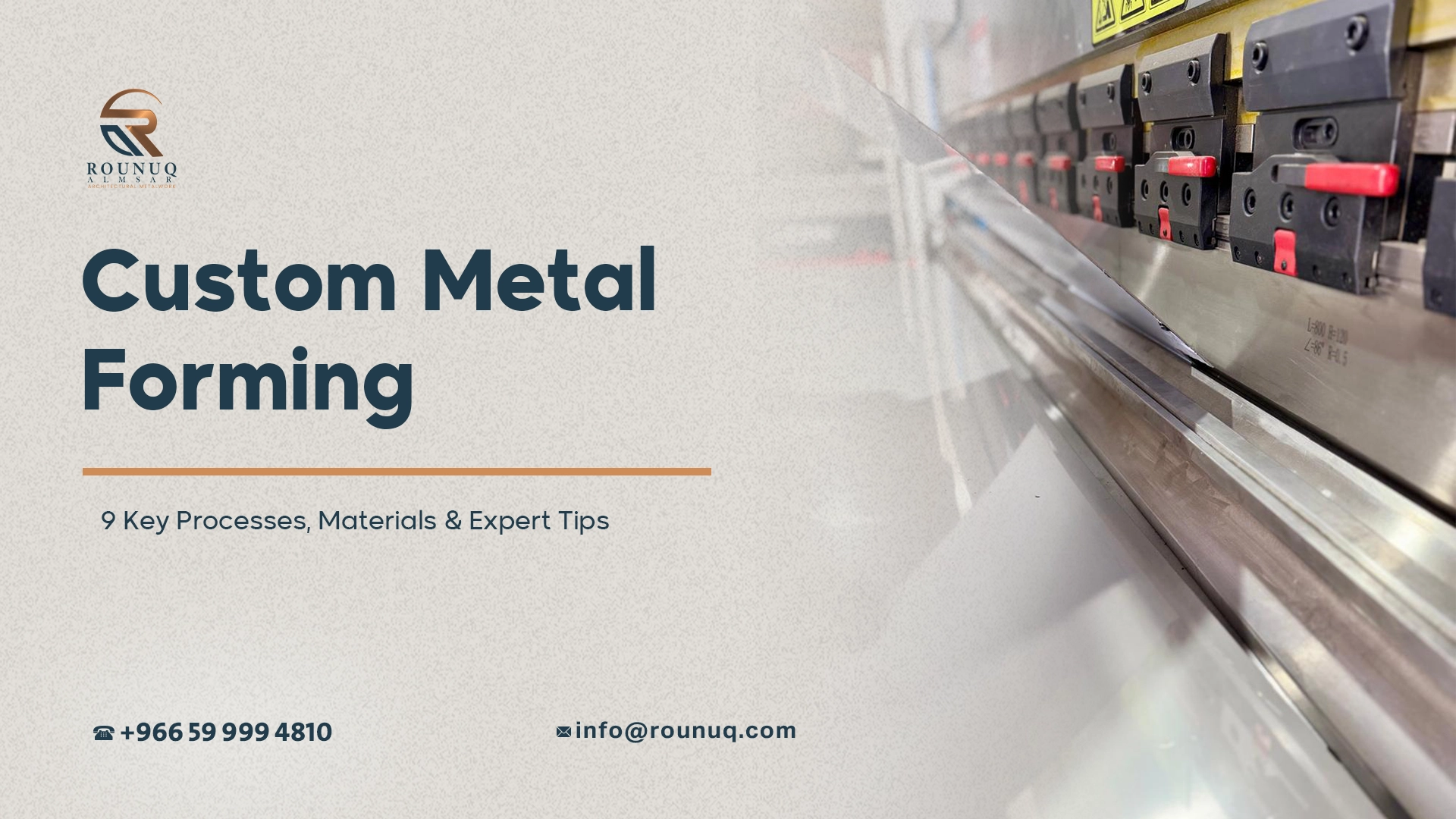
Custom Metal Forming in Saudi Arabia: 4 Essential Processes
Custom metal forming in Saudi Arabia comes down to four processes: CNC press-brake bending for straight folds, plate and roll forming for curves, V-grooving for sharp visible corners, and tube and profile bending for rails and frames. The geometry of the part picks the process, and the material, thickness, finish and site conditions decide whether that process delivers a clean result. Custom metal forming changes the shape of metal with controlled force instead of cutting material away. It is how a flat stainless sheet becomes an escalator cladding panel, how aluminum strip becomes a curved ceiling, and how a steel tube follows a spiral stair.
In Saudi projects the stakes are a little higher than the drawings suggest. Formed parts on a Riyadh façade sit in summer heat that can pass 45 °C, parts in Jeddah or Dammam face humid, salty air, and interior work in malls, hotels and offices is judged under bright lighting from a metre away. A bend that is two degrees off, or a finish scratched by tooling, shows.
This guide explains how custom metal forming works, which process suits which shape, how sheet metal bending, plate rolling, tube bending and pipe bending behave in stainless steel, aluminum and mild steel, how to calculate a flat pattern with bend allowance and K-factor, and what Saudi buyers should specify before asking a metal workshop for a quotation. It is written from our side of the press brake at Rounuq Almsar, where we have been forming and installing architectural metalwork in Riyadh since 2015.
What Is Custom Metal Forming?
Custom metal forming is the controlled plastic deformation of metal into a shape designed for one specific project. Nothing is cut away. The sheet, plate, tube or profile is bent, rolled or folded until it holds the new geometry. Buyers also search for it as metal bending (ثني المعادن), metal bending services, sheet metal forming or metal shaping, and in Arabic as تشكيل المعادن. These names describe the same family of work.
ASM International, the materials engineering society, describes sheet forming as shaping a blank through tools or dies, with the process chosen according to the features the finished part needs. That is the practical point: the geometry decides the process, and the process decides the tooling.
On architectural metalwork and fit-out jobs, custom metal forming typically produces the parts below.
| Formed part | Usual forming process | Typical material |
|---|---|---|
| Folded trims, edges and skirting | CNC press-brake bending | Stainless steel, aluminum, mild steel |
| Column covers and counter fronts | Press-brake bending with V-grooving | Stainless steel, aluminum |
| Curved metal panels for ceilings and façades | Plate and roll forming | Aluminum, stainless steel |
| Elevator and escalator cladding | V-grooving and press-brake bending | Stainless steel |
| Bent brackets and concealed supports | Press-brake bending | Mild steel, stainless steel |
| Curved handrail and canopy members | Tube bending and profile bending | Stainless steel, mild steel |
The word “custom” matters. A standard angle or channel is also formed metal, but it is made to a catalogue size. Custom metal fabrication starts from the project’s dimensions and works backwards to the tooling, material and sequence that can reproduce them.
Custom Metal Forming Services: The Terms Buyers Use
Suppliers, consultants and contractors use different words for the same work, and a request is easier to price when everyone shares the vocabulary. The table lists the terms we see most often in Saudi tenders and enquiries.
| English term | Arabic term | What it means on a project |
|---|---|---|
| Sheet metal bending | ثني الصاج | Folding flat sheet along straight lines, usually on a CNC press brake |
| Metal bending | ثني المعادن | The general term for bending sheet, plate, tube or profile |
| Metal rolling, plate rolling | درفلة المعادن | Passing sheet or plate through rollers to make cylinders and arcs |
| Custom metal forming | تشكيل المعادن | Shaping metal to project-specific geometry without removing material |
| Sheet metal fabrication | تصنيع الصاج | Forming plus cutting, welding, assembly and finishing of sheet parts |
| Tube bending, pipe bending | ثني المواسير | Bending round, square or rectangular sections to a set radius |
| V-grooving | تخريم V أو حز V | Cutting a V channel on the back of a sheet so it folds to a sharp edge |
| Custom metal fabrication | تصنيع المعادن حسب الطلب | Whole-part production from drawings, including forming |
When you request metal bending services in Riyadh or any other Saudi city, name the process you expect and the visible face. A supplier who reads “sheet metal bending, 3 mm 304 stainless, brushed, grain vertical” can quote in one pass. A supplier who reads “bend some steel” has to guess. Any metal workshop offering metal bending services should also be able to name the press brake, the rolling capacity and the grain direction it will use on a visible face.
How Custom Metal Forming Fits With Laser Cutting, Welding and Finishing
Very few architectural parts are formed and nothing else. A decorative wall panel usually starts on the laser cutting bed, gets its returns bent on the press brake, has a stiffener welded behind it, then goes to finishing and inspection before it is packed for site.
| Process | What it does to the metal | Typical result | Choose it when |
|---|---|---|---|
| Custom metal forming | Changes the shape, keeps the material | Bends, folds, curves, profiles | The shape itself is the requirement |
| Laser cutting | Removes material along a path | Outlines, openings, perforation | You need precise profiles or patterns |
| Welding | Joins separate parts | Frames, boxes, assemblies | One sheet cannot produce the whole part |
| Machining | Removes material to tight tolerance | Holes, slots, faces | Fits need to be very accurate |
| Finishing | Treats the visible surface | Brushed, mirror, PVD, powder coat | Appearance or protection matters |
The order matters as much as the processes. Cut before forming and holes near a bend line can distort. Finish before forming and the tooling may mark the face. Sheet metal fabrication as a whole chains cutting, forming, welding and finishing, and the forming stage sets how well the later stages fit. Planning the sequence is part of the forming job, and it is covered in more depth in our overview of metal manufacturing processes.
The 4 Essential Custom Metal Forming Processes
Four processes cover almost all the architectural custom metal forming we see in the Saudi market. The right one depends on whether the part needs a sharp fold or a smooth curve, and whether it starts as sheet or as a tube or profile.
| Shape you need | Process to ask for | Main limit |
|---|---|---|
| Straight fold, return or box | CNC press-brake bending | Straight lines only, length set by the machine bed |
| Smooth arc, cylinder or large curve | Plate rolling and roll forming | Flat ends at the start and finish of a roll, unless pre-bent |
| Sharp, crisp visible corner | V-grooving and folding | Weaker corner, so it needs backing |
| Curved rail, rib or frame | Tube bending and profile bending | Minimum radius set by wall thickness and diameter |
CNC Press-Brake Bending (Sheet Metal Bending)
Sheet metal bending (ثني الصاج) on a CNC press brake is the workhorse of custom metal forming. The sheet sits on a lower die, a punch presses it along a straight line, and the CNC control repeats the programmed angle and back-gauge position bend after bend.
Press brake bending is the most common route in custom metal forming for panels, returns, covers, trims, brackets and enclosures. The advantage on architectural work is repeatability. When forty column covers have to look identical, programmed bending holds each angle far more consistently than manual setting ever could. Our machines list shows the workshop equipment behind this work, and any supplier should be able to state the bed length and capacity of their press brake before you commit.
Its limits are length and shape. A press brake bends in straight lines only, and the maximum length is set by the machine bed, so very long trims may need a joint that has to be planned into the design.
Plate and Roll Forming (Metal Rolling)
When the shape is a curve instead of a fold, metal rolling (درفلة) is usually the better route. The sheet or plate passes between rollers that bend it gradually into a cylinder, an arc or a large-radius curve. Plate rolling and sheet rolling use the same principle at different thicknesses, and heavier plate for curved stair stringers or columns needs a machine with more capacity.
A smooth curved panel can technically be built from a string of small press-brake bends, known as bump bending. Up close, though, it often looks faceted. If the curve is visible, for example on a curved reception wall or the underside of a canopy, rolling gives a cleaner result. Curved metal panels for ceilings and façades are the most common rolled parts of custom metal forming in Saudi fit-out work.
V-Grooving and Metal Folding
V-grooving cuts a controlled channel into the back of the sheet along the fold line before bending. With less material at the corner, the metal folding closes to a much tighter, sharper edge than a standard bend can. Metal folding of a V-grooved sheet is done on the same press brake once the groove is cut. Our page on V-grooving shows the detail.
That crisp corner is why V-grooving shows up on premium interiors: elevator cabins, reception counters, column wraps and feature walls. Our elevator cladding guide shows how often this detail defines the final look. The trade-off is strength. A deep groove weakens the corner, so V-grooved panels usually need backing or stiffeners, and they are rarely used for structural parts.
Tube and Profile Bending (Pipe Bending)
Custom metal forming reaches beyond flat sheet. Round tubes, square hollow sections, channels and angles can all be bent to follow curves, and this is where curved handrails, canopy ribs, pergola members and curved frames come from. Tube bending on a rotary draw or roll bender, and pipe bending at larger diameters, share the same limits: the minimum centre-line radius depends on the section, and a curved handrail in stainless steel is the typical case.
Profiles are less forgiving than sheet. A round tube bent too tightly flattens or wrinkles on the inside of the curve, and a square section can bulge. Wall thickness, outside diameter and radius together decide whether a bend is achievable without distortion. For curved handrails on spiral or helical stairs, like the decorative spiral staircase we delivered at Al Nakheel Mall in Riyadh, the rail has to follow the stair’s geometry without visible kinks along its whole length. Our guide to stainless steel handrails covers what to specify for the rail itself.
Material Choice in Custom Metal Forming
Two sheets with identical dimensions can behave completely differently under the same punch, which is why material choice sits at the centre of custom metal forming. Strength, ductility, thickness and surface condition all change how a part forms and how it looks afterwards.
| Material | How it forms | Springback | Common Saudi applications | Main watch-out |
|---|---|---|---|---|
| Stainless steel (304/316) | Strong, work-hardens | Higher | Cladding, column covers, handrails, elevators | Finish damage, grain direction |
| Aluminum | Light, forms easily | Moderate, varies by alloy | Ceilings, screens, façade panels | Cracking on tight radii in harder tempers |
| Mild / carbon steel | Predictable | Lower | Frames, brackets, stairs, gates, canopies | Coating after forming, corrosion |
| Copper and brass | Soft, ductile | Low | Feature panels, decorative trims | Surface marking, patina |
Stainless Steel Bending
Stainless steel bending is the most common job in Saudi architectural fit-out, and the most demanding one in custom metal forming. Stainless is stronger than mild steel, it springs back more, and its brushed, hairline or mirror finish shows every tooling mark. Stainless steel bending also work-hardens the metal at the fold, so correcting an angle by re-bending risks cracking and should be avoided.
Grade matters too. Grade 304 is standard for interiors. Grade 316 stainless steel, with added molybdenum, is the usual choice for exposed work near the coast in Jeddah, Jubail or Dammam, where salt air attacks lower grades. Our guide to stainless steel cladding covers grade and finish selection in more detail, and the stainless steel finishes guide compares the surface options.
At King Abdullah Financial District (KAFD), our scope included stainless steel cladding for columns, escalators and elevators. On vertical transport, formed panels have to fit around moving equipment and service access while keeping one continuous finish line, which leaves very little room for springback error.
Aluminum Bending and Forming
Aluminum bending is the right call where weight matters: large ceilings, façade panels and screens that have to be lifted and fixed overhead. Aluminum forms easily, but alloys and tempers behave very differently. A radius that bends cleanly in a softer alloy can crack a harder one, so the alloy and temper should be fixed before the bend radius is.
In Saudi heat, aluminum’s thermal expansion is roughly twice that of carbon steel. Long formed aluminum panels outdoors need joints and fixings that let them move. Aluminum bending in harder tempers is also sensitive to grain direction, so bend lines are best oriented across the rolling direction where the drawing allows. Rolled aluminum gives light curved metal panels for an overhead metal ceiling, which keeps fixing loads down.
Mild and Carbon Steel
Mild steel is predictable to form and strong, which makes it the default in architectural metalwork for brackets, frames, stair stringers, gates and canopy structures. Its weakness is corrosion. Bent edges and inside corners are where paint and powder coat thin out and fail first, so the coating system should be chosen with the forming in mind, after the forming sequence is known and before the first part is bent.
For walkways, stair treads and platforms, formed chequered plate is a common mild steel application in Saudi industrial and commercial buildings.
Copper and Brass
Copper and brass are chosen for character in hotel lobbies, restaurants and villas. They form readily, but the soft surface marks easily, and the material will patinate over time. Agree how the finish should age before fabrication, and check compatibility with neighbouring metals and fixings. Our brass cladding guide goes further on alloys and finishes.
Springback in Custom Metal Forming: Why the Angle Moves
Springback is the metal’s tendency to relax partway back toward its original shape once the forming force is released. Bend a sheet to 90° under the punch and it may settle a few degrees open.
How much depends on the material’s strength, thickness, bend radius, tooling and method. Stainless steel springs back noticeably more than mild steel, and harder aluminum alloys more than softer ones. A larger inside radius also springs back more than a tight one.
On a hidden bracket, a degree or two rarely matters. On a feature wall made of ten formed panels that have to read as one continuous line, a small difference on each panel adds up to a visible wave. That is why on visible custom metal forming we test-bend offcuts from the same material batch, adjust the programme to over-bend slightly, and only then run production.
Bend Radius, Bend Allowance and K-Factor in Sheet Metal Bending
The inside bend radius is more than a design preference. Every material and thickness has a minimum bend radius it can take without cracking, orange-peel texture or surface damage on the outside of the bend. As a working rule, harder and thicker material needs a larger radius, and many fabricators start from an inside radius close to the sheet thickness for annealed stainless and confirm it with a test bend.
The radius also decides how long the flat blank has to be. When metal bends, the outer surface stretches and the inner surface compresses, and a neutral axis in between keeps its length. The K-factor describes where that axis sits as a fraction of the thickness, and it usually falls between about 0.3 and 0.5 depending on material, radius, tooling and method. The bend allowance is the length of the neutral axis through the bend:
Bend allowance = bend angle in radians × (inside radius + K-factor × thickness)
The worked example below is illustrative. It uses 2 mm sheet, a 2 mm inside radius, a 90° bend and outside legs of 50 mm and 30 mm.
| K-factor used | Bend allowance | Flat blank length |
|---|---|---|
| 0.33 | 4.18 mm | 76.18 mm |
| 0.40 | 4.40 mm | 76.40 mm |
| 0.50 | 4.71 mm | 76.71 mm |
The flat pattern that feeds the CNC programme comes from these values, so a flat pattern generated by CAD software should be checked against a physical test bend. A change of 0.17 in K-factor moves the blank by about half a millimetre on a single bend. On a part with eight bends, or a run of panels that must align, that error accumulates. This is why a reliable sheet metal fabrication shop calibrates its K-factor from test bends on the actual material and tooling instead of using a textbook value, and why the same drawing can produce different blank sizes at different workshops.
Before any custom metal forming starts, the drawings should state the items below.
| Item | Why it matters |
|---|---|
| Material type, grade and thickness | Sets the minimum radius, springback and finish behaviour |
| Bend angles and inside radii | Sets the tooling and the flat pattern |
| Number of bends and their order | Avoids collisions between the part and the machine |
| Visible face and finish | Decides protection, grain direction and sequence |
| Connection to adjacent parts | Fixes tolerances where parts meet |
| Allowable tolerances, workshop and site | Keeps cost tied to what the part needs |
Bending Tolerances in Custom Metal Forming and Fabrication
Tolerance should match the part’s job. A concealed bracket can accept a looser tolerance than a visible panel that sits in a row of identical panels. Over-specifying tight tolerances on hidden parts adds cost without adding value, and custom metal forming hits its tolerances more reliably when they are stated per feature. State the tolerance for bend angle, for overall dimensions and for position of holes and openings separately, and say whether it applies in the workshop or after installation on site.
Protecting the Finish During Custom Metal Forming
This is the most overlooked part of architectural custom metal forming. A part can be formed to the correct angle and still be rejected because the visible face is scratched, dented or the grain has turned.
Brushed, hairline, mirror, vibration and PVD stainless steel finishes all show tooling marks clearly. Our guide to vibration finish on stainless steel explains why surface preparation matters so much on premium work, and our PVD finish page covers coloured coatings.
For visible custom metal forming, forming and finishing are planned together:
| Control | What it does |
|---|---|
| Protective film on the visible face | Stays on through cutting and bending to prevent scratches |
| Clean, polished tooling or urethane die inserts | Reduces marking on premium finishes |
| Consistent grain direction | Keeps brushed lines aligned across every panel in a run |
| Form-then-finish or finish-then-form, decided per part | PVD is usually applied after forming, because the coating can crack or mark if the sheet is bent afterwards |
| Protected packing and site handling | Guards edges and faces until installation |
Common Custom Metal Forming Defects and How to Prevent Them
Most rejected metal bending jobs in custom metal forming fail for one of a handful of reasons. Knowing them helps both the buyer who writes the specification and the engineer who reviews the first article.
| Defect | Typical cause | Prevention |
|---|---|---|
| Angle open or closed after bending | Springback or wrong K-factor | Test-bend offcuts, over-bend, calibrate the programme |
| Cracks on the outside of the bend | Radius too tight, hard temper, bend line parallel to the rolling direction | Larger radius, softer temper, bend across the rolling direction where possible |
| Orange-peel texture on the bend | Coarse-grained material stretched on a tight radius | Larger radius, finer-grained sheet |
| Scratches and die marks | Dirty tooling, no film | Protective film, clean or urethane tooling |
| Faceted curve | A curve built from bump bending | Roll the part instead, or use finer bump steps and polish the facets |
| Wavy long panel | Accumulated angle error across many bends | Fewer bends per panel, tighter angle control, stiffeners |
| Flattened or wrinkled tube | Radius too tight for wall and diameter | Larger radius, thicker wall or mandrel support |
| Hole distortion near a bend | Holes cut too close to the bend line | Keep holes clear of the bend or cut them after forming |
| Visible weld or seam after bending | Joint in the wrong place | Plan joints into the design, grind and finish consistently |
Custom Metal Forming for Saudi Climate and Site Conditions
Saudi conditions change what custom metal forming has to deliver once a part leaves the workshop.
| Condition | What happens | What to specify |
|---|---|---|
| Heat and UV | Exterior metal in Riyadh can run far hotter than the air in direct sun, and long panels expand and contract daily | Expansion joints and slotted fixings |
| Coastal corrosion | In Jeddah, Yanbu, Jubail and Dammam, humid and salty air speeds up corrosion | 316 stainless, heavier coatings or aluminum, guided by ISO 12944-2, which classifies how corrosive an environment is |
| Dust and sand | Formed ledges and deep returns collect dust | Sloped tops and open profiles that are easier to keep clean |
| Wind loads | Formed façade panels, canopies and screens resist wind pressure | Structural check by the project engineer against the Saudi Building Code SBC 301, which covers design loads |
Structural formed parts should be checked by the project engineer. Shaping a canopy rib so that it looks right does not prove it can carry wind load.
Buying Custom Metal Forming in Riyadh and Across Saudi Arabia
For a Saudi contractor, consultant or developer, a few local points affect both the quality and the cost of custom metal forming.
Material compliance. Building metals in Saudi Arabia fall under SASO’s technical regulation for metals and alloys in buildings, which sets requirements for metals designed for construction work and the conformity procedures suppliers follow. Ask whether the sheet or tube being formed comes with a mill certificate and conformity documents, and keep the mill certificate of the sheet lot used for visible parts so a replacement panel can be matched later, especially on government and large commercial projects, and confirm which certificate applies to your specific product.
What drives the price in SAR. There is no fixed rate per bend in custom metal forming. Cost depends on the factors below.
| Cost driver | Effect on the quotation |
|---|---|
| Material grade and thickness | Sets material cost and machine tonnage |
| Number and complexity of bends | Adds setup and handling time |
| Quantity | Setup is shared across the run, so unit cost drops |
| Finish, especially PVD or mirror | Adds protection, handling and finishing steps |
| Tooling | Special dies add cost on non-standard profiles |
| Welding and assembly after forming | Adds labour and finishing |
| Delivery city and installation scope | Adds transport, site work and access costs |
Quotations in Saudi Arabia are normally issued in SAR, and 15% VAT applies on top. When comparing offers, check that the scope is identical and that VAT is shown the same way on each.
Local fabrication vs. imported parts. Local custom metal forming makes site measurement, mock-ups and late adjustments far easier than importing finished parts. It matters most on fit-out work, where site dimensions rarely match drawings exactly. Custom metal fabrication in Riyadh with a metal workshop that forms, finishes and installs under one roof also removes the hand-offs where quality is usually lost.
If you are still comparing suppliers, our guide to choosing a custom metal workshop in Saudi Arabia sets out the questions worth asking.
Where Formed Metal Is Used in Saudi Projects
Custom metal forming reaches most trades on a Saudi building site, from cladding to ceilings to stairs.
| Application | What is formed | Related page |
|---|---|---|
| Cladding and column covers | Stainless or aluminum wrapping columns, counters, escalators and elevators | Stainless steel cladding |
| Metal ceilings | Linear, curved and folded panels coordinated with lighting and HVAC | Metal ceiling systems |
| Feature walls and decorative panels | Folded and dimensional surfaces, often combined with laser-cut patterns | Decorative metal works |
| Handrails and balustrades | Bent tubes and profiles following stairs, ramps and balconies | Handrail solutions |
| Perforated screens | Folded frames and flat sheets with patterned openings | Perforated metal screens |
| Canopies and pergolas | Rolled ribs and folded fascias exposed to sun, wind and dust | Custom metal projects |
| Industrial floors and stairs | Formed chequered plate treads and platforms | Chequered plate guide |
You can see how these come together on real sites in our custom metal projects across Riyadh and beyond.
Quality Checks for Custom Metal Forming Before Delivery
Parts produced by custom metal forming should be checked against approved drawings before they leave the workshop: overall dimensions, bend angles and radii, flatness, hole and opening positions, weld quality where there is welding, and the condition of the finish.
On architectural metalwork, visual inspection deserves as much attention as dimensional checks. A panel that measures correctly can still look wrong beside its neighbour if the grain runs the other way or a return is slightly out. Standards such as ISO 9001 exist to keep processes consistent, and consistency is what makes the fortieth panel match the first. In custom metal forming, a first-article approval, where the client signs off one finished sample before production, is the simplest way to lock in the standard.
What to Send for a Custom Metal Forming Quote
A useful custom metal forming request lets the supplier price and plan in one pass.
| Include | Example |
|---|---|
| Drawings or sketches | DWG, PDF or a dimensioned sketch |
| Material and grade | 304 or 316 stainless steel, 5052 aluminum |
| Thickness | 2 mm, 3 mm |
| Finish and visible face | Brushed, grain vertical, PVD bronze |
| Quantity | 40 identical column covers |
| Laser cutting or perforation | Pattern file, and whether holes are cut before or after forming |
| Certificates | Mill certificate and conformity documents required |
| Bend angles and radii | 90°, inside radius 2 mm |
| Location | Indoor, outdoor, coastal |
| Delivery city and installation | Riyadh, supply and install |
Send the same package to every metal workshop on the shortlist so the quotations can be compared line by line. If the design is still developing, say what is fixed and what is open. That lets the fabricator flag custom metal forming problems, such as a radius that is too tight for the chosen material, before any metal is cut. Custom metal forming also goes faster when the file already names the process. When you are ready, contact Rounuq Almsar with the details above.
Frequently Asked Questions About Custom Metal Forming
What is custom metal forming?
Custom metal forming is the controlled deformation of sheet, plate, tube or profile into a project-specific shape by bending, rolling or folding, without removing material.
What is the difference between metal forming and metal fabrication?
Forming (تشكيل المعادن) changes the shape of the metal. Fabrication (تصنيع المعادن) is the wider process that also includes cutting, welding, machining, assembly and finishing.
What is sheet metal bending, and which machine does it?
Sheet metal bending (ثني الصاج) folds flat sheet along straight lines, and a CNC press brake does most of it. The sheet sits on a lower die and a punch presses it to the programmed angle.
When should I choose metal rolling instead of press-brake bending?
Choose metal rolling (درفلة المعادن) for smooth arcs, cylinders and large-radius curves, including curved metal panels. Press-brake bending suits straight folds, and a curve built from many small bends often looks faceted up close.
Can stainless steel be custom formed without damaging the finish?
Yes. Stainless steel bending is safe for the finish with protective film, clean tooling and the right sequence. PVD-coated stainless is usually formed before coating, because bending after coating can mark or crack the surface.
What causes springback, and how is it controlled?
Springback is the metal’s elastic recovery after the force is released. It is controlled by over-bending slightly, test-bending samples from the same batch, and adjusting the CNC programme before production.
What are bend allowance and K-factor?
Bend allowance is the length of the neutral axis through a bend, and the K-factor locates that axis as a fraction of the sheet thickness. Together they give the flat blank length and the flat pattern, and they should be calibrated from test bends on the real material.
Which materials can be used for custom metal forming?
Stainless steel, aluminum, mild and carbon steel, copper and brass can all be formed. Aluminum bending and stainless steel bending call for different tooling and radii. The choice depends on strength, finish, weight, corrosion exposure and budget, and the alloy and temper should be fixed before the bend radius.
Is V-grooving better than standard bending?
For sharp, premium-looking corners on visible panels, usually yes. For structural or hidden parts, standard press-brake bending is simpler and stronger.
Which stainless steel grade is better for coastal Saudi cities?
Grade 316 is generally preferred for exposed custom metal forming work in coastal cities such as Jeddah, Jubail and Dammam, because its molybdenum content improves resistance to salt-air corrosion. Grade 304 is usually enough for interiors.
How much does custom metal forming cost in Saudi Arabia?
There is no fixed price. Cost depends on material, thickness, number of bends, quantity, finish, tooling, assembly and delivery city, and quotations are normally in SAR plus 15% VAT.
Do formed parts need SASO certificates?
Building metals fall under SASO’s technical regulation for metals and alloys, so buyers should ask for conformity documents and mill certificates for the sheet or tube being formed, and confirm which certificate applies to the product.
Start Your Custom Metal Forming Project
If you have drawings or a sketch, send us the material, thickness, finish, quantity and site location, and we will price our metal bending services and review the right forming approach with you before anything is cut. Contact the Rounuq Almsar team to get started.
5 Comments
Chequered Plate: 7 Essential Facts for a Smart Selection
September 9, 2026
[…] finishing and installation across stainless steel, aluminium and steel applications. Its custom metal forming guide also emphasizes that material, thickness, geometry, tolerances, finish and installation conditions […]
Metal Manufacturing: 7 Expert Tips for Choosing Materials
September 13, 2026
[…] existing guide to custom metal forming explains how material, thickness, geometry, tooling, tolerances, and finishing need to be […]
Stainless Steel Finishes in Saudi Arabia: Best Choices
September 27, 2026
[…] can scuff or crack the visible face if tooling isn’t protected. Our guide to custom metal forming explains how protective film and tooling choice prevent […]
What Are Bespoke Structures? A Guide for Saudi Projects
November 16, 2026
[…] See custom metal forming […]
Best Metal Column Cladding in KSA: 8 Essential Steps
November 24, 2026
[…] Curved column cladding is the shape that most often separates a fabricator who rolls plate in house from one who buys sheet and folds it. Large-radius curves need controlled plate and roll forming, and the finish must run continuously around the curve without a visible change in grain. Our custom metal forming guide explains the plate and roll forming behind curved column cladding. […]